Unique 4-step Framework to define your company’s Purpose
Plenty has been written – including by myself - about what a purpose is, why it’s important, its foundations, and its benefits. However, there’s almost no guidance on how to actually define it, which factors to consider, which steps to take and in which sequence.
This article introduces a comprehensive framework and a step-by-step process to help executives and entrepreneurs define, adjust, or deepen their company's purpose. It aligns with its business model, core competencies, identity and stakeholder expectations, aiming for both profitability and a genuine impact on the world rather than having to choose between the two, as is often the case.
In addition, it provides 7 industry-overarching strategies that help mitigate potential purpose-profit trade-offs when integrating and bringing that purpose to life.
Finding your specific Purpose is not straightforward
I’ve seen that a lot of companies – often also medium-sized or smaller family- or founder-owned – struggle to find a purpose that really fits them. They might have one, but it’s not really an expression of the company’s DNA or the ideas the owner has about it.
In my experience though, many entrepreneurs or CEOs have a genuine desire to express their values and contribute to the world, not just by providing employment, but by offering something more - something that goes beyond merely creating jobs and paying salaries.
The reason for this is quite clear:
When you have a clear life purpose, or at least a strong desire to contribute to the world, the company you lead or own provides tremendous leverage to achieve that.
Yet even the first step, just identifying an attractive purpose that encapsulates this additional contribution, seems to be not so easy.
This difficulty in defining the right purpose despite desiring one aligns with recent McKinsey research, which suggests that many leaders aspire to have a greater social impact and more purpose but often don't know where to start. In fact, a full 39% of the company leaders surveyed expressed a desire to change the purpose of their company (Interview of 855 people, at a range of US-based companies and across a range of tenures and roles in October 2019).
Again, a purpose statement might be in place, but somehow it’s not really reflecting what the company wants to or could stand for or it’s not triggering the full potential of its desired contribution.
Or the purpose from the beginning might be clashing with another principle every company has, unless it’s an NGO: Financial sustainability, or in other words, the necessity to make a profit.
Interplay of Purpose vs. Mission vs. Vision
To clarify the meaning of 'purpose', its role in strategic management, and how it differs from and complements other guiding principles, let’s briefly revisit the definitions of 'purpose,' 'mission,' and 'vision,' how they are interconnected, and how together they serve as strategic tools to guide the company.
1. Mission: (“What Business are we in?")
The mission describes the rough business model and the benefits for the customers (and not just specific products or technology). A good example illustrating that concept is Mattel:
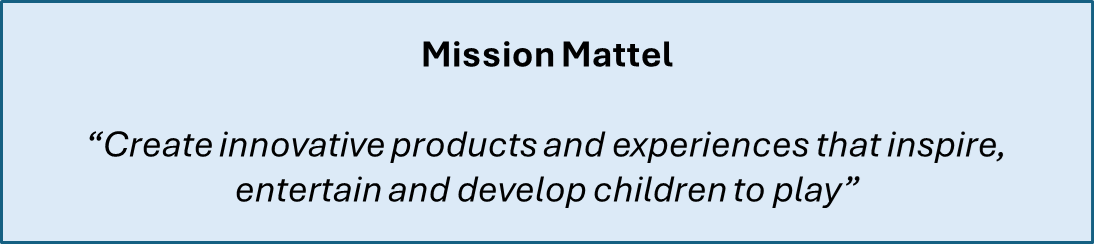
It is what the company at its core is already doing in the present and it’s of ongoing nature, unless its entire business model becomes disrupted by industry forces or will be exited by strategic choice.
The mission explicitly states how the company serves its clients and therefore implicitly how it strives to make a profit with it (“Business model”).
Therefore, the stakeholders the mission addresses are the customers, the shareholders (paying dividends from the profit), and its employees (paying salaries from the profit).
2. Purpose (“Why are we here?”)
Like the mission, the purpose is also what the company is already doing in the present and it’s of ongoing nature. Unlike the mission, though, it describes its contribution beyond itself and its profit ambition and therefore the organization‘s deeper meaning for existence (raison d’être).
Here are some illustrating examples:
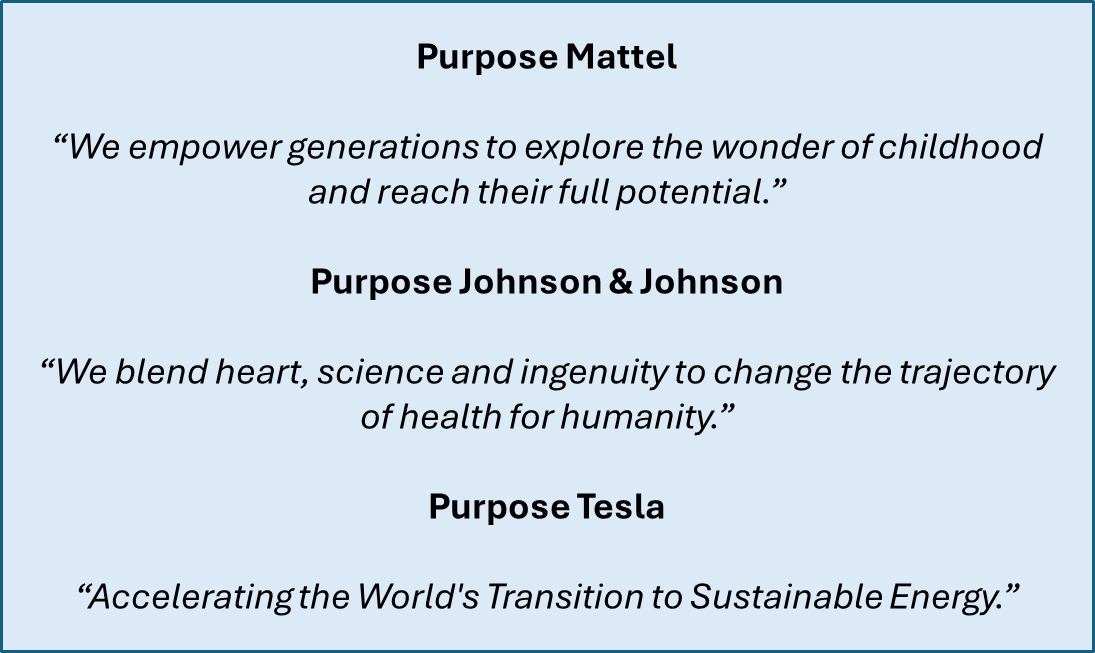
All companies clearly state the general contribution they aim to make to society or humanity in general, beyond just making a profit.
The stakeholders the purpose addresses are outside of the company, like the society, communities or the environment.
3. Vision "Where are we going?"
The vision articulates a clear, desired and inspiring end state that doesn’t yet exist and is not easy to attain. Tesla is a perfect example of a well-articulated vision.
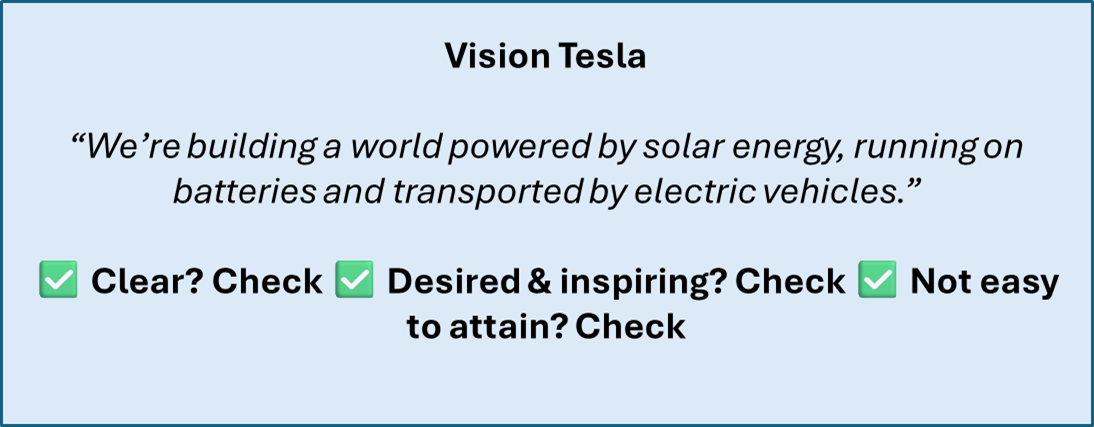
Unlike the mission and purpose, the vision clearly refers to the future. It is not ongoing, rather it projects a concrete goal that ceases once it is fulfilled.
The vision, therefore, ideally projects both the company’s mission AND purpose into the future as concrete aspired achievements and the corresponding vision statement should cover both aspects (as e.g. ingeniously done by Tesla).
As a metaphor, we can imagine the vision as an “inspiration engine” or ”huge magnet” that pulls forward both the company’s purpose (societal contribution) and the mission (profit-making operations) to a higher level.
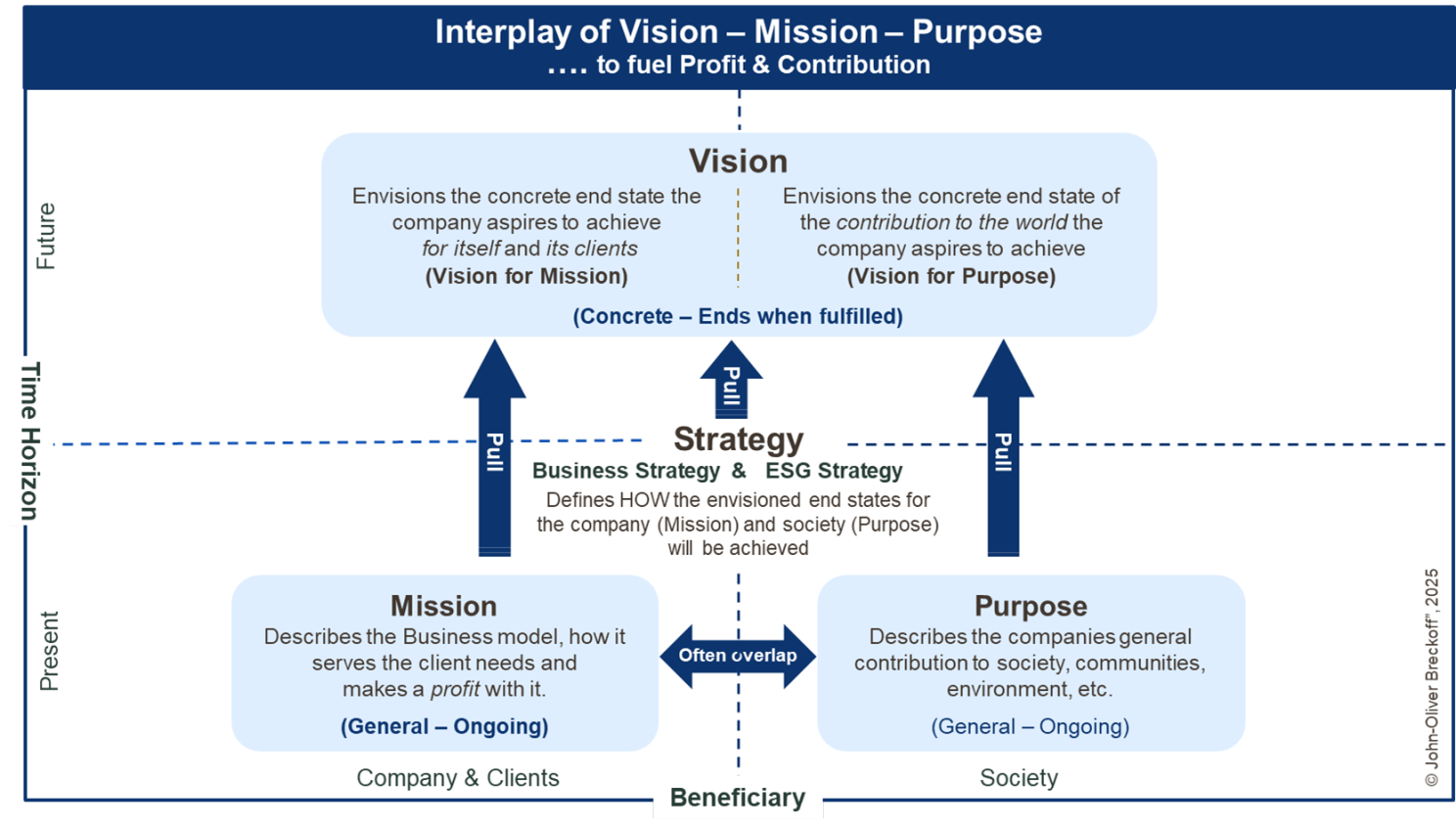
In practice, not all companies have thoroughly considered the differences in meaning, advantages, and application of these principles. As a result, they often do not differentiate their mission, vision, and purpose statements in a way that would fully leverage their benefits.
Ideally though, mission, purpose and vision are formulated to work together, reflecting and balancing both present and future as well as the obligations a company has towards all its internal and external stakeholders. And with this, they ensure its long-term social AND financial sustainability.
Beyond profit, therefore, doesn’t mean to formulate and pursue a purpose that contributes at the cost of profit but on top of a profit.
A well-chosen purpose can even accelerate the company’s profits by creating synergy between their business operations and societal contributions (see below “Purpose AND Profit”).
4-step Framework to find your Purpose
The subsequent framework has been designed to foster and structure a discussion within the team that reviews or develops options for a purpose that ideally strikes the sweet spot mentioned above.
Its overall goal is therefore twofold:
- To define a purpose that makes a real and positive impact on society and the environment beyond just serving their customers and
- Ensure that this purpose fits seamlessly with the company’s profitability imperative
General Framework Mechanics
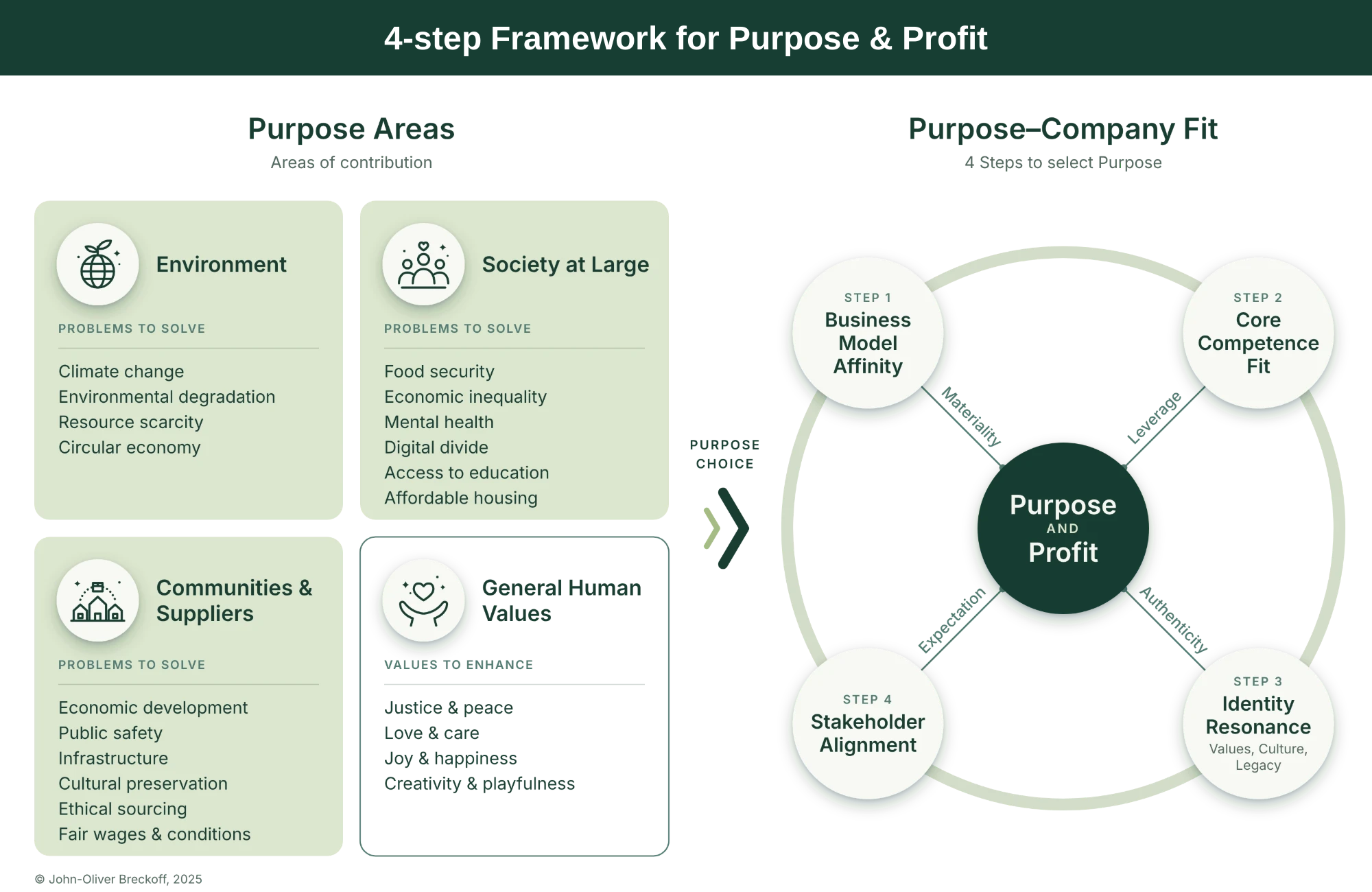
The framework distinguishes between potential “Purpose areas” (left side) and the “Purpose-Company Fit”, focusing on the 4 selection steps it should apply to define a desired purpose that aligns with profitability (right side).
Start by identifying a contribution area and a specific problem (left side), that your company feels attracted to and is able to solve, guided by these 4 steps and selection criteria (right side).
This is an iterative process, switching back and forth between these two perspectives to “try on” different contribution areas and problems by running it through the steps until a purpose is found or refined that ideally matches the 4 criteria and therefore ensures both a real contribution to the world while maintaining profitability.
The step sequence is also deliberately chosen and will be discussed after the 4 steps have been introduced (see below “Company-Purpose-Fit: 4 selection criteria/steps”).
4 Purpose Areas
There are many other frameworks, such as the United Nations 17 Sustainable Development Goals (SDGs) or the ISO 26000 - Guidance on Social Responsibility, that describe areas for societal contribution apt to find a purpose. For the sake of simplicity and clarity, however, I’ve clustered them into the following 4 buckets with the corresponding problems (or values).
1. Environment
2. Society at large
3. Communities and suppliers
4. General human values
The first three areas break down the most pressing concrete problems humanity faces, and a company's purpose can aim at to help solve these problems.
To be very clear, while sharing a certain overlap, a purpose-driven organization is not the same as complying with the reporting-oriented ESG-standards (see my article "7 Reasons Why Purpose ≠ ESG – Learn How to Align Them to Boost your ESG Strategy!").
Although bearing some resemblance to ESG, the first 3 purpose areas listed above just serve as search fields to identify a potential theme to build your purpose on while making sure to not fall into the common trap of defining a pseudo purpose that then serves as mere decor.
Addressing real Problems to avoid Pseudo Purpose
Addressing concrete problems is an important point since most companies are contributing to society already just by performing their normal business activities, but they aren’t necessarily addressing current societal problems.
For example, by producing food, a food company with operations in Europe does contribute to society, since it helps prevent people from starving. However, in Europe starvation is not remotely a problem society faces. On the contrary, the situation is characterized by drastic food overproduction in many categories.
Declaring “We are here to feed society” cannot really serve as a purpose, since it’s not addressing any societal problem within their scope of geographical operations. It’s a pseudo purpose.
Unfortunately, there are plenty of companies that limit their endeavors to define their purpose to just describing their business model, meaning in reality they are just (re-) stating their “mission” (and not a “purpose”).
Declaring one’s mission clearly has benefits, as pinpointing and clarifying exactly where a company's contribution fits within the ecosystems leads to transparency and serves as a strategic guide for decision-making.
However, it neither complies with the expected societal contribution nor does it harness the power of a real purpose, as a strategic tool with proven positive effects on talent attraction, employee engagement, brand reputation, and stakeholder alignment (see my article "The Rise of Purpose in Corporations").
In the example provided, the issue may stem though from the quality of the food, which could lead to health problems, or from harmful production processes that cause environmental damage. These are areas where a credible and effective purpose can be identified and articulated, as demonstrated by Danone's purpose "To bring health through food to as many people as possible".
Eliminating Problems vs. promoting Values
In my personal understanding though, the world today is not only challenged by the material and tangible repercussions created by our societal, political, and economic systems, which then condense into specific problems clustered under areas 1-3.
It also fundamentally lacks human values in general.
While it may be difficult to establish a direct link between the lack of specific values and particular problems, it is evident that forgetting, neglecting, or compromising human values significantly contributes to the issues we face.
Even if the impact of these values on the material world cannot be “proven”, they undeniably influence our emotional well-being. Justice & peace, love & care, joy & happiness, creativity & playfulness are the foundation of a flourishing society.
I also believe that energetically, it is different to engage in "stimulating the good" than only in "fighting the bad." That’s why contribution area 4 is about promoting and enhancing general human values.
These are the 4 purpose areas and the primary problems they display:
1. Environment
The "Environment" area addresses the sustainability and health of our planet, which is fundamental for the survival and well-being of all living organisms, with climate change being the most important and pressing issue humanity faces.
The primary problems to solve in this area include:
- Climate change
- Environmental degradation
- Resource scarcity
- Promoting a circular economy
These issues encompass the need to reduce greenhouse gas emissions, restore damaged ecosystems, manage natural resources efficiently, and transition from a linear to a circular economic model to reduce waste and reuse materials.
Addressing these problems collectively aims to preserve the environment for future generations while ensuring the planet's ecological balance.
Many known high-profile companies like Unilever, Ikea and Tesla have their purpose focused on this area but no company exemplifies it as well as Patagonia.

Patagonia is THE role model company for environmental conservation that is actually walking the talk and delivering on its purpose in manifold ways both within and outside of its core business model.
This includes e.g.:
- Sustainable product design and manufacturing (use of recycled materials)
- Exclusive use of organic cotton to avoid the harmful pesticides and synthetic fertilizers used in conventional cotton farming
- Circular economy: The “Worn wear program” (customers to buy used Patagonia gear and trade in their old items)
- Environmental philanthropy: 1% of its total sales for the planet
- Campaigns and advocacy: Campaigns to protect public lands, promote responsible farming practices, and combat climate change
- Legal actions to protect the environment (e.g. suing the Trump administration in 2017 over the reduction of Bears Ears National Monument and Grand Staircase-Escalante National Monument)
- Diverse cultural, organizational and leadership measures (see below “Patagonia’s strong culture and identity”)
2. Society at large
The "Society at Large" area focuses on broader societal well-being and equity. Addressing this area involves solving problems such as
- Food security
- Economic inequality
- Mental health
- Digital divide
- Access to education
- Affordable housing
Here are some examples of companies that choose contribution to “Society at large” as their purpose:
1. Whole Foods Market
The purpose of US retail chain “Whole Foods Market” is a good example of addressing the problem of food security:
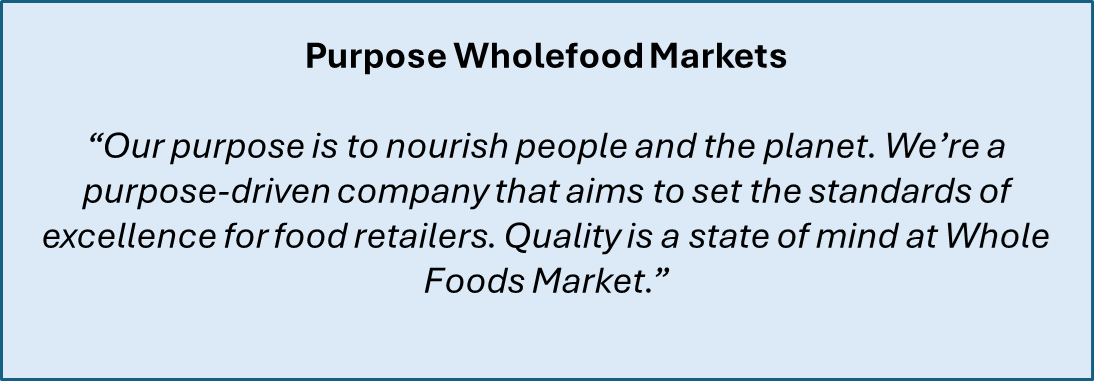
Whole Foods Market addresses food security by focusing on nutrition and health through its product offerings and its rigorous commitment to organics and strict quality standards across all categories.
2. Salesforce
Salesforce’s purpose, on the other hand, is a good example of addressing economic inequality:
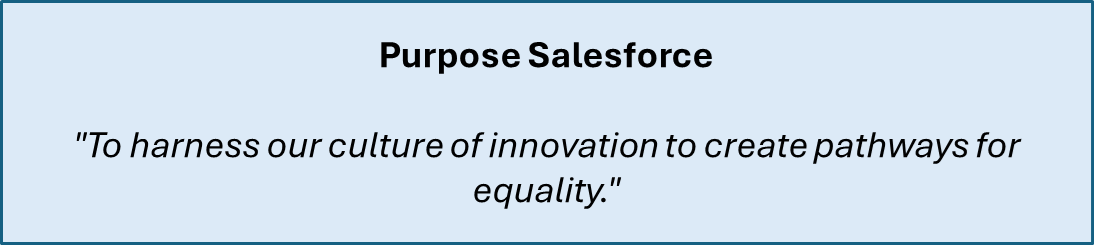
Salesforce works to bridge economic inequality by promoting equal opportunities and investing in communities through its philanthropy and workforce development programs.
3. Google Google’s purpose is another good example of addressing the digital divide:
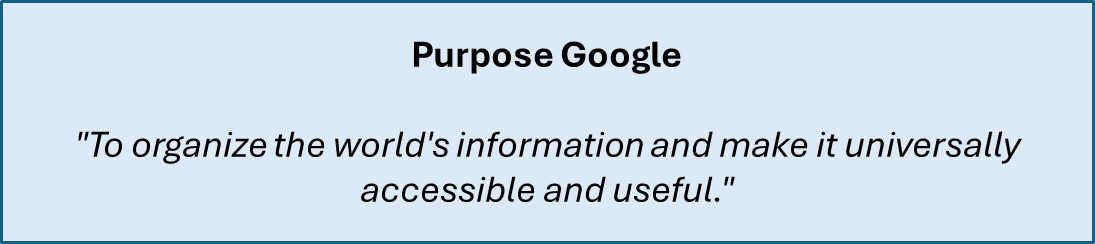
Google addresses the digital divide by providing tools and resources to increase internet accessibility and digital literacy worldwide, e.g. by offering professional certifications and providing scholarships.
3. Communities & Suppliers
The "Communities & Suppliers" area emphasizes the importance of ethical and sustainable practices within local communities and supply chains.
The main problems to solve within communities typically include:
- Economic development
- Public safety
- Infrastructure & transportation
- Cultural preservation
And within the supply chain:
- Ethical sourcing
- Fair wages and working conditions
- Market access
These challenges focus on protecting, stabilizing and developing local communities.
Here are 2 examples of companies that choose “Communities & Suppliers” as their purpose:
1. Caterpillar & Caterpillar Foundation
Caterpillar provides a good example to focus on communities.
Both the purpose of Caterpillar and the Caterpillar Foundation are good examples to support communities with infrastructure development.
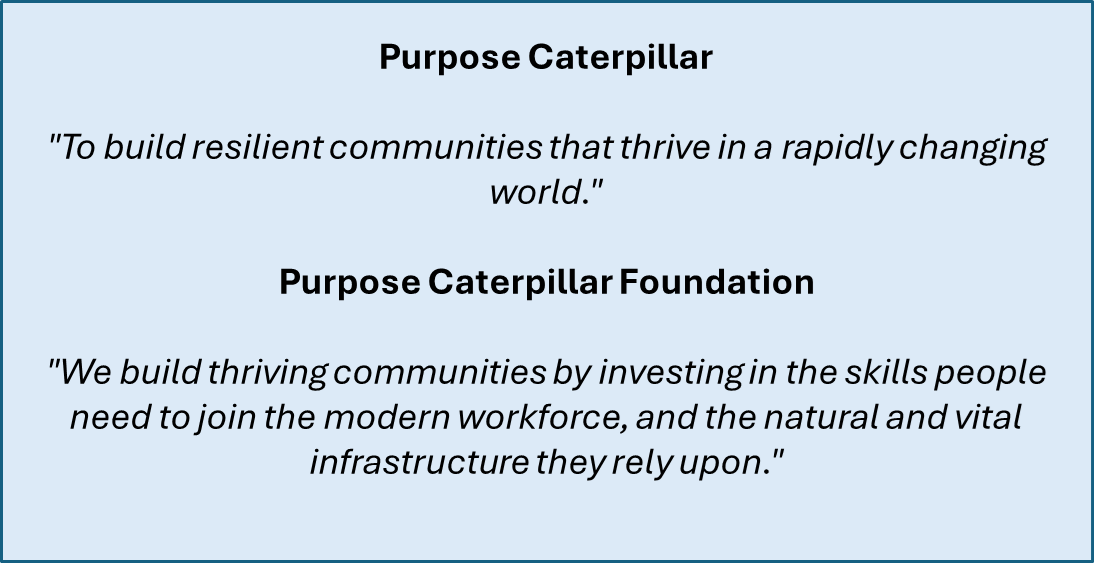
The Caterpillar Foundation invests in projects that stimulate local economies, providing grants and donations to organizations that promote economic growth and development in underdeveloped areas. It also supports cultural preservation through community engagement programs by funding local cultural projects and preserving historical sites that are significant to community heritage.
In 2019, the Caterpillar Foundation committed $300 million to alleviate poverty and build resilient communities worldwide.
2. Starbucks
On the other hand, Starbucks’ purpose provides a good example that focuses on the supply chain:
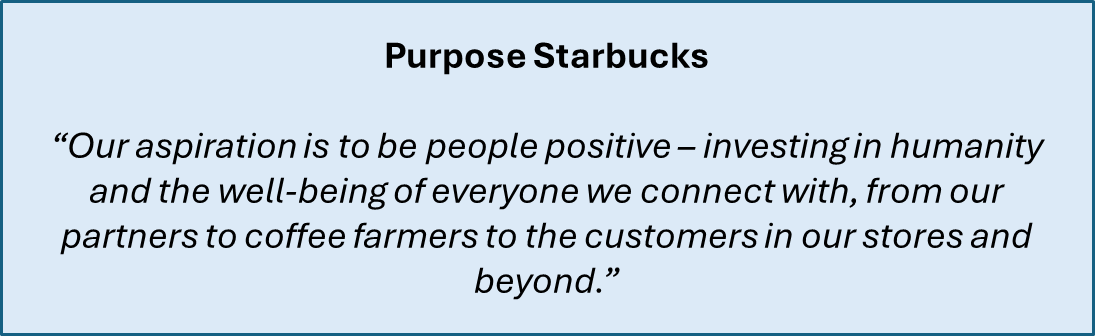
Starbucks’ commitment to ethical sourcing through its “Coffee and Farmer Equity” (C.A.F.E.) practices helps support local communities and ensures sustainable farming practices.
4. General Human Values
The "General Human Values" area is dedicated to fostering core values that enhance human dignity and societal harmony. Key values to enhance include “Justice & Peace”, “Love & Care”, “Joy & Happiness”, “Creativity & Playfulness”.
Promoting these values creates healthy and thriving societies.
Here are 2 examples of companies or brands that choose “General Human Values” as their purpose:
1. Unilever’s Dove
Unilever’s body care brand Dove is a good example of a purpose that addresses the values beauty, (self-) love & care and inner peace. Dove’s overarching theme is
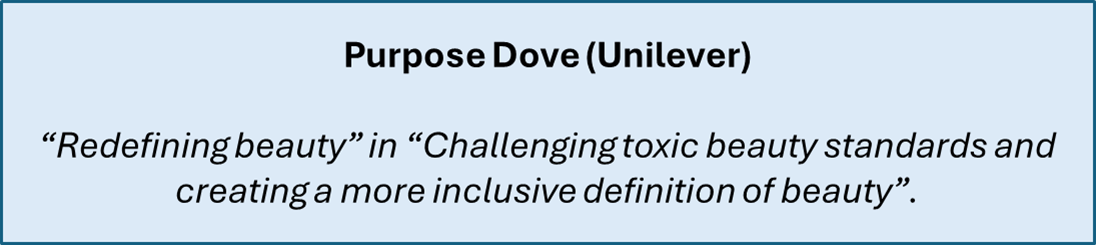
Among many other activities, Dove delivers on its purpose by its “Real Beauty Campaign”, showing real women, never models, as they are in real life, without digital distortion. The campaigns include women of different ages, sizes, ethnicities, and backgrounds, promoting a broader definition of beauty.
They also launched the “Self-Esteem Project” with the following goal:
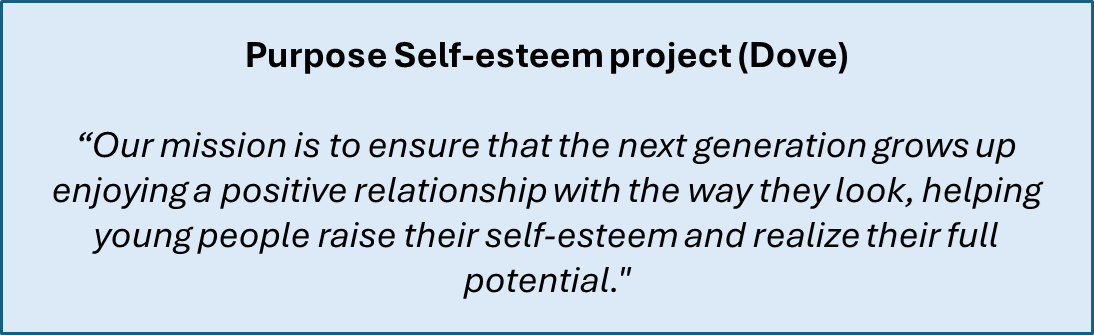
Dove’s “Self-Esteem Project” offers educational resources and workshops designed to help young people develop a healthy body image. The resources are aimed at parents, teachers, and youth leaders.
The project has reached over 60 million young people across 142 countries through partnerships with educational institutions and non-profits.
Dove’s purpose focuses on fostering values like inner peace and self-acceptance, reducing the negative impacts of societal pressures and beauty standards on individuals' mental health and promotes living an unburdened life.
2. Disney
Disney is another good example of promoting human values through its purpose and various complementing statements:
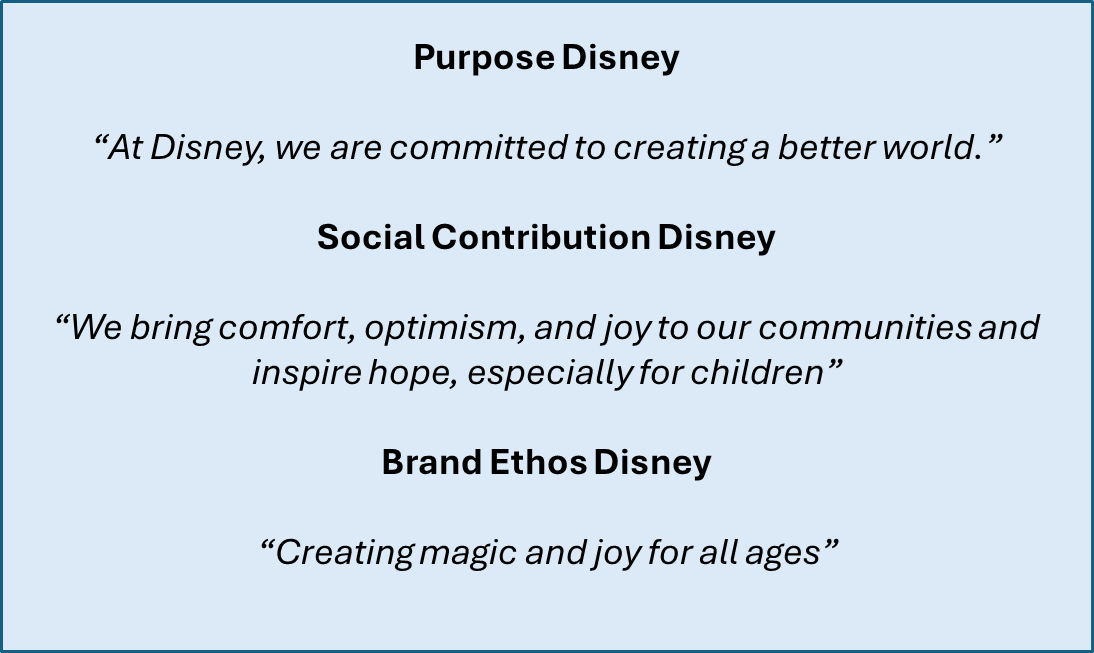
One of Disney's most prominent initiatives in this regard is its "Disney Magic of Storytelling" campaign, encouraging reading and helping children and families to connect, develop their imagination, and nurture their creativity. The initiative promotes access to books for children in underserved communities, fostering joy and curiosity in young minds. Over the years, the campaign has donated millions of books worldwide.
The values promoted in Disney's statements are geared towards instilling and fostering a sense of wonder and happiness.
However, it’s Disney’s products themselves that are already conveying its purpose and mission. Through its films, shows, theme parks, and characters, Disney creates magic and joy for all ages, fostering wonder and happiness. Whether through classic animations or modern blockbusters, the company creates experiences that bring people together and spread positivity.
Company-Purpose Fit
After identifying potential areas where your company can contribute by addressing societal issues or promoting human values, it is now essential to define your company’s specific purpose. As described in the introduction, not every purpose fits well with every company. Therefore, deliberate selection criteria are needed to ensure an optimal purpose fit with the specifics of the company. These four selection criteria or steps are:
- Business model affinity
- Core competence fit
- Identity resonance
- Stakeholder expectation
While the focus of the discussion may vary depending on where a company stands in its purpose definition, it is essential to discuss all criteria in an integrated manner. Starting from scratch, I suggest following the indicated sequence as they build on each other in a logical order.
Step 1: Business Model Affinity (= Materiality)
Begin with “Business model affinity” to ensure that the purpose is material, meaning it is real and impactful, not just a superficial or symbolic cause (pseudo purpose).
Step 2: Core Competence Fit (= Leverage)
Then consider “Core competence fit,” which, while closely related to the business model, emphasizes leveraging existing competencies for even greater impact and differentiation.
Step 3: Identity Resonance (= Authenticity)
Next is “Identity resonance,” which ensures authenticity - crucial for building external trust and fostering internal adoption and implementation.
Step 4: Stakeholder Alignment (= Meeting Expectations)
Finally, address “Stakeholder expectation,” ensuring the purpose is aligned with stakeholder needs and expectations, serving as a confirmation that it is both relevant and “safe”.
This framework for purpose definition is not a precise scientific model, but rather a practical and experience-based problem-solving strategy. It follows the principles of a “back and forth” iterative heuristic process.
While there is a suggested sequence to follow, you revisit earlier steps based on new insights or outcomes from later steps (Feedback loops), refining and improving the overall solution as you progress.
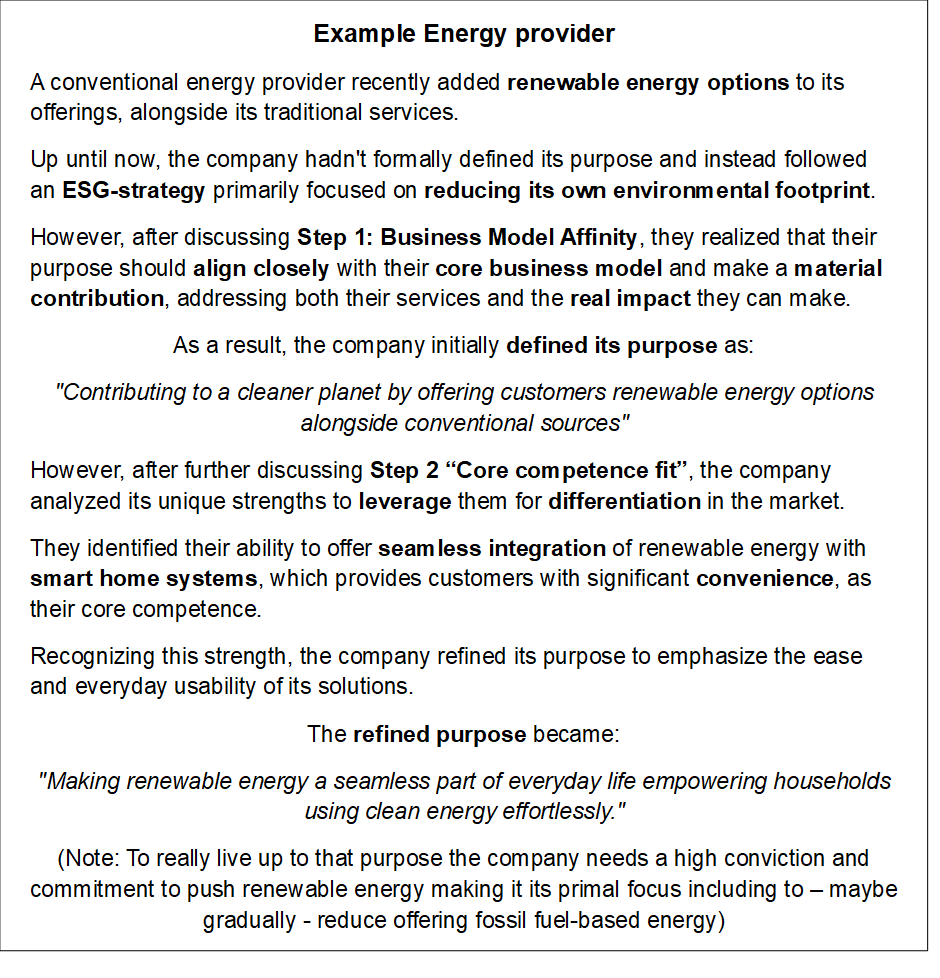
The following sections describe all 4 steps in detail, providing additional concepts and clarification, action steps, as well as plenty of real cases analyzing and contrasting companies’ purposes with their own behavior or that of other companies.
At the end of the section for each step, the most important practical questions required to discover and define a purpose are provided.
1. Step: Business Model Affinity
The most important factor that determines the optimal purpose is the company’s business model and therefore automatically the industry it’s operating in. The industry typically presents certain types of problems that the business model creates and/or is able to help solve. In other words, societal problems have a certain industry or business model affinity.
The following table shows this “Problem - Business model affinity”:
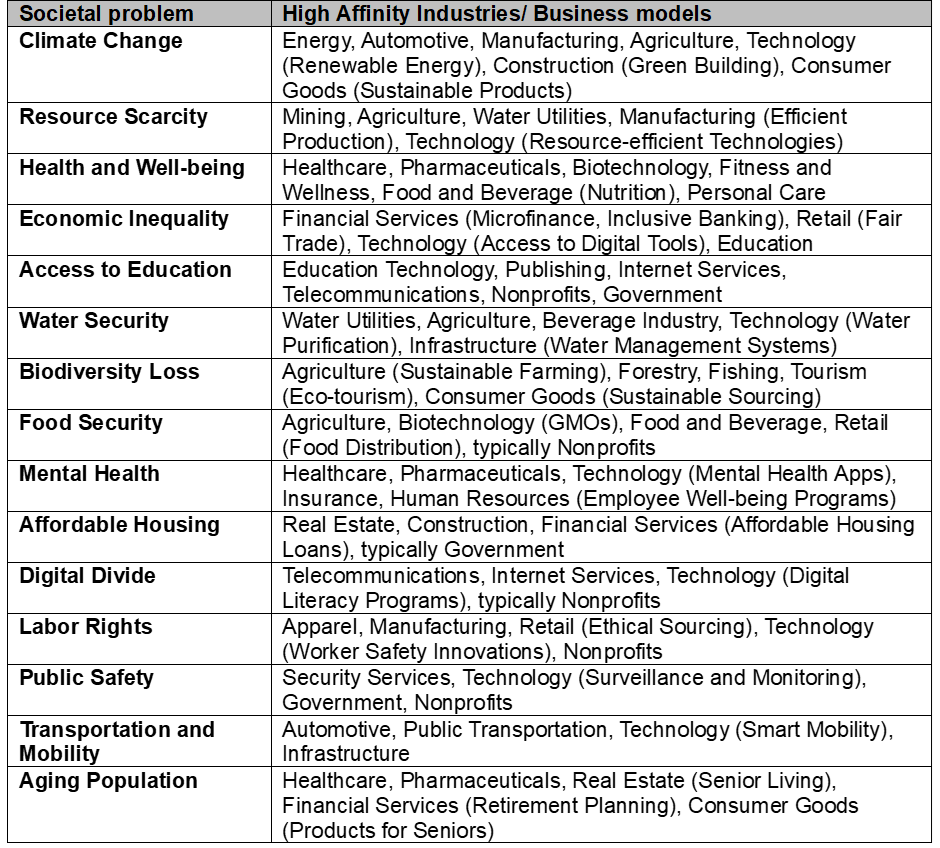
As a first approximation, a purpose will likely be found within these problem areas for the associated industries. Already here, the added parentheses indicate how companies could wield their business model to address problems and therefore find their purpose (see more below).
We also see that companies can address problems and find their purpose in different areas. E.g. companies within agriculture can help solve climate change, resource scarcity, water security, biodiversity loss, food security.
Note: Likewise, companies that are already obliged to report on ESG-standards will find relevant connections to their purpose in their materiality analysis when reporting on the topical standards or in the sector specific standards once they’ve been issued by the legislator (in fact a table like that above is what the legislator still has to develop).
However, this first approximation needs one step of refinement to define a concrete and precise purpose that states how the company intends to address these listed problems.
Clustering Business Models to find real Purpose
As described earlier, plenty of companies limit their endeavors to define their purpose by just describing their money-generating business model, regardless of whether that business model actually is geared towards addressing a real problem society faces.
To better understand to what degree and where different business models are actually creating, and therefore also have the possibility of solving, problems, and what that means for the company’s purpose formulation, we must break down its business model into two fundamental components (simplified):
- Services and products: What does the company sell or provide? Does the core product or service directly address societal issues?
- Operations: How does the company create its product or service? Are the operations behind it sustainable, ethical, and socially responsible?
Running common business model types or industries through that lens results in 5 clusters that share similarities in how to extend or twist their business model in order to find a real (=not pseudo) purpose and the strategies and key contributions to bring that purpose to life.
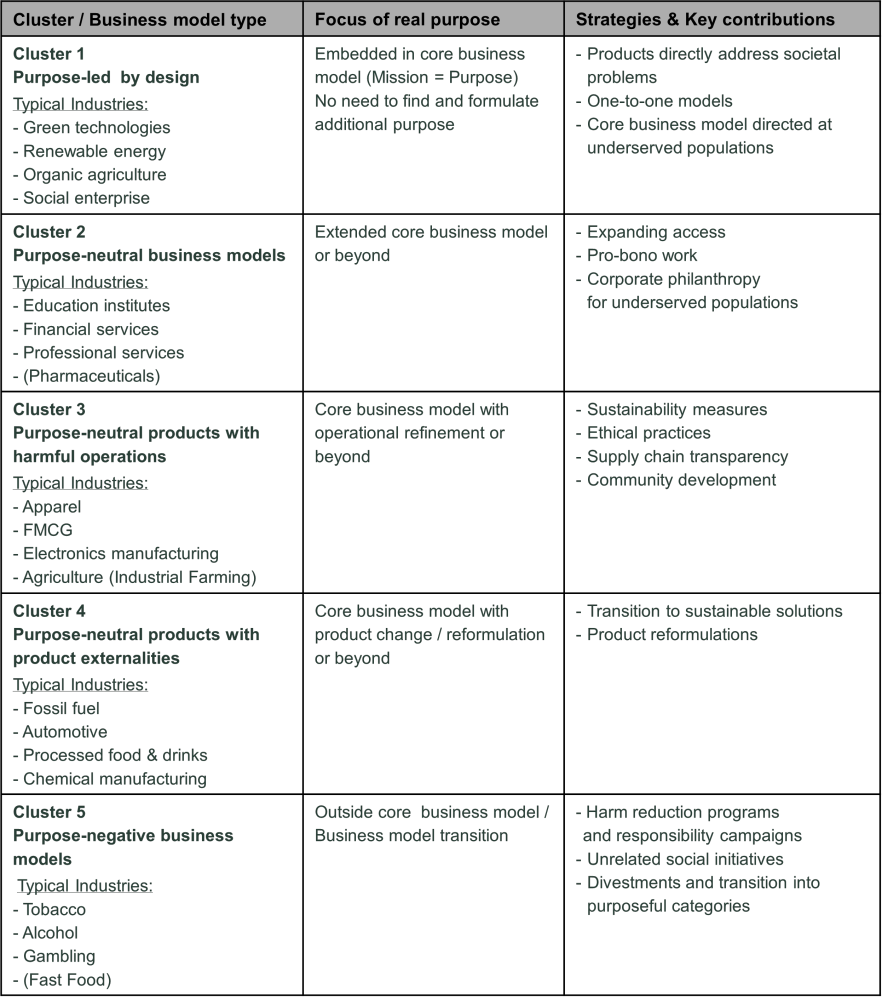
For a comprehensive description and discussion of these clusters of companies and the possible areas to formulate their real purpose, I highly recommend my article “Does your Company pursue a real or pseudo Purpose?”).
It provides 20+ well-formulated example purpose statements and plenty of insight and inspiration on how well-known and lesser-known companies defined their strategies and concrete contribution to walk the talk and make that purpose a tangible reality.
Fundamental questions to be answered
To put these insights into action, analyze, discuss and answer the following questions:
- Where does my company currently fall within this framework, and what does that mean for our potential to contribute positively to society?
- Are we creating or solving societal problems? To what extent?
- Does my company pursue a genuine purpose, or are we only adhering to a pseudo purpose?
- Does our purpose statement accurately reflect and drive our full contribution potential? If not, how should we reformulate it?
- How do we compare with the companies featured in this framework? What can we learn from their approaches and contributions?
- Are there any industry leaders outside of this framework that we should consider benchmarking against?
2. Step: Core Competence Fit
Core competence refers to the uniquely orchestrated combination of resources & capabilities that competitors cannot easily replicate or substitute and that form the basis for the company’s core products (e.g. Apple’s operating system or Google’s search algorithm) and end products (e.g. “Mac” computer or “iPhone” or “Google Search”).
These competencies are not just technical abilities; they can encompass organization, culture, brand reputation, customer relationships, or the ability to innovate. They represent what the company does best and are often deliberately developed over years of investment in technology, talent, and processes and are foundational for the company’s potential competitive advantage.
In fact, the concept of core competency is foundational for the entire strategic paradigm of the so-called “Resource-based View” (see my article “How to use Vision & Purpose to win in any Market!”).
When core competencies align with a company's purpose, it creates a powerful synergy that can drive superior innovation, customer loyalty, and sustained market leadership.
Vice versa, when they don’t, it can hinder the purpose’s ability to “pull” the company to fully leverage its potential, leading to missed opportunities and a diminished impact in the market and society.
To illustrate that point, let’s look at Tesla again and compare it with Porsche.
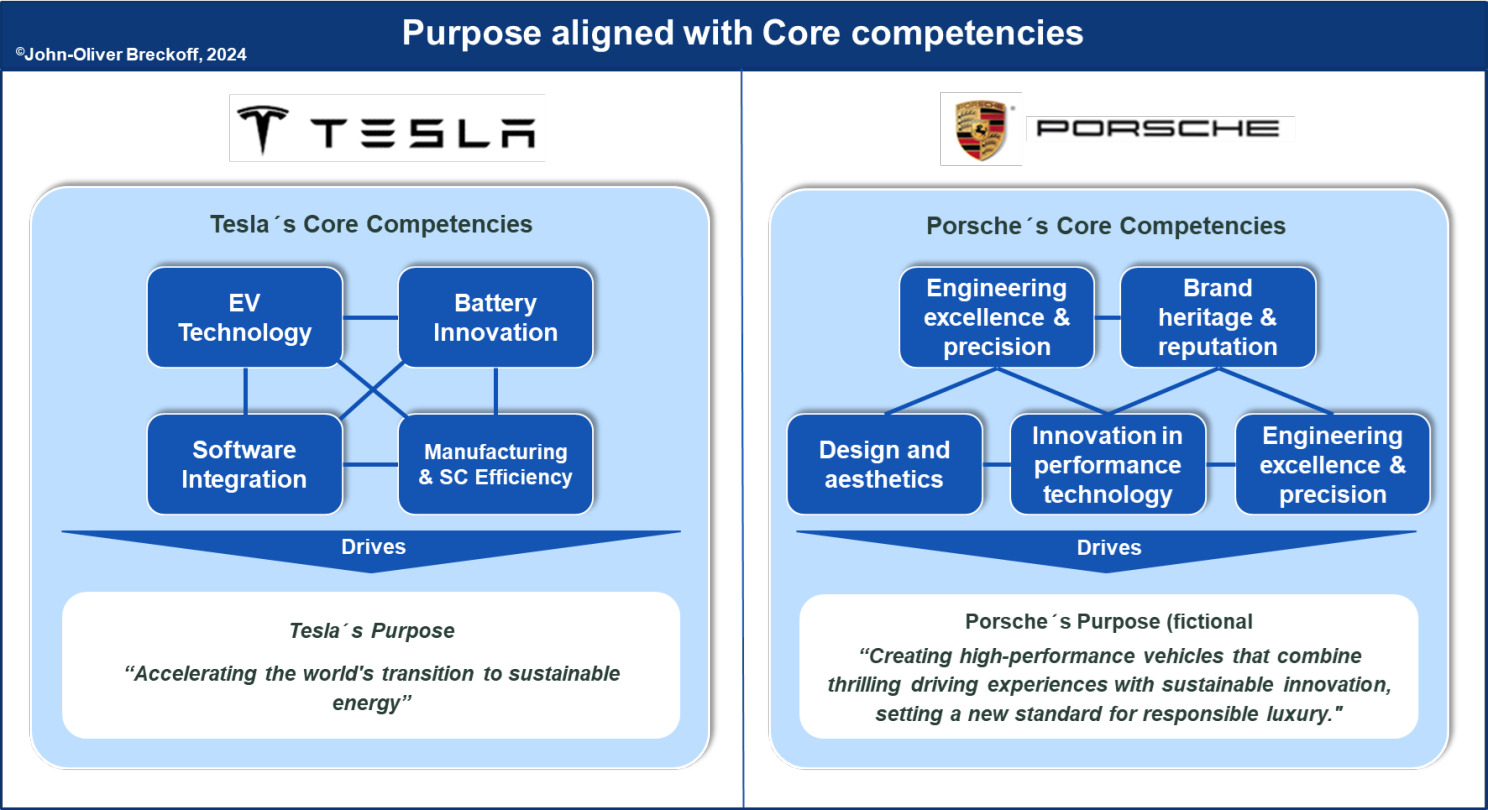
Both companies are in the same industry; nevertheless, due to their very different core competencies they are guided by a very different purpose (Porsche has no officially articulated purpose), or rather their defining purpose led to the development of their distinctive core competencies.
For a more detailed description of this interesting comparative case study check out my article "Learn how Tesla & Apple align their Purpose with Core Competencies".
How Apple’s core competencies power its purpose
Apple is another showcase where purpose perfectly links with core competencies (although admittedly Apple’s purpose is not the best example of actually addressing societal problems or promoting human values).
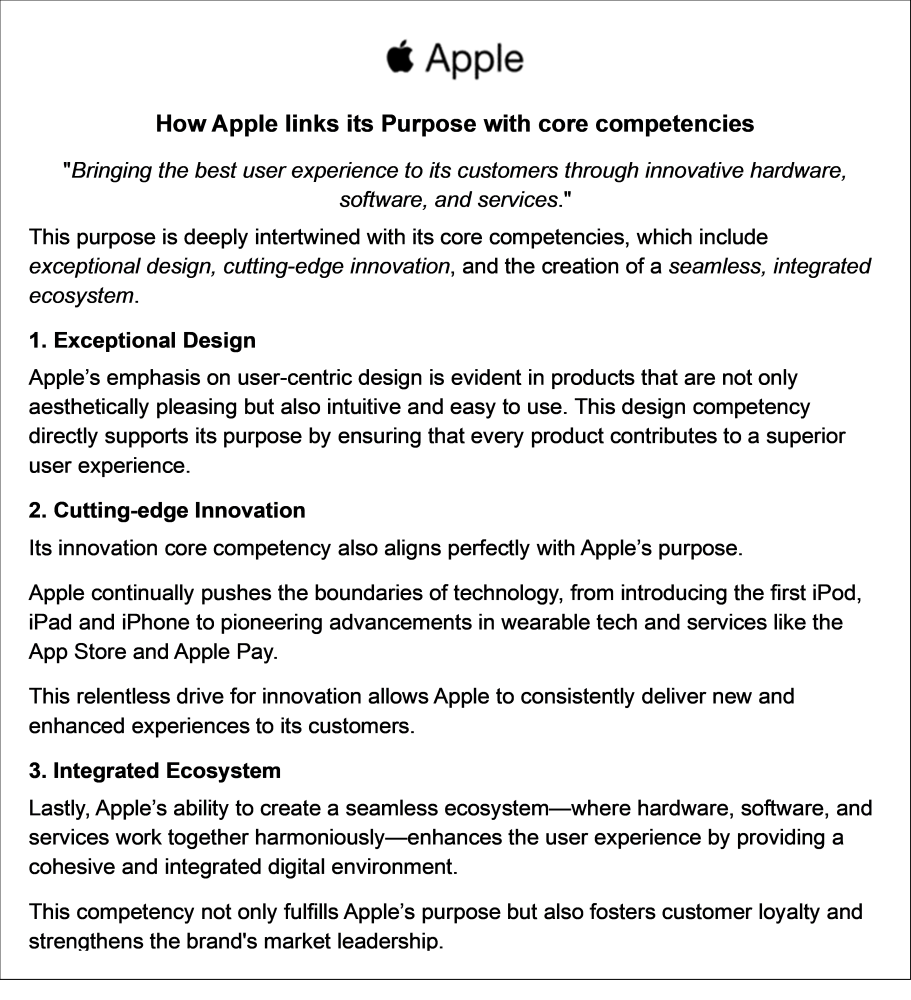
The synergy between Apple’s core competencies and its purpose has led to sustained success, enabling the company for almost 5 decades to set industry standards and shape market trends rather than just follow them.
Purpose and core competence must be aligned. This alignment leverages the company’s strengths and can create a synergy that drives innovation, customer loyalty, and industry leadership, positioning the company for long-term success and meaningful market impact.
Fundamental questions to be answered
To put these insights into action, analyze, discuss and answer the following questions:
- What are our core competencies?
- Is our existing or to be defined purpose actually aligned with our core competencies?
- If not, how should we define or refine it so that it fully leverages our strengths?
- If our purpose is clear and desired, but our competencies aren’t fully supporting it, what are the necessary capabilities to be developed or enhanced?
- Where do or should our purpose and core competencies meet?
- What can we copy, adapt or learn from the presented cases?
3. Step: Identity Resonance
The business model and core competencies are strong indicators of where to identify and how to formulate a company's purpose. However, for the purpose to be truly impactful, it must also resonate with the company's identity.
A company’s identity is the deeper essence that defines who it is at its core. It is the continuous thread that weaves together the company’s foundational and resilient values, motivations, and historical legacy. Therefore, identity is more than the company’s present-day culture, which may change over time - it reflects the enduring elements that have shaped the company through different phases of its existence.
While culture plays an important role by reflecting the current behaviors, practices, and norms that manifest in day-to-day operations, identity goes beyond culture. Culture can point to or shape identity but doesn’t equate to it.
Values, in general, are closely related to - or even part of - culture, but they too can evolve. Not all values are equally enduring. It is only the core values that are resilient and remain fixed - such as a commitment to innovation or sustainability—that constitute the true identity, while others may shift in response to market pressures or leadership changes.
Identifying this core identity is not an easy task. It requires deep analytical and emotional immersion into both a company’s historical path and current characteristics to filter through its various cultural expressions and pinpoint its enduring core identity. Over time, a company’s true identity can become overlayered by changing market demands, leadership shifts, or evolving strategies, and in some cases, it may even be forgotten amid short-term objectives. However, most companies still retain this identity core, which can be rediscovered and leveraged to shape a meaningful and authentic purpose.
Current culture and values do not necessarily determine purpose; it is the company’s identity that does. In turn, this (re)defined purpose shapes the culture, which may even require a major cultural shift to better align with the company’s true direction, especially when the current culture has drifted from the company’s true identity or has become toxic. While such a shift can be challenging and take time, it ensures that the company’s culture aligns with its core purpose and identity.
Thus, identity is the more permanent and holistic framework within which culture operates.
While the business model and core competencies describe the company's general economic activities, its identity consists of these deeper, intrinsic, and more nuanced qualities that define the organization and should therefore be reflected in its purpose.
Only then does the key ingredient that fosters trust and loyalty among both external stakeholders and internal leadership and employees emerge: Authenticity.
A purpose that is misaligned with the company’s identity and therefore with its behavior will internally not be adopted and externally not believed, thus reducing it to mere décor.
Patagonia’s strong Culture and Identity
A textbook example of a purpose that flows naturally out of the company’s culture and identity is again Patagonia. I will here only focus on the cultural and values aspects as we’ve already covered its concrete environmental activism initiatives.
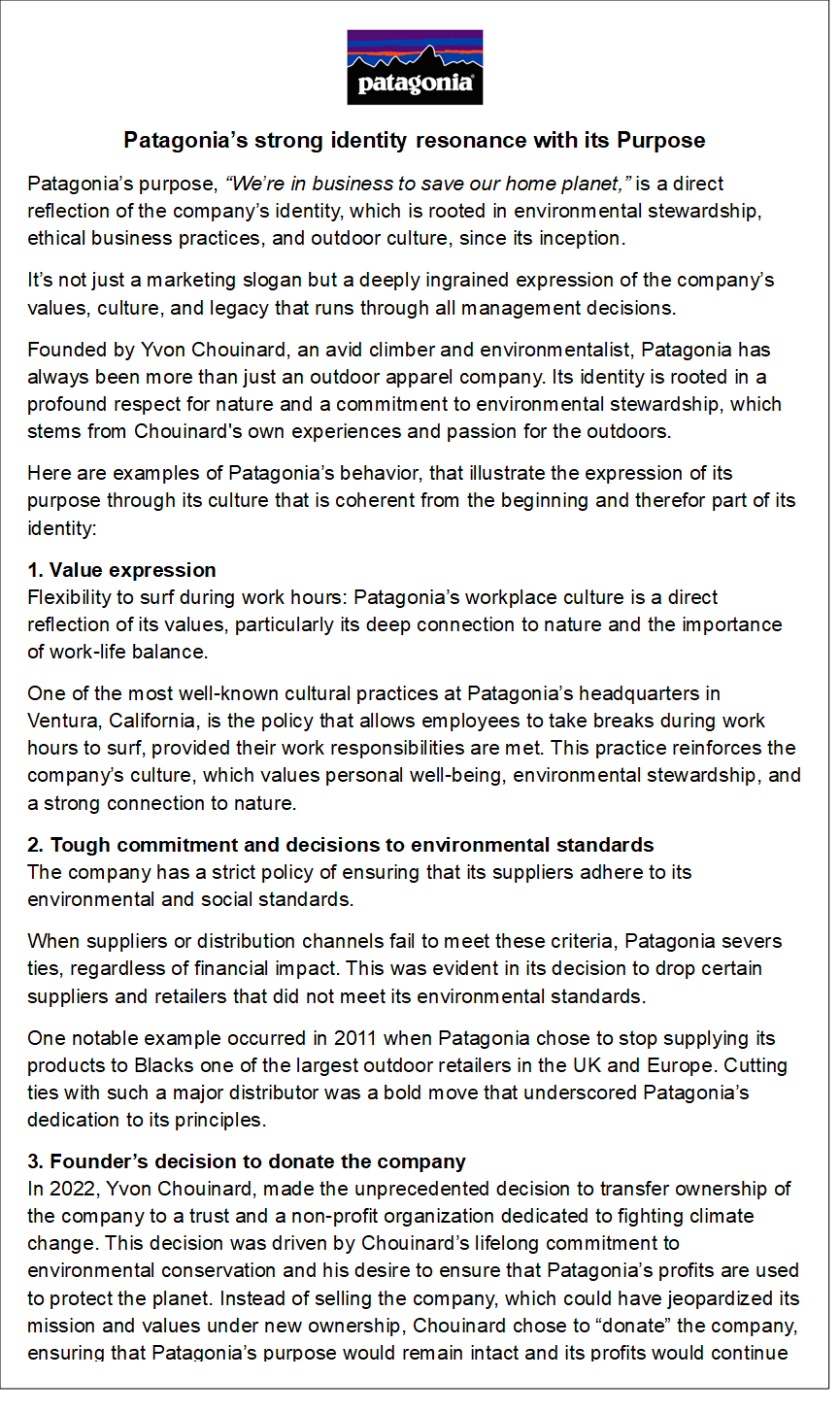
These are powerful testaments to the authenticity of Patagonia’s purpose and its commitment to the company’s legacy. It expresses and solidifies Patagonia’s identity as a business that even prioritizes the planet over profits and demonstrates the extent to which the company is willing to go to live by its values.
Check out my article "Purpose must be shaped by the company's Identity, not Culture!" for more insights into the relationship of culture, identity, authenticity and purpose, including an instructive comparative case study of Nestlé vs. Unilever as well as many examples of known failed companies and the incongruity of their corporate behavior with their declared purpose.
Fundamental questions to be answered
To put these insights into action, analyze, discuss and answer the following questions:
- What values and cultural practices are deeply embedded in our identity? How can we use these insights to ensure that the purpose is a true reflection of these values and cultural practices?
- What historical milestones, traditions, and legacy aspects should influence our company’s purpose?
- What are our employees' perceptions of the company’s identity, and do they feel a connection to the company's values? How can we ensure the purpose resonates with these perceptions to foster genuine buy-in?
- Does the existing or proposed purpose evoke a strong emotional connection and cultural resonance within the organization? If not, how should we adapt it so that it does?
- Is our corporate behavior congruent with our purpose? If not, should we reformulate our purpose, change our behavior or both? How exactly and to which extent?
- What can we copy, adapt or learn from the presented cases?
4. Step: Stakeholder Alignment
In any business, stakeholders are individuals or groups with a vested interest in the company’s activities and outcomes. They can have varying degrees of influence or interests and therefore also expectations.
Different Stakeholder Interests and Expectations about Purpose
1. Regulators (external)
Regulatory bodies ensure that companies operate within legal frameworks and adhere to standards that protect public interest. Their expectations focus on compliance with laws and ethical business practices.
When a company's purpose intersects with existing regulations, it is important to understand the implications, as the purpose might address or even supersede these rules.
Additionally, having a rough understanding of why regulators issue certain regulations, their overall concerns, and their anticipated future actions provides valuable insights into how a company can align with or anticipate regulatory changes.
2. Communities (external)
Local and global communities where a company operates are increasingly important stakeholders. These groups are primarily concerned with the company’s economic, social, and environmental impacts.
Understanding the needs and challenges of these communities in detail is important if the company's purpose is community-focused. It must be informed by the positive or negative effects it has on these communities and should seek to address or mitigate them effectively.
3. Environment (external)
While often a concern for communities, it is a distinct and broader consideration in corporate purpose. Unlike communities, which may prioritize local environmental issues among other social and economic concerns, the environment represents a systemic and overarching responsibility.
The environment’s "interest" is inherently one of protection and conservation. As it cannot safeguard itself, this responsibility has historically fallen to regulators or non-governmental organizations (NGOs), who advocate for policies and actions that ensure long-term environmental sustainability.
As the power and influence of these constituencies are limited, and because the environment is the responsibility of everyone, companies must recognize the environmental impact of their operations and incorporate sustainable practices, which often makes it a key component of their purpose.
4. Customers (external)
Customers are key stakeholders, primarily concerned with product fit and quality, service, and value for money. Pricing, innovation and the overall customer experience are often seen as direct reflections of the company’s commitment to delivering value. Customers and their needs are integral to the company’s business model, which is typically addressed in the company's mission.
However, modern consumers are not only concerned with product quality and service but also increasingly with the ethical stance of the companies they support. In general, they want transparency, sustainability, and social responsibility from the businesses they engage with. Consumers are 4-6 times more likely to purchase from purpose-driven companies ("Strength of purpose study" Zeno, 2020).
Therefore, when formulating a company’s purpose, it is important to understand the specific societal concerns customers have regarding the company’s products and operations, as well as what they expect in terms of the company’s particular societal contribution.
5. Employees (internal)
Employees are deeply involved in the day-to-day operations of the company. Their expectations typically include good compensation packages, fair treatment, autonomy, opportunities for growth, and a healthy and flexible work environment. Therefore, they have an interest in the company making a profit.
However, like customers, employees also increasingly want the company to have a purpose that aligns with their personal values. The Deloitte Millennial Survey 2014: “Big demands and high expectations” revealed that more than 70% of Millennials expect their employers to focus on societal or mission-driven problems.
6. Investors (internal)
Investors have traditionally been a highly influential stakeholder group, primarily interested in a company's financial performance and ability to generate returns.
However, over the last decade, they have increasingly recognized that companies with a clear, purpose-driven strategy are better positioned for long-term success. By now, even investors are increasingly interested in whether a company has and pursues a purpose and how it aligns with ESG-criteria.
Understanding and integrating these diverse perspectives of stakeholders is important when identifying, defining, or reformulating a company's purpose, as this ensures that the resulting purpose aligns with their interests, ultimately garnering their support.
Within this framework, it is an additional procedural step that ensures:
- Eliminating blind spots: By considering the perspectives of all stakeholders, companies can avoid the risk of overlooking critical issues. A purpose informed by diverse stakeholder insights is less likely to miss emerging challenges or opportunities, ensuring a more comprehensive and robust mission statement.
- Building trust and credibility: When stakeholders see their values and concerns reflected in a company’s purpose, it strengthens their trust in the organization. This trust is foundational, helping to establish the company’s credibility and securing long-term support from all stakeholder groups.
- Enhancing relevance and resilience: A purpose that aligns with stakeholder expectations is more likely to remain relevant over time. As societal values shift, a purpose that has been carefully crafted with stakeholder input will be better equipped to adapt and sustain the company’s relevance in a changing environment.
Shift towards a balanced Stakeholder view
It also becomes clear that these interests must be balanced between the stakeholders, otherwise the company risks creating conflicts, undermining its credibility, and ultimately losing their support.
By defining its purpose through the lens of all stakeholders - not just shareholders- a company automatically balances its societal contributions with its profit ambitions. In fact, it’s the focus on satisfying customer and employee needs that drives profits, ultimately meeting shareholder expectations.
Check out my article "4 practical Steps to align all Stakeholders with your Purpose") for a detailed view on the recent shift of stakeholder balance away from Milton Friedman’s shareholder value primacy and how it is reflected both in the CEO agendas and financial markets.
Fundamental questions to be answered
To ensure that the company’s purpose is aligned with and reflects a balanced stakeholder view, analyze, discuss and answer the following questions:
- Who are our key stakeholders, and what are their primary concerns and expectations?
- What long-term trends in stakeholder expectations should we consider in our purpose formulation?
- How do our stakeholders perceive our current purpose, and how well does it resonate with their values?
- What potential conflicts of interest exist among our stakeholders, and how can we balance them in our purpose?
Besides this perspective shift and anticipating how contributions in various areas will align with the interests of different stakeholder groups, the company should also engage directly with stakeholders to discuss these matters.
Engaging & Aligning Stakeholders
The following graphic depicts a practical 4-step process and concrete formats on how to involve stakeholders when defining and implementing your company’s purpose.
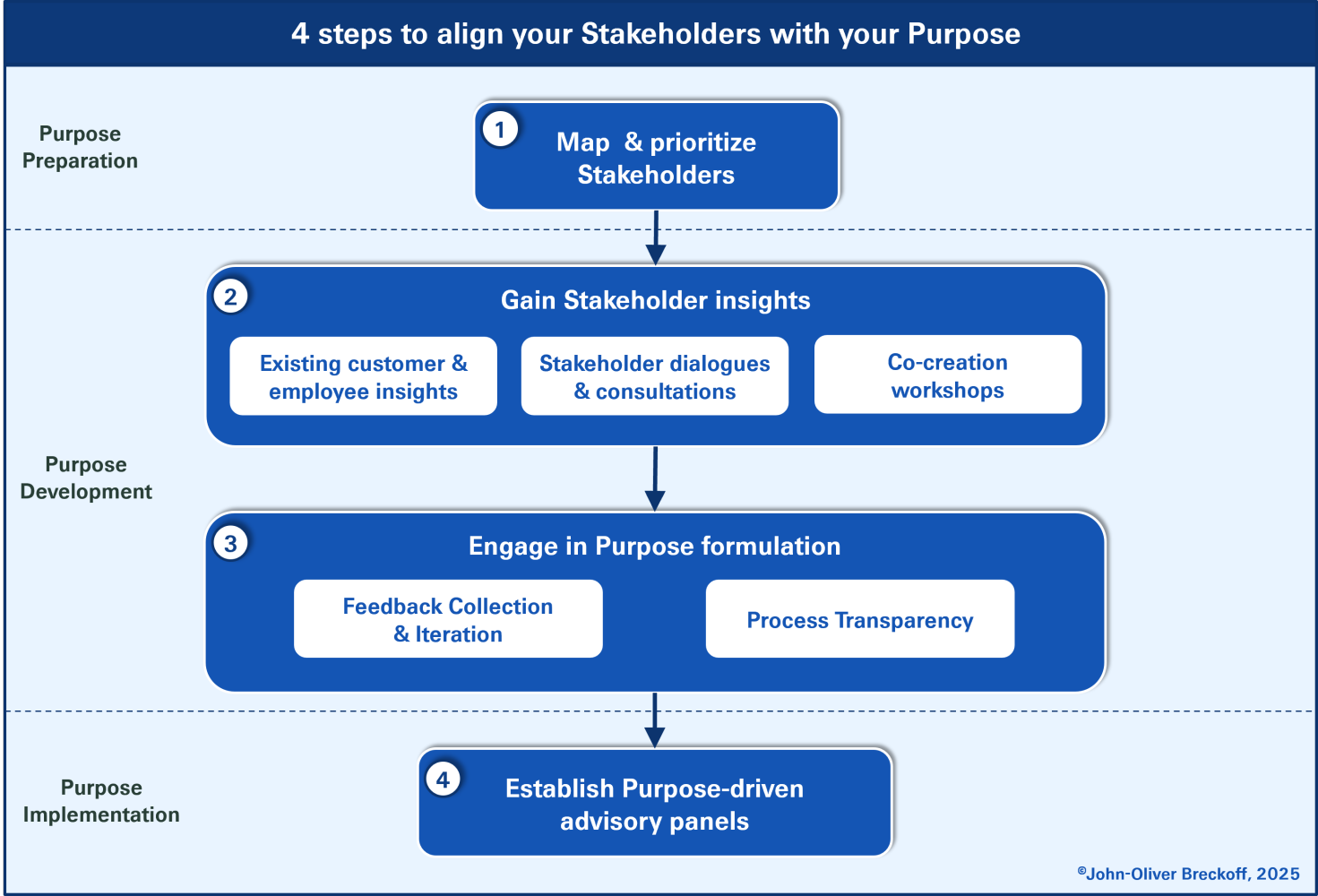
Depending on the degree and moment the company wishes to integrate their feedback, step 2 can be adjusted or expanded upon to ensure that stakeholders feel meaningfully involved throughout the process.
Early engagement may focus on gathering broad insights, while later stages may prioritize refining the purpose based on more detailed feedback and co-creation activities.
This structured approach ensures that stakeholder voices are integrated at key moments during the formulation of a company’s purpose to reflect both organizational ambitions and stakeholder values.
For a detailed description of this process again, check out my article "4 practical Steps to align all Stakeholders with your Purpose").
Purpose AND Profit
Finding a real purpose that clearly makes a positive impact in the world, genuinely fits with the company and is therefore perceived as relevant and authentic is already an achievement as such. The company is now aligned and recognizes its responsibility towards society and the environment as important external stakeholders.
However, as discussed in the introduction, the company must also ensure profitability and meet the expectations of their internal stakeholders. This includes employees, who anticipate competitive salaries and compensation packages, as well as shareholders, who expect solid dividends or stock price appreciation.
Companies can encounter difficulties in serving the needs of all their stakeholders at the same time and in striking the balance between purpose and profit.
A McKinsey survey indicated that 33 percent of managers experienced trade-offs between purpose and profit (McKinsey organizational purpose survey, October 2019). And I would assume that the other 67% do not experience this just because their purpose is well chosen, and they are actively managing and balancing the two.
Purpose-Profit Trade-off
In his thought-provoking book "Deep Purpose," Ranjay Gulati describes exactly that difficult balance that companies must maintain between their social missions and profitability.
Gulati offers a simple 2x2 matrix crossing the social and the commercial logic to pinpoint this tricky trade-off.
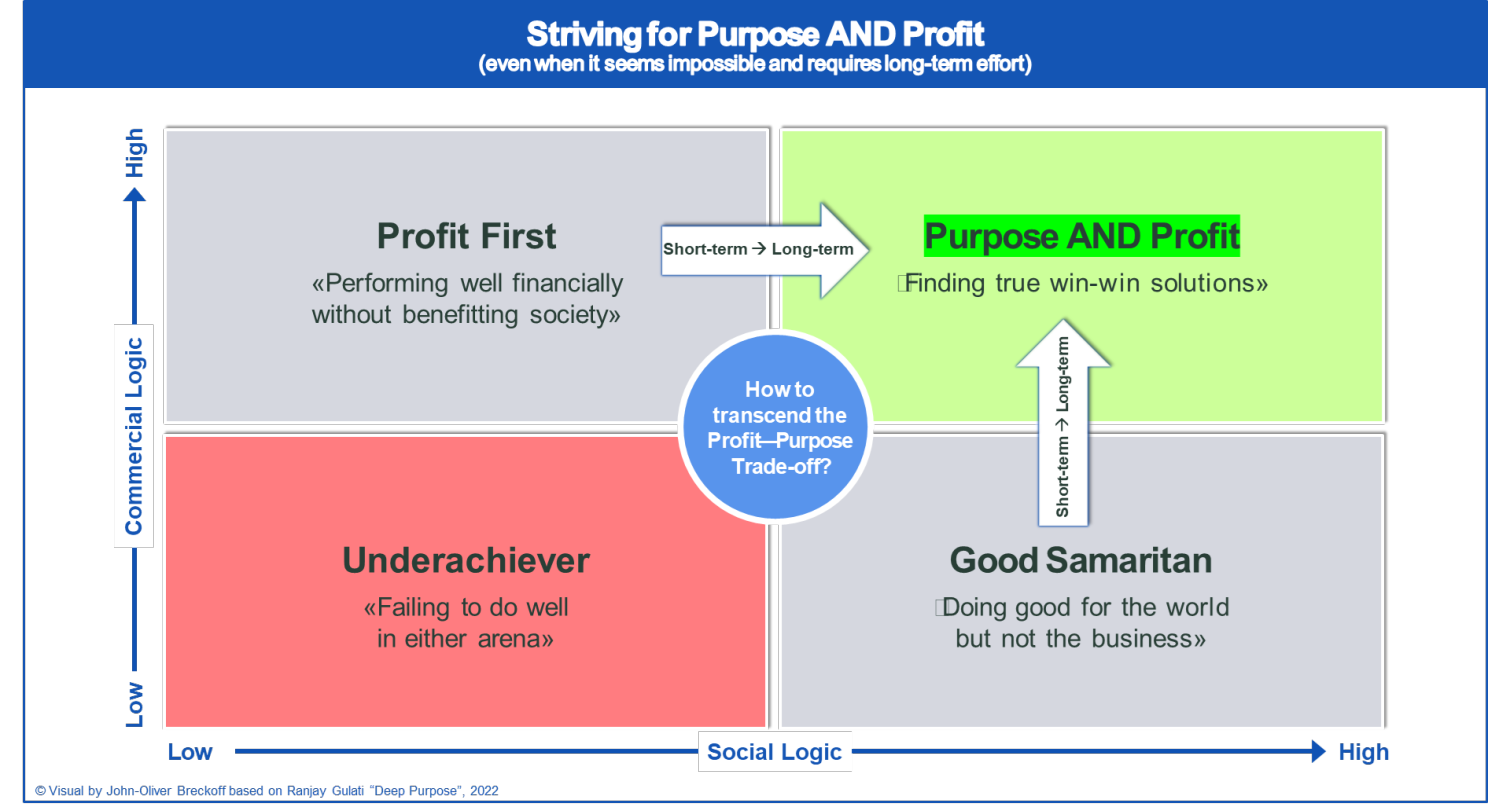
But let’s make no mistake. It’s difficult to strike this balance all the time and in all aspects of business operations. Being and staying in this desired upper right quadrant is not automatic; rather, it must be proactively strategized, planned and managed.
7 Strategies to align Purpose & Profit
The following graphic depicts 7 industry-overarching strategies to overcome that potential purpose-profit trade-off any company can adopt.
They should be understood as rough strategic approaches that need to be concretized and adapted, according to the actual industry specifics the company is operating in:
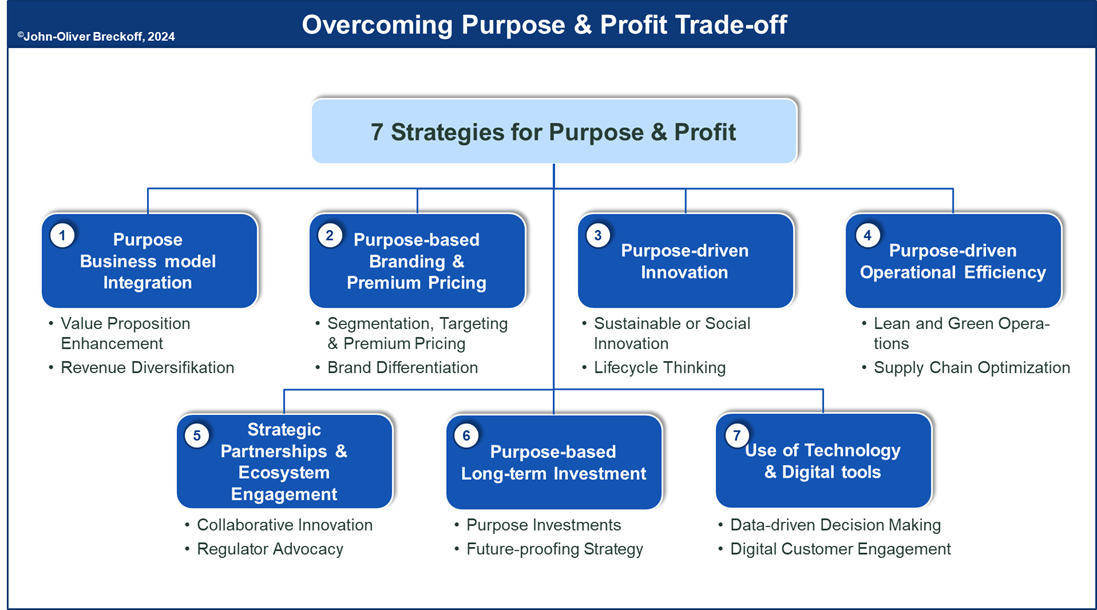
For a detailed description of each of these strategies, including plenty of real-life examples, check out my article "7 Strategies for making your Purpose profitable!"
Each of the seven overarching strategies presented offers a roadmap for companies to follow. However, these approaches must be tailored to the specific context, industry, and business model of each company.
By continually adapting and refining these strategies, organizations can position themselves in the "Purpose AND Profit" quadrant, ensuring both financial sustainability and a meaningful, positive impact on the world.
Conclusion
This framework guides companies in finding a purpose that is authentic, aligned with their stakeholders and creates a positive impact in the world while maintaining or even boosting their profitability.
Defining that company’s purpose is a core strategic process that identifies, evaluates and chooses a contribution addressing real societal and environmental problems by aligning and integrating it with its business model, core competencies, identity and stakeholder expectations.
A purpose chosen based on these criteria lays the foundation for external trust and internal adoption, allowing its multiple profit-enhancing benefits to unfold.
Although a purpose defined and formulated according to these criteria favors profitability, potential purpose-profit trade-offs still need to and can be strategically managed within a long-term time horizon. Companies can achieve this by applying the 7 overarching strategies provided, adjusting them to their particular industry and business model specifics.