Does your Company pursue a real or pseudo Purpose?
The corporate mission (“What business are we in?”) describes the rough business model of the company, the benefits for the customers and therefore also implicitly how it strives to make a profit with it.
In contrast, the corporate purpose (“Why are we here?”) describes the company’s contribution to the world, beyond itself and its profit ambition, and is therefore the organization‘s deeper meaning for existence (raison d’être).
Given the current state of affairs humanity confronts, politics, regulators, employees (especially Millennials and Generation Z), but also consumers and increasingly even investors expect companies to dedicate attention to really tackling societal problems. CSR and ESG and their corresponding, increasingly strict regulations are a clear reflection of this trend.
Highlighting this is important since plenty of companies define their purpose by just describing their profit-generating business model, regardless of whether that business model actually is geared towards addressing a real problem society faces.
Real purpose vs. Pseudo purpose
For example, by producing food, a food company with operations in Europe does contribute to society, since it helps prevent people from starving.
However, in Europe starvation is not remotely a problem society faces. On the contrary, the situation is characterized by drastic food overproduction in many categories.
Declaring “We are here to feed society” cannot really serve as a purpose, since it’s not addressing any societal problem within their scope of geographical operations. It’s a pseudo purpose.
This neither complies with the expected societal contribution nor does it harness the power of a real purpose, as a strategic tool with proven positive effects on talent attraction, employee engagement, brand reputation, and stakeholder alignment (see my article "The Rise of Purpose in Corporations").
However, the real problem for that company might lie in the quality of the food, potentially leading to health issues, or in harmful production processes, causing environmental damage. These are the areas where a credible and effective purpose could be identified and formulated, as e.g. by Danone’s "To bring health through food to as many people as possible".
Real purpose depends on business model
Depending on its business model and the industry it operates in, different companies have different affinities to both create and solve different problems. And therefore also different fields in which to find and formulate their real purpose.
To better understand that relationship, we must break down the business model into two fundamental components (simplified):
1. Services and products: What does the company sell or provide? Does the core product or service directly address societal issues?
2. Operations: How does the company create its product or service? Are the operations behind it sustainable, ethical, and socially responsible?
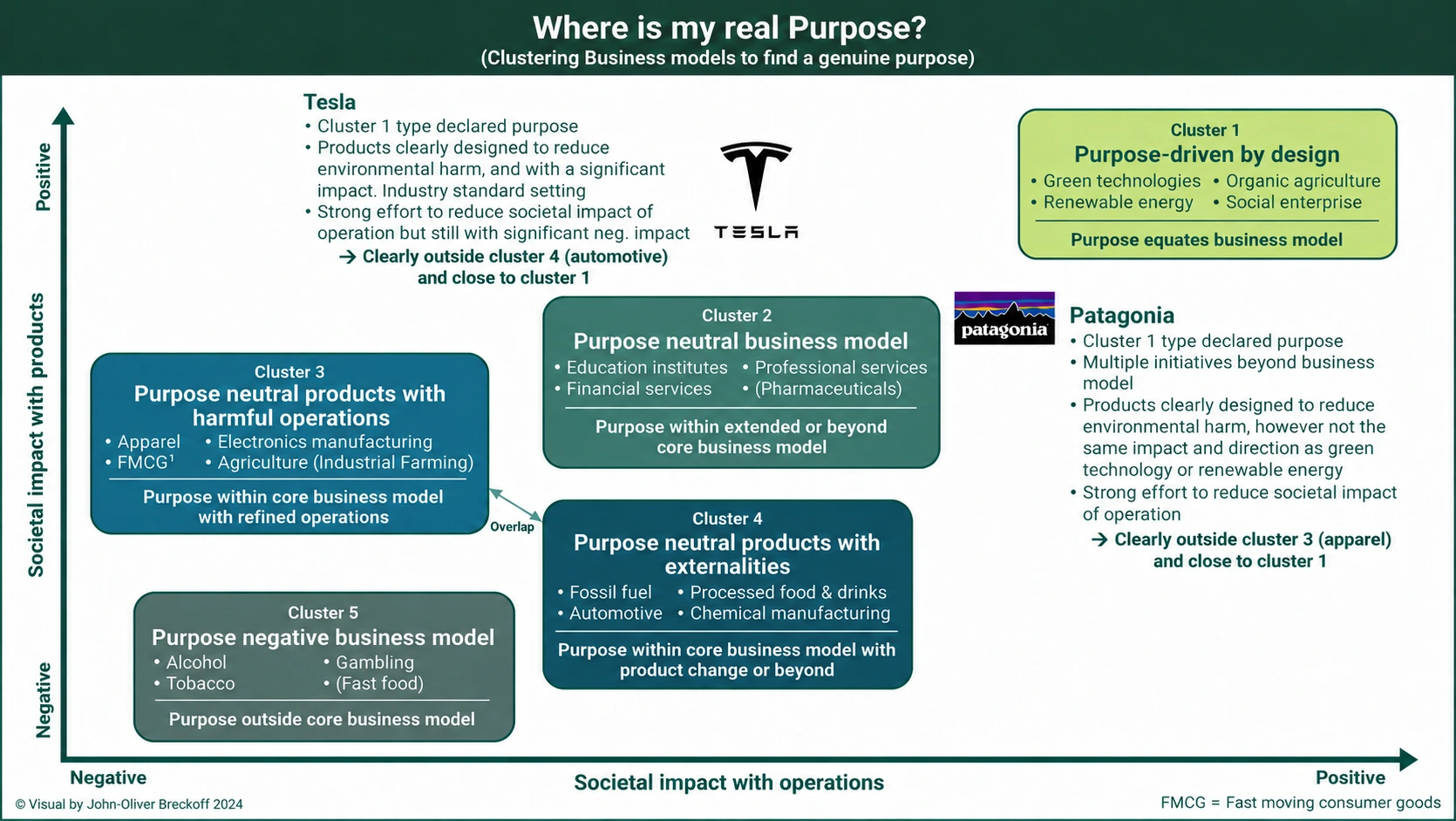
To visualize this assessment, the following graphic groups industries into 5 clusters based on their societal impact, both in their products/services and operations, and differentiates per cluster where and how a company’s purpose might be derived or enhanced.
It’s important to note that the classification of industries into specific clusters is not always precise (as e.g. with pharmaceuticals), and some clusters overlap, particularly Cluster 3 and 4.
Additionally, companies within the same industry, while sharing many commonalities, can differ significantly in their specific business models, sometimes to the extent that a company cannot be ascribed to the same cluster as its peers anymore.
This is the case with Tesla (its car division), an automotive company, and Patagonia, an apparel company. Despite their industry classifications, in terms of purpose-driven strategies and positive impact, they clearly align more closely with Cluster 1.
5 Clusters to find the real purpose
Subsequently, each cluster is described in detail, accompanied by purpose statements from various companies, both well-known and lesser-known. The descriptions also include examples of the strategies and concrete initiatives with which these companies pursue and live up to their stated purposes.
I have made an effort to feature companies that appear to be authentically purpose-driven and genuinely committed to bringing that purpose to life.
However, as an outsider relying on external information sources - mostly provided by the companies themselves - I cannot definitively determine to what extent this information reflects reality. Additionally, often I cannot assess whether a company’s efforts to live up to its purpose are proportional to its means or potential, or how effective those efforts actually are in terms of real impact.
With the possible exception of Patagonia (and perhaps Unilever over the past 10-15 years), no company mentioned outside Cluster 1 is intended to serve as a role model. The information presented can be questioned or interpreted differently, as I have done. Nevertheless, I believe these companies provide useful comparisons and, in certain aspects, hopefully also serve as inspiration.
Cluster 1: Purpose-driven by design
Companies in this category inherently align their core products and services with societal problems. Their business models are deliberately built around addressing pressing societal issues, and their operations are designed to avoid creating additional problems. Often (but not always) they are relatively new and also smaller companies.
For these companies, purpose and profit are naturally intertwined, and their success in the marketplace equates to success in achieving their purpose.
Typical industries:
1. Green Technologies: Companies like Vestas Wind Systems or Tesla (Energy division) that design, develop, and manufacture technologies that enable the transition to a sustainable, low-carbon economy. These technologies can include wind turbines, solar panels, energy storage systems, electric vehicle components, and other innovations that help reduce environmental impact.
2. Clean Water Technology: Companies like Xylem Inc. or Pentair that develop and manufacture technologies designed to ensure the availability of clean, safe water. These may include water filtration systems, desalination plants, and wastewater treatment solutions.
3. Renewable Energy Providers: Companies that generate and supply renewable energy using green technologies like the Danish Ørsted or UK-based Ecotricity. Their primary focus is on the production or trading and distribution of clean energy sources such as wind, solar, hydro, and geothermal power. These companies directly contribute to reducing carbon emissions and transitioning the energy sector away from fossil fuels.
4. Ecological Agriculture: Businesses like SunOpta Inc. (non-GMO Food) or Organic Valley (organic dairy, eggs, other agricultural products) that engage in organic farming, sustainable agriculture, or permaculture practices contribute to environmental conservation and food security.
5. Social Enterprises: Organizations that operate on a one-for-one model, like online retailer TOMS or eyewear retailer Warby Parker.
TOMS focuses its purpose on mental health, ending gun violence, and environmental conservation. It started in 2006 with a one-for-one model, donating 1 pair of shoes for every pair sold. Since then, it has evolved that model and adopted a more flexible and comprehensive approach to social impact. The current model involves giving a portion of profits to a variety of causes through grants and partnerships with grassroots organizations. The company gives at least 1/3 of its profit to its purpose initiatives.
Other social enterprises directly provide services to underserved populations, such as education (e.g. Bridge International Academies that operates a network of low-cost private schools for kids in underserved communities across Africa and Asia).
Or healthcare for disadvantaged communities (e.g. Aravind Eye Care System, based in India, offering high-quality, affordable eye care, operating on a model where paying patients subsidize the cost of care for those who can’t afford it).
The core business model of these companies is directly geared towards these disadvantaged populations or consistently includes them.
Purpose articulation: Equates business model (=Mission)
For companies in these industries, the real purpose is already embedded within their core business model. They don’t need to find and formulate an additional special purpose or create dedicated strategies and measures to bring it to life.
Simply by successfully pursuing their core business model and strategy, they automatically fulfill their purpose, because addressing current pressing societal issues is what they are built for.
Purpose statement examples:
- Vestas (Green Technologies): "To become the global leader in sustainable energy solutions."
- First Solar (Green Technologies): "Leading the world’s sustainable energy future."
- Xylem Inc. (Clean Water Technology): "Let's Solve Water."
- Pentair (Clean Water Technology): "We deliver smart, sustainable solutions that empower our customers to make the most of life’s essential resources."
- Ørsted (Renewable Energy): “To create a world that runs entirely on green energy.”
- Ecotricity (Renewable Energy): “End fossil fuels”
- Bridge International Academies (Social Enterprise Education): “Knowledge for all”
- Aravind Eye Care System (Social Enterprise Healthcare):"To eradicate needless blindness by providing appropriate, compassionate, and high-quality eye care to all."
- TOMS (Social Enterprise One-to-one model): "We're in business to improve lives. That’s why we give ⅓ of profits for good."
- Warby Parker (Social enterprise One-to-one model): "To inspire and impact the world with vision, purpose, and style."
Strategies & concrete contribution:
As the products and services of these companies are already geared to solve problems and their operations don’t cause harm, they don’t need to find additional contribution areas for their purpose.
Nevertheless, as these types of companies tend to be strongly purpose-driven, they often devote further activity outside of their core business model to their cause, especially as this at the same time indirectly markets their products.
1. Campaigning and Advocacy: Companies in green technologies and ecological agriculture often engage in advocacy to promote sustainable practices and influence public policy. For example, Vestas actively lobbies for renewable energy incentives and stronger environmental regulations.
2. Education and Awareness: Social enterprises may run campaigns to raise awareness about the issues they address, such as Warby Parker’s initiatives to highlight the importance of vision care.
3. Partnerships and Collaborations: Clean water technology companies often partner with NGOs and governments to implement large-scale water purification projects in regions facing severe water shortages.
Being in a profit-making business (if viably managed) by solving societal problems is an attractive position. For purpose-driven founders, but also for existing technology or service firms, this is the cluster to start a business or to diversify or transform into.
The Swedish Norrsken Foundation enables exactly this. It’s a non-profit foundation whose mission is “to help entrepreneurs solve the world's greatest problems” by “connecting founders with capital, knowledge, world-class working facilities and a global network of exceptional people and organizations”.
Among other things they run tech hubs in Stockholm, Barcelona and Kigali.
With 6’000 founders, 2’000 investors, 150 portfolio companies and $700 million under management, they are building an ecosystem where founders can find everything they need to “make saving the planet their business.”
This is exactly what Cluster 1 companies are about.
Cluster 2: Purpose-neutral business models
These companies offer harm-free products and services that fulfill everyday needs but are not inherently designed to address societal challenges like those of Cluster 1. Also, their operations are potentially ethical and sustainable, ensuring they do not contribute negatively to societal or environmental issues.
That doesn’t mean they don’t have to make efforts to further reduce their operational impact or comply with ESG-regulation. But comparatively, they don’t display the negative operational impact of Cluster 3 or the product-related impact of Cluster 4 companies.
The important distinction here is between merely participating in economic activity by providing necessary goods or services (fulfilling some sort of a "basic purpose") vs. finding a real purpose to make a positive societal impact by solving real societal problems (as do Cluster 1 companies).
Typical industries:
1. Education Institutes: These organizations provide essential educational services but may not specifically target educational disparities or underserved populations as part of their core business model.
2. Financial Services: Companies in this sector offer products that help individuals manage finances, such as banking, investment, and insurance services, but do not inherently address financial inequality.
3. Professional Services: Law firms, consulting agencies, and accounting firms that offer needed expertise but do not necessarily target issues like legal or financial inequity.
4. (Pharmaceuticals): The business model of these companies is controversial, making it challenging to assign them to a specific cluster. Typically, these companies focus on developing and distributing medications that address health needs but prioritize profitable markets over underserved communities and ailments.
It's debatable whether their products serve only a 'basic purpose' (like food, or energy) or actually help solve pressing societal problems like those of Cluster 1. At the same time, their operational impact is definitely higher than that of the service firms in this cluster (and also Cluster 1), but lower than that of the Cluster 3 companies.
Their general focus on developing medications to fight diseases (and often only symptoms) instead of developing products to prevent them is also criticized (and obviously a topic of the entire healthcare system structure and dynamic).
Purpose articulation: Within extended or beyond core business model
For these companies (and those of all following clusters), it’s not enough to just follow their business mission as Cluster 1 companies can; rather, they need to find a real purpose.
Their real purpose can still be found in the core business model but requires extending it to reach underserved populations or to contribute to societal well-being through initiatives that go beyond their immediate business interests.
Purpose statement examples:
- Arizona State University (ASU) (Education Institutes): "To be a comprehensive public research university, measured not by whom it excludes, but by whom it includes and how they succeed."
- JPMorgan Chase (Financial Services): “To be the best financial services firm in the world, serving our clients and growing our communities."
- Deloitte (Professional Services): "To make an impact that matters."
- Merck (Pharmaceuticals): "We use the power of leading-edge science to save and improve lives around the world."
Strategies & concrete contributions:
1. Expanding access: Education institutes can create scholarship programs or offer online courses to make education more accessible to underserved populations. For example, ASU’s contributions include partnerships like the “Starbucks College Achievement Plan” and the “Access ASU” program, which aim to increase college readiness and access for underserved populations. Pharmaceutical companies, on the other hand, have a huge contribution field in granting access to their treatments, beyond their core clients.
Novartis, for example, has launched the “Novartis Access” program, which focuses on making affordable medicines available in low- and middle-income countries. This initiative includes a portfolio of 15 medicines to treat chronic diseases like cardiovascular diseases, diabetes, and respiratory illnesses, priced at $1 per treatment per month.
Merck’s Mectizan Donation Program is one of the most notable examples of a pharmaceutical company extending its impact. Since 1987, Merck has donated Mectizan® (ivermectin) for the treatment of river blindness (onchocerciasis) and lymphatic filariasis in endemic countries. With over 3.4 billion treatments, the program, in collaboration with global health partners, has been instrumental in reducing the burden of these neglected tropical diseases, particularly in sub-Saharan Africa.
2. Pro bono work: Professional services firms often engage in pro bono work to support social justice causes or provide services to those who cannot afford them, like law firms offering free legal aid to underprivileged communities.
Baker McKenzie has provided extensive pro bono legal support to organizations focused on climate change and environmental sustainability. For instance, the firm has partnered with ClientEarth, a nonprofit environmental law organization, to offer legal assistance on projects that tackle climate change and protect biodiversity.
Deloitte provides pro bono consulting services to nonprofit organizations and social enterprises. An example includes Deloitte’s collaboration with the United Nations on initiatives related to sustainable development goals (SDGs).
3. Corporate philanthropy: Financial services companies might donate to causes that align with their values, such as the JPMorgan Chase Foundation, which makes charitable donations to support a variety of causes, including economic development, education, workforce development, and community development. Goldman Sachs operates a donor-advised fund (Goldman Sachs Gives) that allows current and retired senior employees to recommend grants to nonprofit organizations globally. The firm has donated hundreds of millions of dollars to support education, healthcare, and economic development projects through this philanthropic initiative.
Cluster 3: Purpose-neutral products with harmful operations
Companies in this category provide products that meet everyday needs that are neither inherently harmful (Cluster 2) nor address current societal problems (Cluster 1), but their production processes or supply chains and in case of consumer goods also their packaging have significant negative impacts on society or the environment.
These impacts might include high resource consumption, pollution, or unethical labor practices.
The challenge here is to reduce the harm caused by their operations or packaging.
Typical industries:
1. Apparel: Companies in this industry, particularly those involved in fast fashion, may provide affordable clothing but often at the cost of significant environmental impact and labor issues, such as water pollution from dyeing processes, excessive water use, and poor working conditions in factories.
2. Fast-moving consumer goods: This sector includes companies that produce everyday items like food, household products, and personal care items, but their operations may contribute to ethical concerns in the supply chain, pollution and waste such as excessive plastic packaging and the use of non-renewable resources.
3. Electronics manufacturing: Companies that produce electronics or other high-tech products face challenges related to resource-intensive production processes, including the extraction of rare minerals, significant energy consumption, and labor conditions in their global supply chains.
4. Agriculture (Industrial farming): While agriculture produces essential food products, industrial farming practices can lead to significant environmental and social issues such as soil degradation, water contamination, and loss of biodiversity through the use of herbicides and pesticides, deforestation and animal welfare violations.
Purpose articulation: Within core business model with refined operations
For these companies, the real purpose lies within the core business model but requires optimizing their operational model to mitigate the harm caused by their processes and contribute positively to the communities and environments they impact.
Purpose statement examples:
- Eileen Fisher (Apparel): "We make clothes to create confidence. We make clothes to inspire and connect with our values. We make clothes to change the world."
- Unilever (Consumer Goods): "To make sustainable living commonplace”
- Schneider Electric (Technology Manufacturing): "To empower all to make the most of our energy and resources, bridging progress and sustainability for all."
Strategies & concrete contributions:
1. Sustainable innovation: Purpose-driven apparel companies like Levi Strauss or New York-based Eileen Fisher invest in sustainable materials and processes, such as waterless dyeing technologies and using organic cotton, to reduce their environmental footprint.
2. Recycling and circular economy initiatives: Technology manufacturers like Apple and Schneider Electric are focusing on recycling programs and developing products with longer lifespans to reduce electronic waste.
3. Supply chain transparency: Consumer goods companies, such as Unilever, commit to ensuring transparency and ethical practices throughout their supply chains, reducing environmental and social harm.
To not cite the known Patagonia case again, Eileen Fisher is an excellent example to illustrate what it means to deliver on its purpose, even in problematic industries such as apparel.
Like Patagonia, Danone, TOMS or Ben & Jerry’s, Eileen Fisher is one of the few Certified B Corporations, a designation given to for-profit companies that meet rigorous standards of social and environmental performance, accountability, and transparency.
As such, the company has made a strong commitment to:
- Sustainability by using only sustainable materials like organic and recycled fibers and natural dyes (reaching 100% organic cotton and linen by 2025), closed-loop production (its "Renew" program takes back old garments to resell or recycle) and waste reduction in its production process (it turns damaged or unsalable garments into new items).
- Ethical Labor Practices by committing to fair wages and safe working conditions in its supply chain (the company is fully transparent about its sourcing practices and works closely with suppliers to maintain high ethical standards, and promoting human rights (e.g. the empowerment of women who are often employed in the garment industry). The company’s commitment to gender equality and fair labor practices is central to its operations.
- Social Responsibility and Community Engagement by endorsing and promoting women’s leadership (its Leadership Institute provides leadership programs that focus on empowering young women) and environmental advocacy (e.g. the company frequently collaborates with environmental organizations to promote sustainability in the fashion industry).
Cluster 4: Purpose-neutral products with product externalities
Companies in this category offer products or services that fulfill essential needs or provide significant value but have substantial negative externalities, such as environmental degradation, health risks, or social issues. The challenge is to maximize the positive aspects while mitigating the negative externalities.
Typical industries:
1. Fossil fuel: Provides energy crucial for economic development and daily life but has significant environmental impacts, including greenhouse gas emissions, air and water pollution, and contribution to climate change.
2. Automotive: Traditional vehicle manufacturers provide essential mobility solutions but contribute to environmental issues through carbon emissions, resource-intensive manufacturing processes, and the use of non-renewable materials.
3. Chemical manufacturing (pesticides & herbicides): Companies in this industry increase agricultural productivity by controlling pests and weeds but create externalities such as health risks to humans, environmental contamination, and biodiversity loss.
4. Processed food & beverage: Companies in this sector may offer popular products that contribute to health issues, such as those high in sugar, fats, or other unhealthy ingredients, leading to obesity, diabetes, and heart disease.
Purpose articulation: Within core business model with product change or beyond
For these companies, the real purpose is within the core business model but requires changing the product formulation or product mix or going beyond the operational model.
Purpose statement examples:
- Shell (Fossil Fuel): "Powering Progress by providing more and cleaner energy solutions."
- General Motors (Automotive): "We envision a future with zero crashes, zero emissions, and zero congestion, and we have committed ourselves to leading the way toward this future."
- Syngenta (Chemical manufacturing): "Bringing plant potential to life by delivering sustainable agricultural innovation."
- Danone (Food & beverages): "Bringing health through food to as many people as possible."
Strategies & concrete contributions:
1. Transition to renewable energy: Fossil fuel companies like BP are investing in renewable energy sources, such as wind and solar, to diversify their energy portfolios and reduce their carbon footprints.
2. Transition to electric vehicles: Automotive companies like Volvo and GM are leading the charge in transitioning from internal combustion engines to electric vehicles, reducing their carbon footprint. GM’s commitments to net-zero emissions (already by 2035) and also its strides towards EVs or even next-generation mobility solutions like autonomous driving are way more aggressive than e.g. those of Ford. Tesla is still another case. As Tesla’s business model from the beginning excludes combustion fuels and it is the clear leader both in EV, autonomous driving and battery technology, it is more or less part of Cluster 1.
3. Product reformulation: Food and beverage companies, such as Danone, are investing in reformulating their products to reduce sugar and unhealthy ingredients, thereby contributing to public health.
4. Development of safer chemicals: Chemical manufacturers like Syngenta are focusing on developing safer, more environmentally friendly pesticides and herbicides that reduce harm to human health and biodiversity.
It is demanding and a long-term endeavor to change the product mix or even the whole business model to really make a positive impact in the world.
Basically all fossil fuel companies, despite their efforts to deliver on their purpose, are constantly criticized for still being too slow and hesitant and still way too dependent on selling fossil fuel.
The mentioned Danish company Ørsted, however, made a complete shift to fully renewable energy within 10 years and jumped from Cluster 4 to Cluster 1, demonstrating that these transformations are feasible.
Cluster 5: Purpose-negative business models
These companies produce goods whose positive contributions are limited or debatable, while their negative impact is clear and significant. Unlike Cluster 4 companies, whose products have an important societal function but cause externalities, the intended use of Cluster 5 products already creates problems.
The challenge for these companies is finding an authentic purpose outside their core business model or contributing positively in ways that go beyond their products.
Typical Industries:
1. Tobacco: The products in this industry are legally sold but are known to cause significant health issues, including addiction, making it difficult to find a positive purpose within the core business model.
2. Alcohol: Companies in this sector produce products that are socially accepted but contribute to health problems and social issues like addiction and drunk driving.
3. Gambling: This industry offers entertainment but can lead to addiction and financial distress for individuals, raising ethical concerns about its impact.
4. (Fast food): Companies in this sector produce affordable and convenient food; however, while their products may not be as immediately harmful as tobacco or alcohol, they contribute significantly to health problems such as obesity, heart disease, and diabetes. This is due to the unhealthy fats (trans fats), excess sugar, low-quality meat, synthetic flavors and a plethora of unhealthy additives often found in their offerings. In fact, certain combinations of fat, salt, and sugar - often deliberately engineered - are known to create significant addiction as well.
Regular consumption of these products is a major driver of the global rise in obesity, type 2 diabetes, and other diet-related health issues.
Furthermore, these products are frequently marketed to children and low-income populations, raising ethical concerns about their impact on public health. As a result, fast food could be classified into Cluster 5 or 4.
Purpose articulation: Outside of core business model
For these companies, purpose formulation is problematic.
The real purpose is often found outside the core business model, as it’s difficult to articulate an authentic purpose within, given the harmful nature of their products.
Within their model, they might focus on harm reduction and social responsibility initiatives or invent products that are less harmful.
Outside their business model, these companies could contribute positively to unrelated societal needs like funding education, supporting healthcare initiatives, or investing in environmental conservation projects. This approach is similar to offsetting carbon footprints for companies that otherwise cannot yet reduce their emissions, allowing them to create a balance between their negative impact and positive contributions.
Strategies & concrete contributions:
1. Harm reduction programs: Tobacco companies like Philip Morris International are investing in the development of reduced-risk products, such as e-cigarettes, and supporting smoking cessation programs.
2. Responsible drinking campaigns: Alcohol companies like Diageo are funding initiatives that promote responsible drinking and support programs that address alcohol misuse.
3. Social responsibility initiatives: Gambling companies like Caesars Entertainment are investing in programs that support responsible gambling and help those affected by gambling addiction.
Purpose statement examples:
- Philip Morris International (Tobacco): "To lead the transition to a smoke-free future”
- Diageo (Alcohol): "To celebrate life, every day, everywhere”. This purpose doesn’t express any contribution to the harm its product potentially causes. Diageo could enhance it with “while championing responsible drinking and supporting programs that combat alcohol misuse."
- Caesars Entertainment (Gambling): No purpose statement.
Again, for Cluster 5 companies, whose core business models revolve around products that are inherently harmful, formulating an authentic purpose within their existing operations is problematic.
These businesses face intense skepticism and criticism because any attempt to define a purpose within the scope of their current products is often viewed as contradictory. Consumers and stakeholders may perceive these efforts as insincere or merely as attempts to improve the company’s public image without addressing the fundamental harm their products cause.
Even actually addressing them with harm reduction programs e.g. with the typical responsibility campaigns, or low-alcohol or light cigarette alternatives is still challenging in these industries as the very problematic nature of their products (whether it's addiction, health risks, or social problems) means that even with substantial changes, the core issues remain.
Moreover, these campaigns, such as promoting responsible drinking or smoking cessation, can appear hypocritical, as the companies’ profits are directly tied to the very behaviors they claim to mitigate.
It’s hard to see how the clear conflict between business goals to maximize sales and consumption and genuine efforts to promote responsibility by reducing consumption can be effectively resolved.
One option could be to focus on promoting the occasion rather than the consumption itself, for example by associating the brand with high-quality, curated events, artisanal cocktails, or premium drinking experiences where the emphasis is on savoring and enjoying the moment, not the quantity of alcohol consumed.
With data-driven marketing approaches, companies could also try to target low and moderate consumers. Using data analytics, they could tailor their marketing efforts to target consumers who are already inclined towards moderation. This includes creating campaigns that appeal to older demographics, professionals, and those interested in health-conscious lifestyles, rather than targeting younger demographics that might be more prone to binge drinking.
However, the moment a company promotes its brand, people will react to it by consuming the product. It’s not really controllable, and even unlikely, that a campaign will activate only low users rather than heavy users as well.
Additionally, fostering organizational coherence towards such initiatives is challenging, as marketing and sales teams typically are incentivized to drive consumption, making it difficult to align their efforts with campaigns that aim to curb the very usage they promote. Incentive systems would need significant adjustments to support such a shift.
Attempting to find a real purpose through harm reduction within its business model, or through “offsetting” by supporting unrelated social causes, is already better than nothing. Going one step further, these companies could additionally consider long-term strategies for transitioning into entirely new business categories.
Over time, alcohol companies, for instance, could gradually diversify into non-alcoholic beverages, crafting unique flavors without alcohol content, or into health and wellness products aligned with healthier lifestyles, such as herbal supplements, functional beverages, or organic food products.
Alternatively, or in addition, they could acquire or invest in companies that are already operating in purpose-driven sectors, allowing them to diversify their business while also contributing positively to society.
Eventually, by engaging with stakeholders, especially their owners or investors, and depending on their purpose-drivenness, they could develop a strategy for gradually reducing their dependence on alcohol sales through strategic divestments and the sell-off of their alcohol brands.
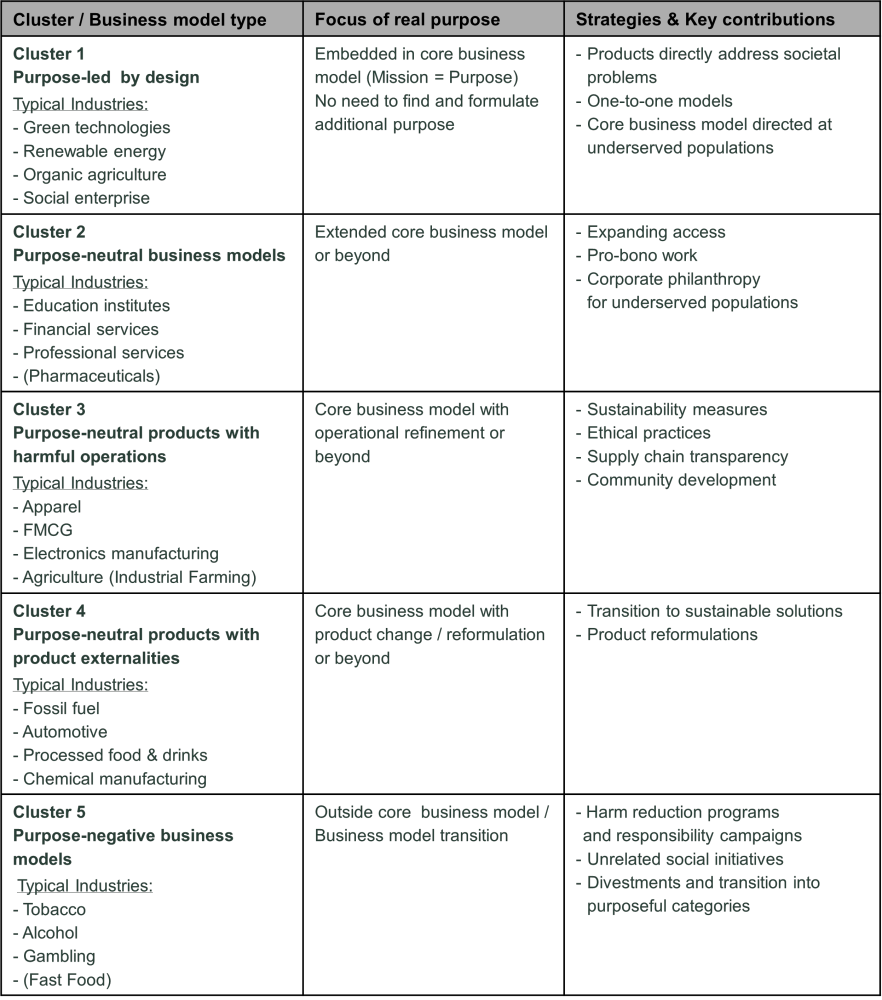
Summarizing business model type and impact on purpose
The comparison of these clusters helps illustrate the diversity in how companies address their societal responsibilities based on the nature of their business models.
It reveals how they can either inherently align with societal needs or require additional efforts to define and pursue a genuine purpose.
Some businesses are inherently purpose-driven by design, while others must extend their core operations, reorganize them, or even go beyond their core operations to make a meaningful impact.
The following table summarizes again where to find and formulate a real purpose and the corresponding strategies and key contributions:
Practical steps to refine purpose
As a founder, entrepreneur, CEO or responsible executive, ask yourself the following questions:
1. Position and Impact
- Where does my company currently fall within this framework, and what does that mean for our potential to contribute positively to society?
- Are we creating or solving societal problems? To what extent?
2. Purpose Authenticity
- Does my company pursue a genuine purpose, or are we only adhering to a pseudo purpose?
- Does our purpose statement accurately reflect and drive our full contribution potential? If not, how should we reformulate it?
3. Benchmarking and Learning
- How do we compare with the companies featured in this framework? What can we learn from their approaches and contributions?
- Are there any industry leaders outside of this framework that we should consider benchmarking against?
4. Innovation and Evolution
- What innovative steps can we take to move towards a more purpose-driven business model?
- Are there new markets, products, or services that align better with our purpose and societal needs?
5. Long-term Sustainability
- Are our current business practices sustainable in the long term, both environmentally and socially? What changes are necessary to ensure ongoing positive impact?
- How can we build resilience into our business model to adapt to future societal and environmental challenges?
6. Measuring Impact
- How do we measure the impact of our purpose-driven initiatives? Are our metrics aligned with our long-term goals?
- What benchmarks or goals should we set to ensure continuous improvement in our societal contributions?
7. Communication and Transparency
- How transparent are we with our purpose and impact? Are we clearly communicating both our successes and challenges?
- What channels and methods are we using to share our purpose-driven initiatives with the public? Are these effective?
If the answers to these questions are unclear or don’t meet your expectations, consider conducting a comprehensive audit of your company’s current purpose, business practices, and societal impact, addressing the questions above.
Engage a cross-functional team to assess alignment between your stated purpose and actual practices and in case of misalignment to reformulate or refine your purpose and/or review your goals and initiatives.