4 practical Steps to align all Stakeholders with your Purpose
In any business, stakeholders are individuals or groups with a vested interest in the company’s activities and outcomes. They can have varying degrees of influence or interests and therefore also expectations.
That’s why knowing and aligning with them when developing or reviewing the company’s purpose is crucial. Both for capturing the unique nuances that make your purpose truly yours and ensuring full internal implementation and optimal external communication.
Different Stakeholder Interests and Expectations about Purpose
From the company’s perspective, it serves both internal and external stakeholders.
1. Customers (external)
Customers are key stakeholders, primarily concerned with product fit and quality, service, and value for money. Pricing, innovation and the overall customer experience are often seen as direct reflections of the company’s commitment to delivering value. Customers and their needs are integral to the company’s business model, which is typically addressed in the company's mission.
However, modern consumers are not only concerned with product quality and service but also increasingly with the ethical stance of the companies they support. In general, they want transparency, sustainability, and social responsibility from the businesses they engage with. Consumers are 4-6 times more likely to purchase from purpose-driven companies ("Strength of purpose study" Zeno, 2020).
Therefore, when formulating a company’s purpose, it is important to understand the specific societal concerns customers have regarding the company’s products and operations, as well as what they expect in terms of the company’s particular societal contribution.
2. Regulators (external)
Regulatory bodies ensure that companies operate within legal frameworks and adhere to standards that protect public interest. Their expectations focus on compliance with laws and ethical business practices.
When a company's purpose intersects with existing regulations, it is important to understand the implications, as the purpose might address or even supersede these rules.
Additionally, having a rough understanding of why regulators issue certain regulations, their overall concerns, and their anticipated future actions provides valuable insights into how a company can align with or anticipate regulatory changes.
3. Communities (external)
Local and global communities where a company operates are increasingly important stakeholders. These groups are primarily concerned with the company’s economic, social, and environmental impacts.
Understanding the needs and challenges of these communities in detail is important if the company's purpose is community-focused. It must be informed by the positive or negative effects it has on these communities and should seek to address or mitigate them effectively.
4. The Environment (external)
While often a concern for communities, it is a distinct and broader consideration in corporate purpose. Unlike communities, which may prioritize local environmental issues among other social and economic concerns, the environment represents a systemic and overarching responsibility.
The environment’s "interest" is inherently one of protection and conservation. As it cannot safeguard itself, this responsibility has historically fallen to regulators or non-governmental organizations (NGOs), who advocate for policies and actions that ensure long-term environmental sustainability.
As the power and influence of these constituencies are limited, and because the environment is the responsibility of everyone, companies must recognize the environmental impact of their operations and incorporate sustainable practices, which often makes it a key component of their purpose.
5. Employees (internal)
Employees are deeply involved in the day-to-day operations of the company. Their expectations typically include good compensation packages, fair treatment, autonomy, opportunities for growth, and a healthy and flexible work environment. Therefore, they have an interest in the company making a profit.
However, like customers, employees also increasingly want the company to have a purpose that aligns with their personal values. The Deloitte Millennial Survey 2014: “Big demands and high expectations” revealed that more than 70% of Millennials expect their employers to focus on societal or mission-driven problems.
6. Investors (internal)
Investors have traditionally been a highly influential stakeholder group, primarily interested in a company's financial performance and ability to generate returns.
However, over the last decade, they have increasingly recognized that companies with a clear, purpose-driven strategy are better positioned for long-term success. By now, even investors are increasingly interested in whether a company has and pursues a purpose and how it aligns with ESG-criteria.
Stakeholder alignment ensures credibility and support
Understanding and integrating these diverse perspectives of stakeholders is important when identifying, defining, or reformulating a company's purpose, as this ensures that the resulting purpose aligns with their interests, ultimately garnering their support. Stakeholder alignment ensures:
- Eliminating blind spots: By considering the perspectives of all stakeholders, companies can avoid the risk of overlooking critical issues. A purpose informed by diverse stakeholder insights is less likely to miss emerging challenges or opportunities.
- Making the purpose truly yours: The different perspectives and interests help to uncover the nuances that make your company’s identity genuinely unique, ensuring its purpose statement is shaped by shared values and real-world experiences. This level of authenticity reinforces why your company exists and how it creates meaningful value for all involved.
- Building trust and credibility: When stakeholders see their values and concerns reflected in a company’s purpose, it strengthens their trust in the organization. This trust is foundational, helping to establish the company’s credibility and securing long-term support from all stakeholder groups.
- Increasing relevance and resilience: A purpose that aligns with stakeholder expectations is more likely to remain relevant over time.
Shift towards a balanced Stakeholder view
It also becomes clear that these interests must be balanced between the stakeholders, otherwise the company risks creating conflicts, undermining its credibility, and ultimately losing their support.
By defining its purpose through the lens of all stakeholders - not just shareholders- a company automatically balances its societal contributions with its profit ambitions. In fact, it’s the focus on satisfying customer and employee needs that drives profits, ultimately meeting shareholder expectations.
This notion of a balanced stakeholder view is comparatively new.
For much of the 20th century, Milton Friedman’s shareholder primacy doctrine, published as an article on September 13, 1970, in The New York Times Magazine, dominated corporate governance, advocating that the sole responsibility of a company was
a) to make a profit (and leave societal responsibility to governments)
b) to maximize shareholder value
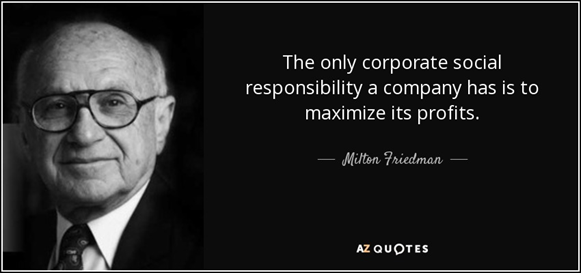
According to this view, profit generation was seen as the primary measure of a company’s success, under the belief that it would ultimately benefit society.
However, this shareholder-centric approach has become increasingly controversial, especially regarding the advancing and accelerating social and environmental problems humanity faces.
Critics argue that it neglects the broader impact of corporate actions on society and the environment, leading to a narrow focus that results in environmental degradation and social inequality or even corresponding corporate scandals such as the Volkswagen emissions fraud (“Dieselgate”), the BP Deepwater Horizon oil spill, or Enron’s and Wells Fargo’s account fraud where this aggressive profit orientation even led companies to cut corners.
These cases may be extreme and unrepresentative exceptions, however, prioritizing profits and the shareholder perspective above all often leads companies to engage in e.g. disproportionate cost-cutting measures that exploit labor or curtail investment that then later stifle innovation, ignore community needs, degrade natural resources, and cause excessive pollution.
It has also incentivized companies to adopt compensation schemes that have drastically widened the income gap (e.g. CEO-to-worker pay ratio in the US has skyrocketed 1’600% from 21:1 in 1965 to 351:1 in 2020, Economic Policy Institute, August 10, 2021).
This approach exacerbates environmental harm, leading to climate change, and deepens social inequalities, then leading to a range of additional, well-researched and undisputed problems such as reduced social mobility, poorer health outcomes, increased crime rates, educational disparities, political instability and polarization and even economic inefficiency.
These are all clearly attributable externalities that are not reflected in the company’s profit and loss statements, leading to a one-sided and distorted picture that overlooks the broader impacts of corporate actions. As early as 1994, John Elkington, a British business consultant and sustainability advocate, proposed the so-called Triple Bottom Line (TBL) approach, which expands the focus beyond financial performance to include social and environmental responsibility. This approach has since influenced and been modified and integrated into frameworks like ESG reporting standards, which are now widely adopted.
Furthermore, the doctrine is built on the flawed assumption of infinite growth, simply ignoring the reality of finite resources on which capitalism currently depends. These resources, such as fossil fuels, minerals, wood, water, and arable land, are essential for sustaining economic activity, but de facto by now they are being depleted at an unsustainable rate.
Given the current state of affairs, particularly in relation to climate change, its underlying causes, and looming consequences, it is evident that corporate actions cannot continue in the same manner as they historically have.
Climate change, for instance, is a highly complex and systemic problem, both caused and mitigated by multiple, interrelated, and often mutually reinforcing factors that span various domains. These include industrial practices, population growth, and resource use on one hand, and technological developments, regulatory frameworks, and a general shift in consciousness on the other.
This challenge cannot be solved by governments alone as suggested by Milton Friedman; it requires a concerted effort involving companies working in cooperation with their supply chains, NGOs, the scientific community, governments, regulators, and, of course, consumers.
In response to all that (especially in Europe, where the shareholder focus was never as pronounced as in the Anglo-Saxon culture), there has been a significant shift toward a more balanced stakeholder view, which acknowledges the importance of considering the interests of all stakeholders—not just shareholders.
Investors themselves prefer Purpose-driven Companies
Moreover, as briefly mentioned above, investors themselves have increasingly shifted their views and attitudes towards purpose and ESG, either due to a growing sense of responsibility or because their profit-driven focus and unique position allow them to recognize the positive impact a well-defined purpose can have on profitability.
Prominent figures like Larry Fink, CEO of BlackRock with $10.6 trillion in assets under management (AUM), the world’s largest asset management firm, along with other influential investors such as Ray Dalio, founder of Bridgewater Associates, and Bill Ackman, CEO of Pershing Square Capital Management, are actively promoting or even requiring companies to follow ESG and purpose-driven strategies.
In his famous annual letters to CEOs, Fink has repeatedly emphasized the importance of companies having a clear sense of purpose and addressing social and environmental issues as part of their long-term strategy. In his 2018 letter, Fink stated, “Society is demanding that companies, both public and private, serve a social purpose. To prosper over time, every company must not only deliver financial performance but also show how it makes a positive contribution to society.”
This does not fall on deaf ears, as CEOs themselves (often being also shareholders) have a very clear opinion.
The 2020 McKinsey article “Purpose: Shifting from why to how” cited the 2019 Fortune 500 CEO Survey according to which “only 7 percent of Fortune 500 CEOs believe their companies should mainly focus on making profits and not be distracted by social goals.”
In August 2019, the Business Roundtable, an organization consisting of 181 top global CEOs, including the leaders of companies like Apple, Walmart, Amazon, American Express, BP, ExxonMobil, and Goldman Sachs, issued an open letter that repudiated the view that the business of business is merely the chase for profit with statements such as “We foster diversity and inclusion, dignity and respect” and “We respect the people in our communities and protect the environment by embracing sustainable practices across our businesses.”
Research by author and professor Raj Sisodia suggests that purpose-led companies significantly outperformed the S&P 500 between 1996 and 2011 (R. Sisodia, J. Sheth, D. Wolfe, Firms of Endearment: How World-Class Companies Profit from Passion and Purpose, 2014).
More than 2,000 academic studies have examined the impact of environmental, social, and governance propositions on equity returns, and 63 percent of them found positive results versus only 8 percent that were negative (Gunnar Friede “ESG and financial performance: Aggregated evidence from more than 2000 empirical studies”, Journal of Sustainable Finance & Investment, October 2015).
Although the evidence is very clear, investors’ skepticism shifted only gradually, but it shifted. In his insightful 2021 book “Purpose + Profit - How Business can Lift Up The World”, HBS Professor George Serafeim presents research on Wall Street analysts’ recommendations that shows the shift in optimism from the 90’s to 2007.
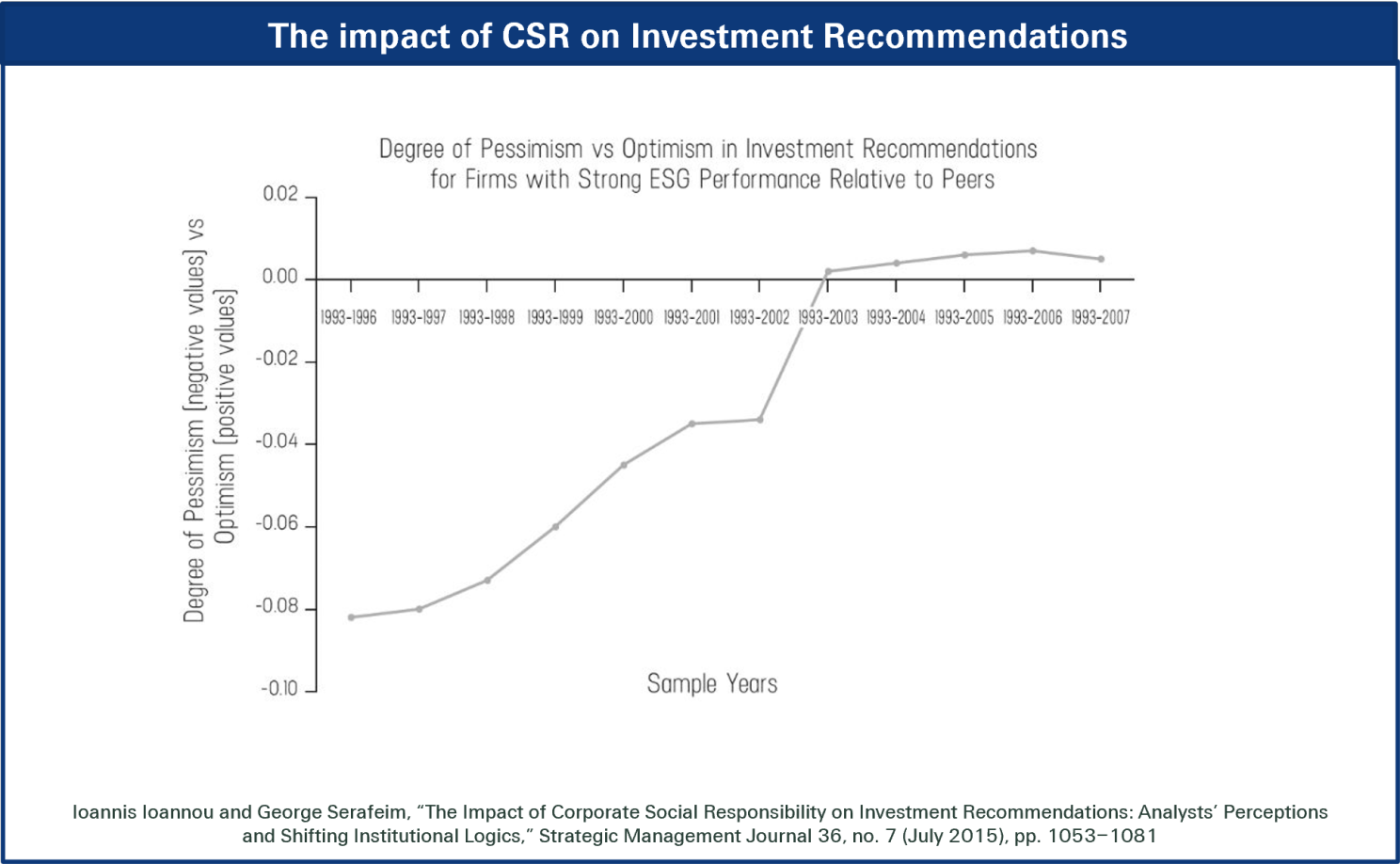
Purpose-led companies, previously undervalued, are now often seen as more innovative, resilient, and capable of sustainable growth.
Concrete questions to be answered
To ensure that the company’s purpose is aligned with and reflects a balanced stakeholder view, analyze, discuss and answer the following questions:
- Who are our key stakeholders, and what are their primary concerns and expectations?
- How do we prioritize them in order to balance their interests when defining our purpose?
- What long-term trends in stakeholder expectations should we consider in our purpose formulation?
- How do our stakeholders perceive our current purpose, and how well does it resonate with their values?
- What potential conflicts of interest exist among our stakeholders, and how can we balance them in our purpose?
- When and to what extent should we integrate them in the process?
Besides this perspective shift and anticipating how contributions in various areas will align with the interests of different stakeholder groups, the company should also engage directly with stakeholders to discuss these matters.
Process for Engaging & Aligning Stakeholders
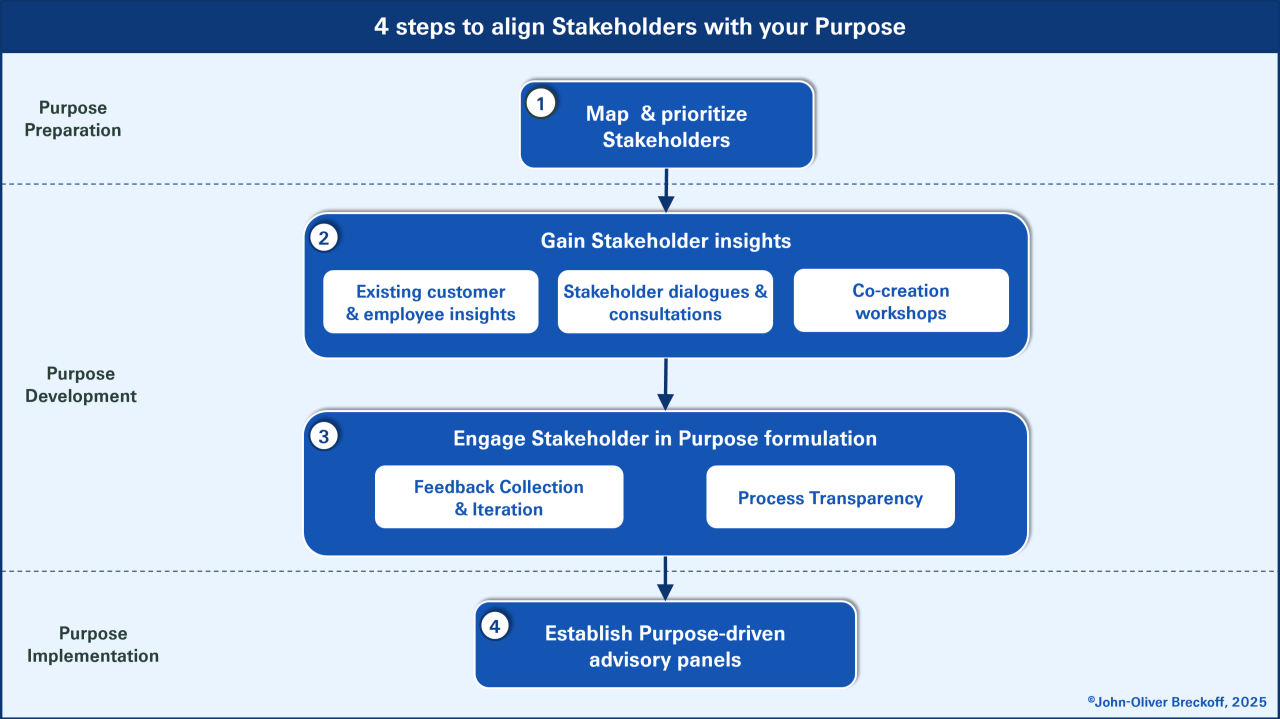
The following graphic depicts a practical 4-step process and concrete formats on how to involve stakeholders when defining and implementing your company’s purpose.
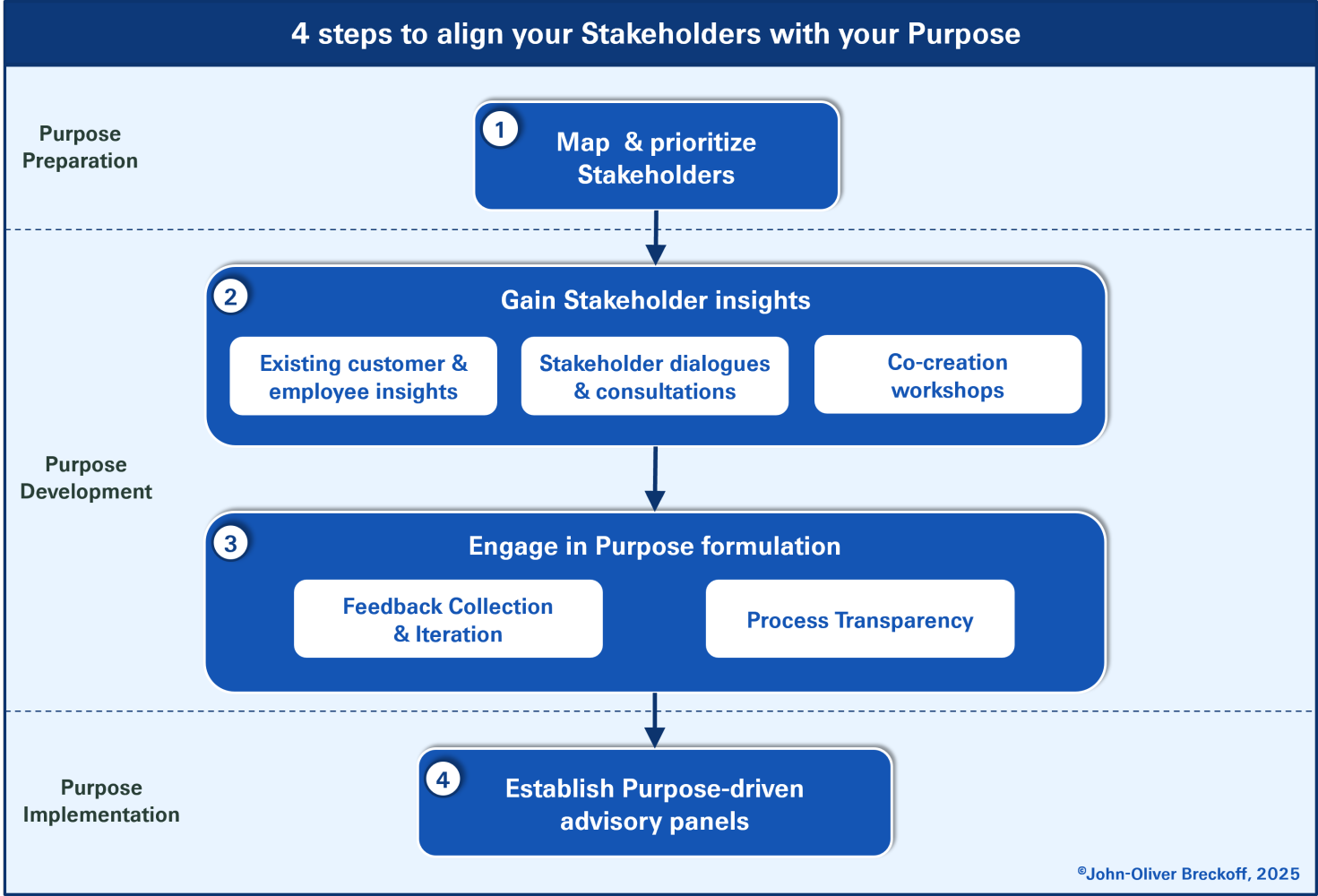
Depending on the degree and moment the company wishes to integrate their feedback, step 2 can be adjusted or expanded upon to ensure that stakeholders feel meaningfully involved throughout the process.
Early engagement may focus on gathering broad insights, while later stages may prioritize refining the purpose based on more detailed feedback and co-creation activities.
1. Map & prioritize Stakeholders: Begin by identifying all relevant stakeholders and prioritizing those whose values, needs, and expectations should be central to the company’s purpose.
2. Gain stakeholder insights
a. Customer-centric & employee insights: Use already collected customer and employee data and direct feedback to understand what values resonate with your customers and employees.
b. Stakeholder dialogues & consultations: Then organize structured engagements like interviews, surveys, and focus groups to gather first insights into what matters most to stakeholders. Ask general and open questions like:
- What value do you believe the company brings to the world?
- What role should the company play in addressing social, environmental, or economic issues?
- How can the company better align its activities with your needs and values?
- What products and services would you expect? What would a ranking of our current products and services according to the purpose “xyz” look like?
c. Co-creation workshops: Then engage a diverse group of most important stakeholders in workshops where they can collaboratively explore the company’s vision and purpose. These workshops can help distill common themes and shared values that reflect both stakeholder interests and the company's ambitions.
Instead of entirely co-creating you can also discuss and work on purpose versions that have been roughly designed internally beforehand.
3. Engage in Purpose formulation
a. Feedback and iteration: After developing an initial draft of the purpose, share it with selected stakeholders for feedback. This can be done through public forums, company-wide meetings, or even targeted discussions with key stakeholder groups. Their feedback will help refine and ensure the purpose is credible, meaningful, and inclusive.
b. Transparency in purpose formulation: Keep stakeholders informed about the process of defining the purpose. Be clear about how their input will be used and how the final purpose reflects their values and expectations. This builds trust and demonstrates that the purpose is not just a top-down initiative but a collective effort.
4. Establish Purpose-driven advisory panels: In a next step, consider establishing advisory panels that include key stakeholders (e.g., community leaders, employee representatives, customer advocates) to advise the leadership team on implementation and execution-related matters. This guarantees the purpose is actually being implemented and is unfolding its intended effect.
Conclusion
By integrating diverse stakeholder perspectives, businesses can make sure that their purpose resonates across their entire ecosystem, driving trust, credibility, and support. This shift from a pure shareholder-centric to a balanced stakeholder view is important, as it helps companies align their societal contributions with profit ambitions, creating a more sustainable, inclusive and responsible approach to growth.
Moreover, investors are shifting their perspective themselves, underscoring the growing importance of purpose-driven strategies. Prominent investors now recognize that companies with a clear purpose are more innovative, resilient, and capable of long-term success. Aligning with ESG criteria and incorporating societal contributions into business practices has become a decisive factor for investment decisions.
To achieve this, companies should follow a structured process to engage and align stakeholders. The four steps – 1. Map & prioritize stakeholders, 2. Gain stakeholder insights, 3. Engage in Purpose formulation and 4. Establish Purpose-driven advisory panels - ensure meaningful involvement and foster shared ownership.
Should companies focus on generating profits only and leave societal matters to politics and NGOs? If not, how can they best take responsibility?