
Learn how Tesla & Apple align their Purpose with Core Competencies – And consistently reshape Industries and outperform their Markets!
As shown by studies multiple times, having and genuinely pursuing a purpose is better than having none (see my article “4 Reasons high-impact Entrepreneurs and CEOs have a purpose”)
However, for a company to achieve meaningful impact and sustained market leadership, its purpose must be in alignment with its core competencies - the unique strengths and capabilities that set it apart from competitors. When these two elements work together in synergy, they create a powerful engine for innovation, competitive advantage, and therefore increased profitability.
Vice versa, when they don’t, it can hinder the purpose’s ability to “pull” the company to fully leverage its potential, leading to missed opportunities and a diminished impact in the market and society.
Core competencies are therefore an important factor (1 out of 4) to define a company’s purpose that fits with its uniqueness and sets it apart.
But what exactly are core competencies and how do they differ from a simple strength?
Core Competence Fit
Core competence refers to the uniquely orchestrated combination of resources & capabilities that competitors cannot easily replicate or substitute and that form the basis for the company’s core products (e.g. Apple’s operating system or Google’s search algorithm) and end products (e.g. “Mac” computer or “iPhone” or “Google Search”).
These competencies are not just technical abilities; they encompass organizational culture, brand reputation, customer relationships, and the ability to innovate. They represent what the company does best and are often deliberately developed over years of investment in technology, talent, and processes and are foundational for the company’s potential competitive advantage.
In fact, the concept of core competency is foundational for the entire strategic paradigm of the so-called “Resource-based View” (see my article “How to use Vision & Purpose to win in any Market!”)
How Tesla’s Core Competencies power its Purpose
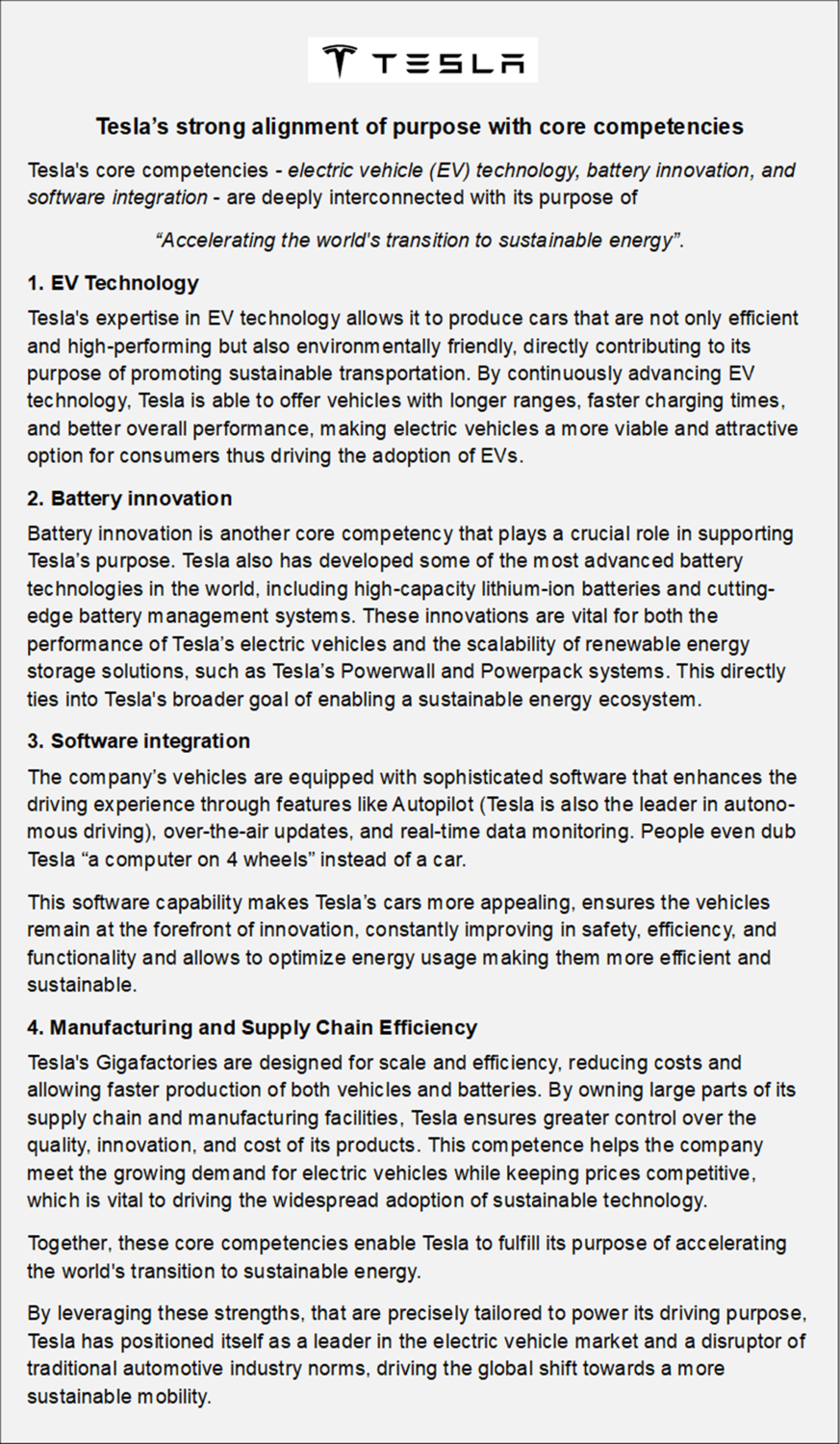
Tesla as a clearly purpose-driven company and by far the most valuable car manufacturer (No. 14 among the most valuable companies with a market cap of 571 billion dollars, far ahead of Toyota with 291 billion ranked 31) is an instructive example of how a successful purpose that really drives a company forward is strongly intertwined with that company’s core competencies.
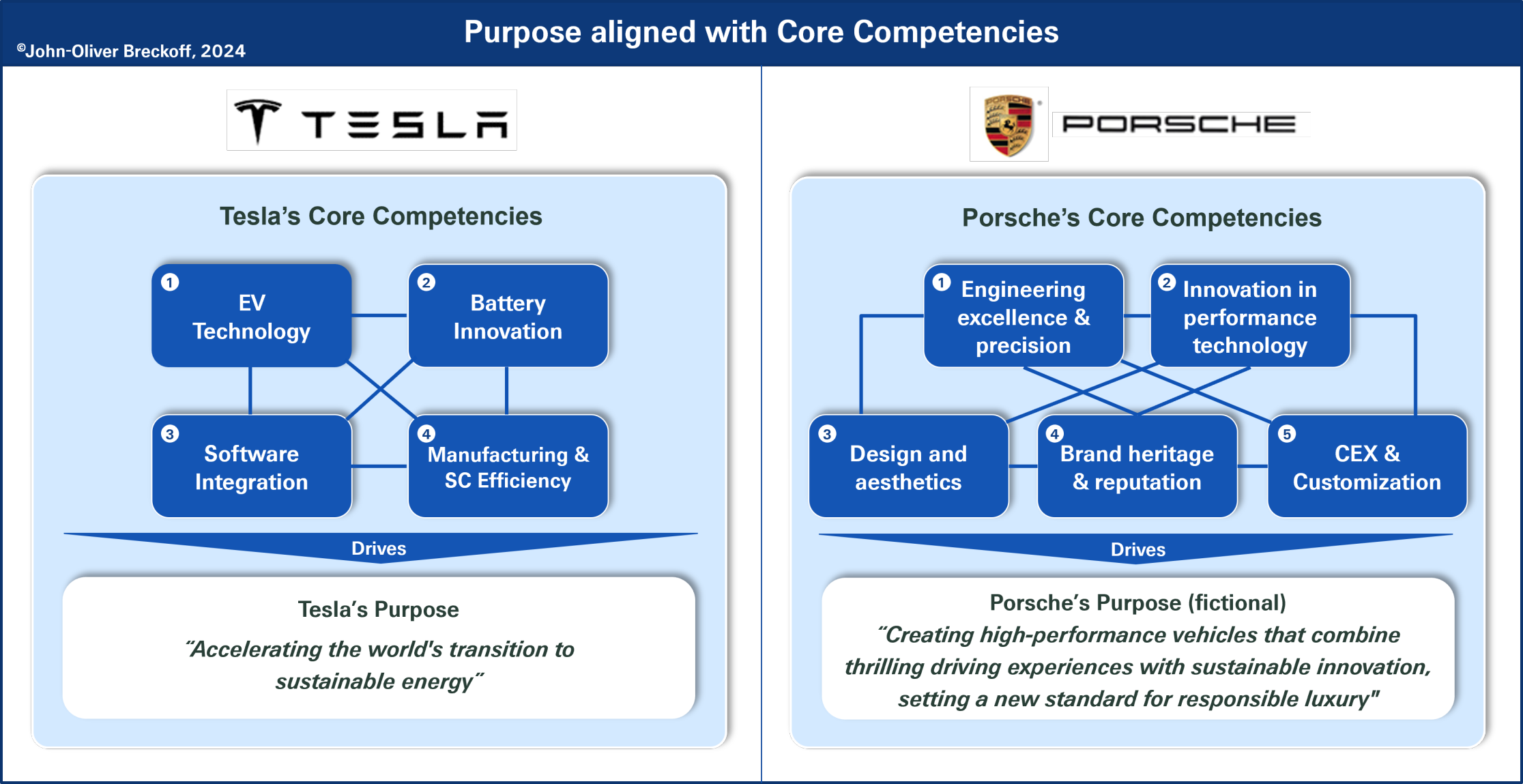
Let's look at Tesla’s core competencies and how they power its purpose:
Porsche’s potential Purpose infused by its Core Competencies
If we contrast that, for example, with Porsche, which doesn’t have a purpose statement, it becomes immediately clear that its core competencies are vastly different from those of Tesla.
Porsche’s core competencies probably revolve around:
- Engineering excellence and precision: Porsche is renowned for its engineering expertise, particularly in the development of high-performance engines, transmissions, and chassis. This precision engineering results in vehicles that offer exceptional performance, handling, and driving dynamics, which are core to the brand's identity.
- Brand heritage and reputation: Porsche has a strong brand heritage rooted in motorsports and luxury performance vehicles. The brand’s reputation for quality, exclusivity, and a deep connection to automotive enthusiasts is a significant core competency that sets Porsche apart in the luxury car market.
- Innovation in performance technology: Porsche consistently integrates cutting-edge technology into its vehicles, including advancements in aerodynamics, lightweight materials, and hybrid/electric powertrains. This commitment to innovation ensures that Porsche vehicles remain at the forefront of performance and efficiency.
- Design and aesthetics: Porsche’s design philosophy combines functionality with iconic visual and sound aesthetics. The brand’s ability to design cars that are instantly recognizable and timeless (its iconic 6-cylinder boxer engine sound, the classic front headlights) while maintaining aerodynamic efficiency is a core competency that reinforces its luxury and performance status.
- Customer experience and customization: Porsche offers a highly personalized customer experience, including extensive customization options for vehicles. This ability to tailor products to individual preferences enhances customer loyalty and positions Porsche as a brand that caters to the unique desires of its clientele.
While these are impressive or even inspiring capabilities, it’s obvious that they are very different and much less geared towards environmental conservation than those of Tesla.
Unlike Tesla, Porsche cannot credibly claim to be “accelerating the world's transition to sustainable energy”, and it shouldn’t.
Nevertheless, Porsche, like all automotive companies, has made huge efforts in EVs. “Balance-sheet CO₂-neutral value chain” and “best in class ESG-rating” are 2 of its 8 strategic top goals in its 2030 strategy published on its website (see below).
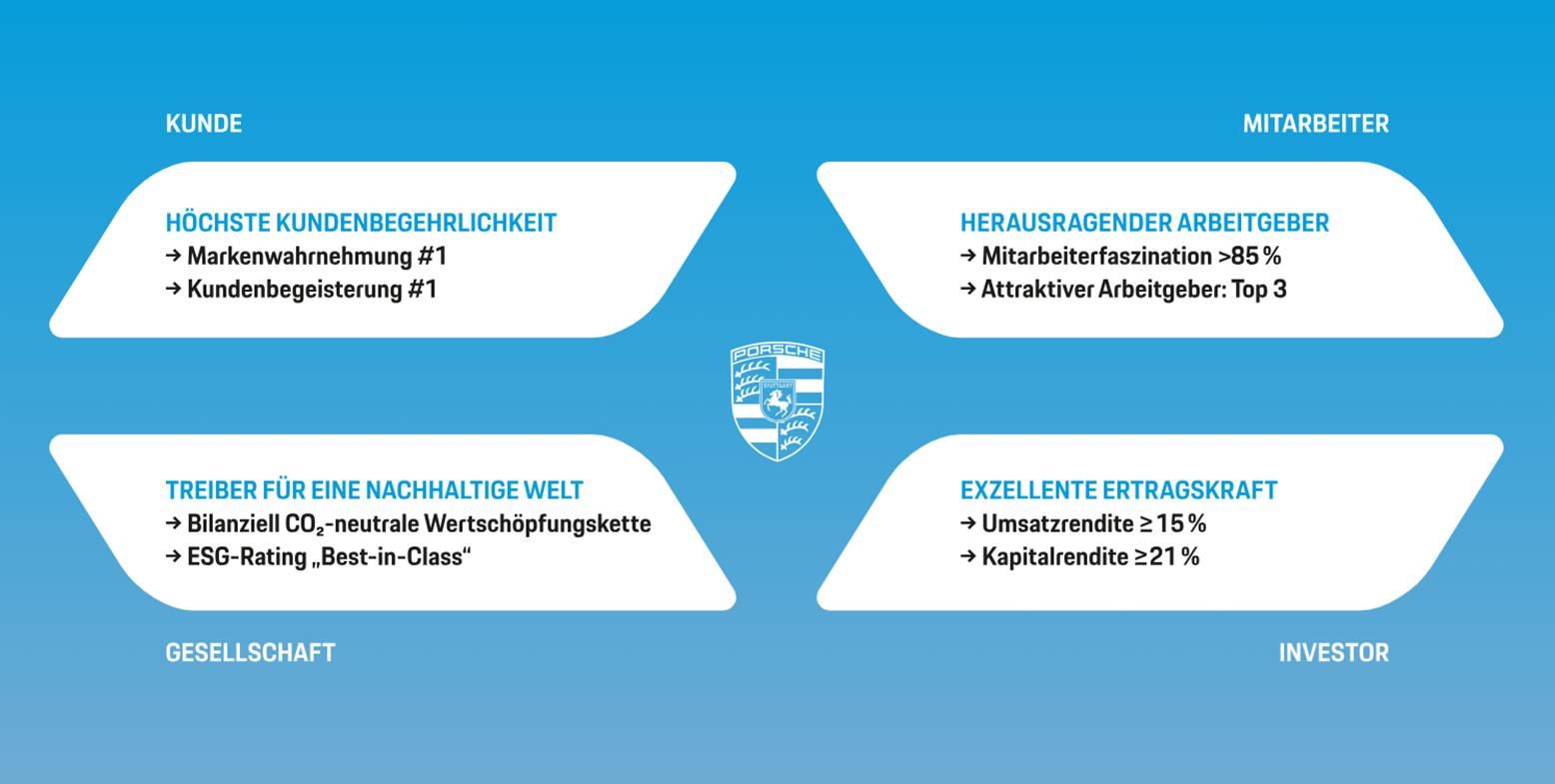
It's important to note that these sustainability goals aren't "buried" or isolated in Porsche's ESG-strategy but are just as important as the client, employee and investor top goals figuring in Porsche's overall strategy. Porsche, known for its long-term strategic outlook ("long term growth" and "sustainable profitability") clearly commits to a balanced stakeholder approach and a contribution to the "Gesellschaft" (society) in the form of ambitious or even "aggressive" environmental goals. In that third out of 4 areas where Porsche sets strategic goals, it aims to be a "Driver for a sustainable world".
To reflect, and further push this strategic direction, attract younger generation top talent and new – maybe more environmentally conscious – customer segments, the company could formulate a purpose statement that reads:
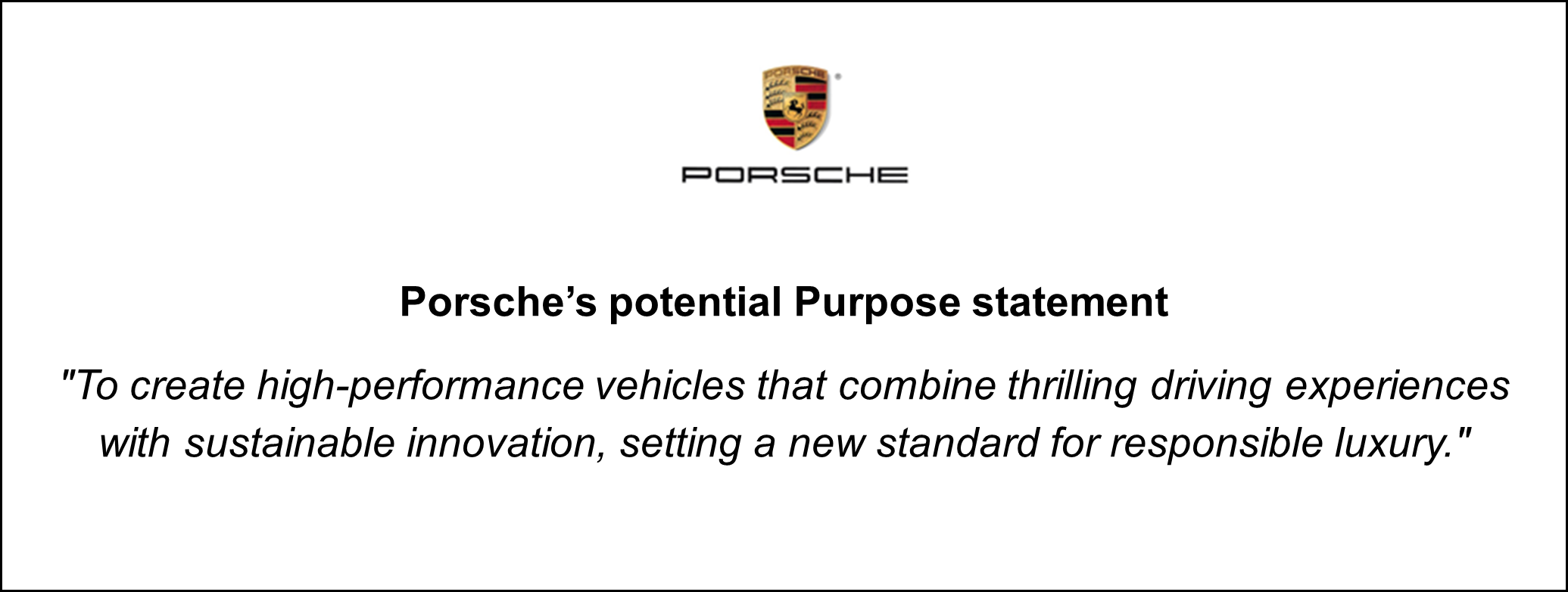
This purpose reflects both Porsche’s commitment to society and its deeply embedded core competencies.
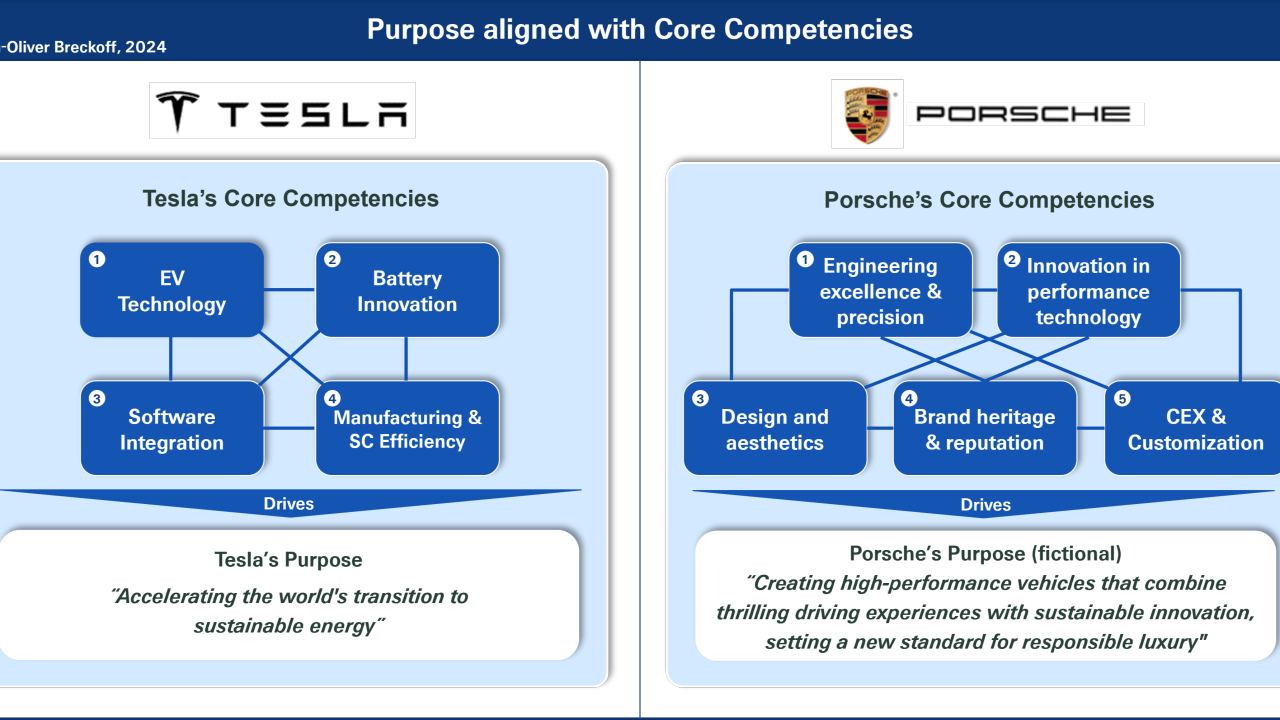
The subsequent graphic directly compares and contrasts Tesla's and Porsche’s core competencies and depicts how players in the same industry can infuse them to differentiate their purpose that reflects their unique strengths.
How Apple’s core competencies power its purpose
Apple is another showcase where purpose perfectly links with core competencies (although admittedly Apple’s purpose is not the best example of actually addressing societal problems or promoting human values).
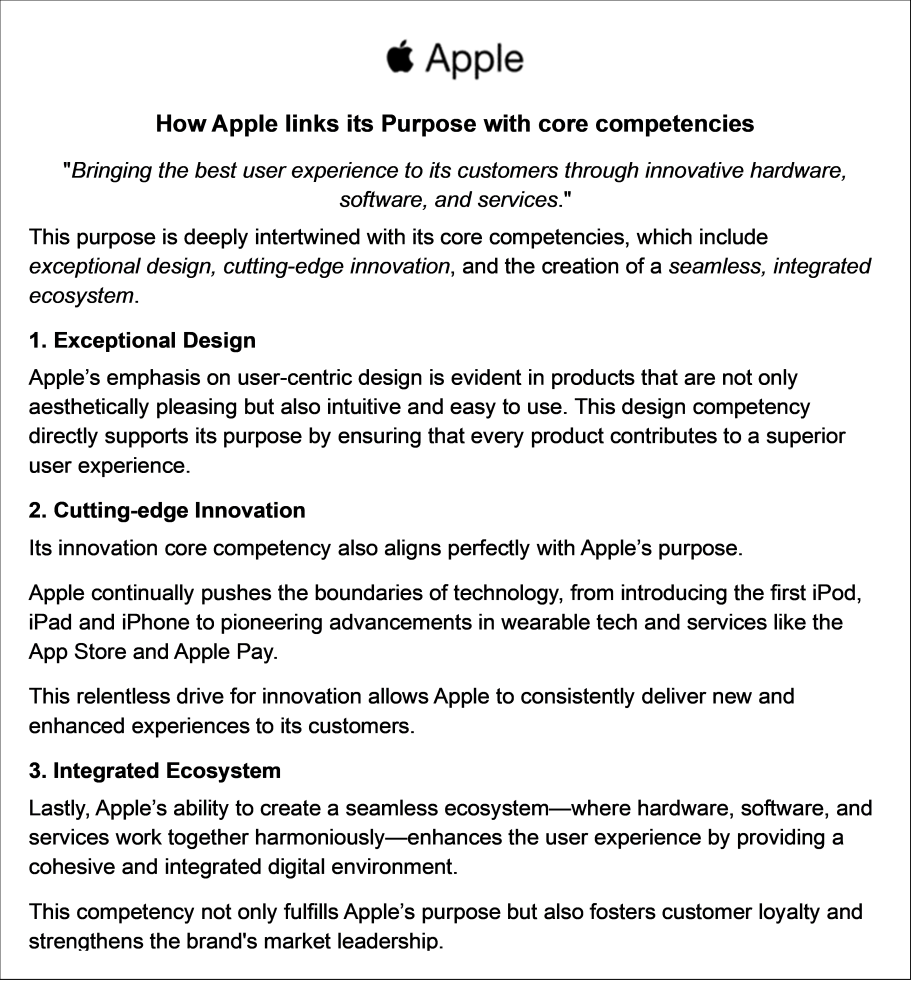
The synergy between Apple’s core competencies and its purpose has led to sustained success, enabling the company for almost 5 decades to set industry standards and shape market trends rather than just follow them.
Purpose and core competence must be aligned. This alignment leverages the company’s strengths and can create a synergy that drives innovation, customer loyalty, and industry leadership, positioning the company for long-term success and meaningful market impact.
Concrete questions to be answered
To put these insights into action, analyze, discuss and answer the following questions:
- What are our core competencies?
- Is our existing or to be defined purpose actually aligned with our core competencies?
- If not, how should we define or refine it so that it fully leverages our strengths?
- If our purpose is clear and desired, but our competencies aren’t fully supporting it, what are the necessary capabilities to be developed or enhanced?
- Where do or should our purpose and core competencies meet?
- What can we copy, adapt or learn from the presented cases?
To what degree is your company’s purpose aligned with its core competencies?