
How to use Vision & Purpose to win in any Market!
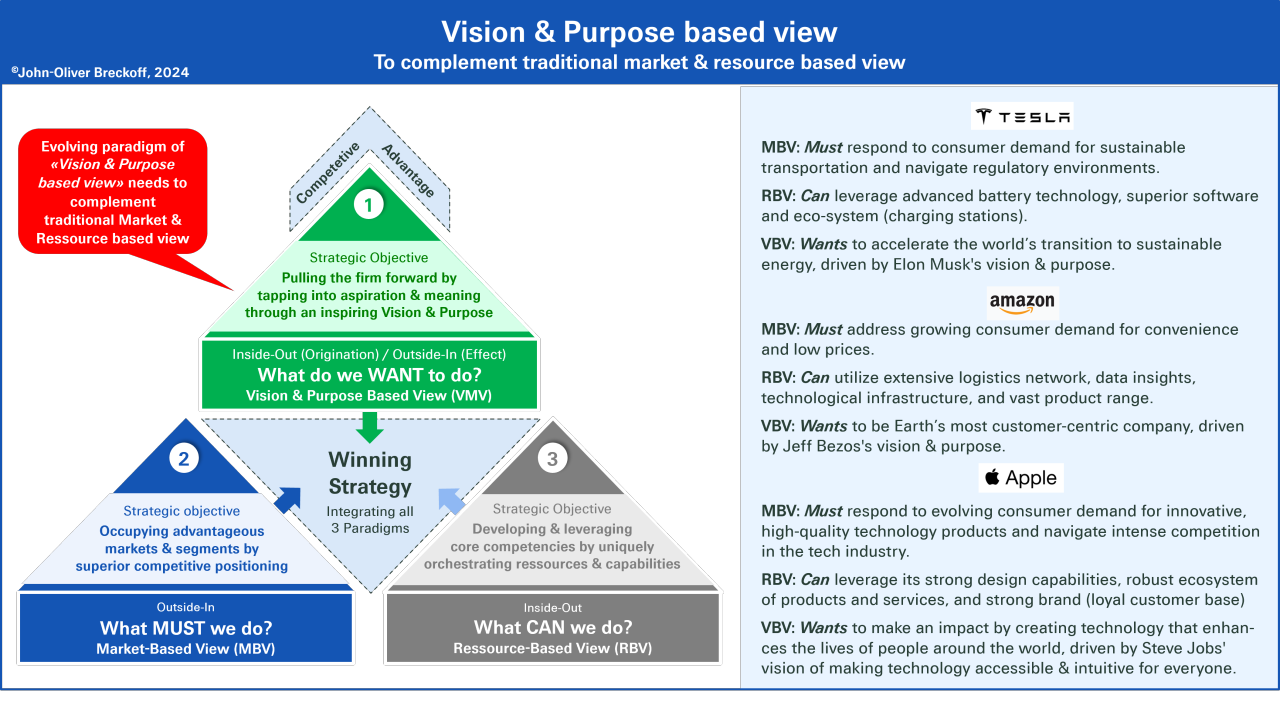
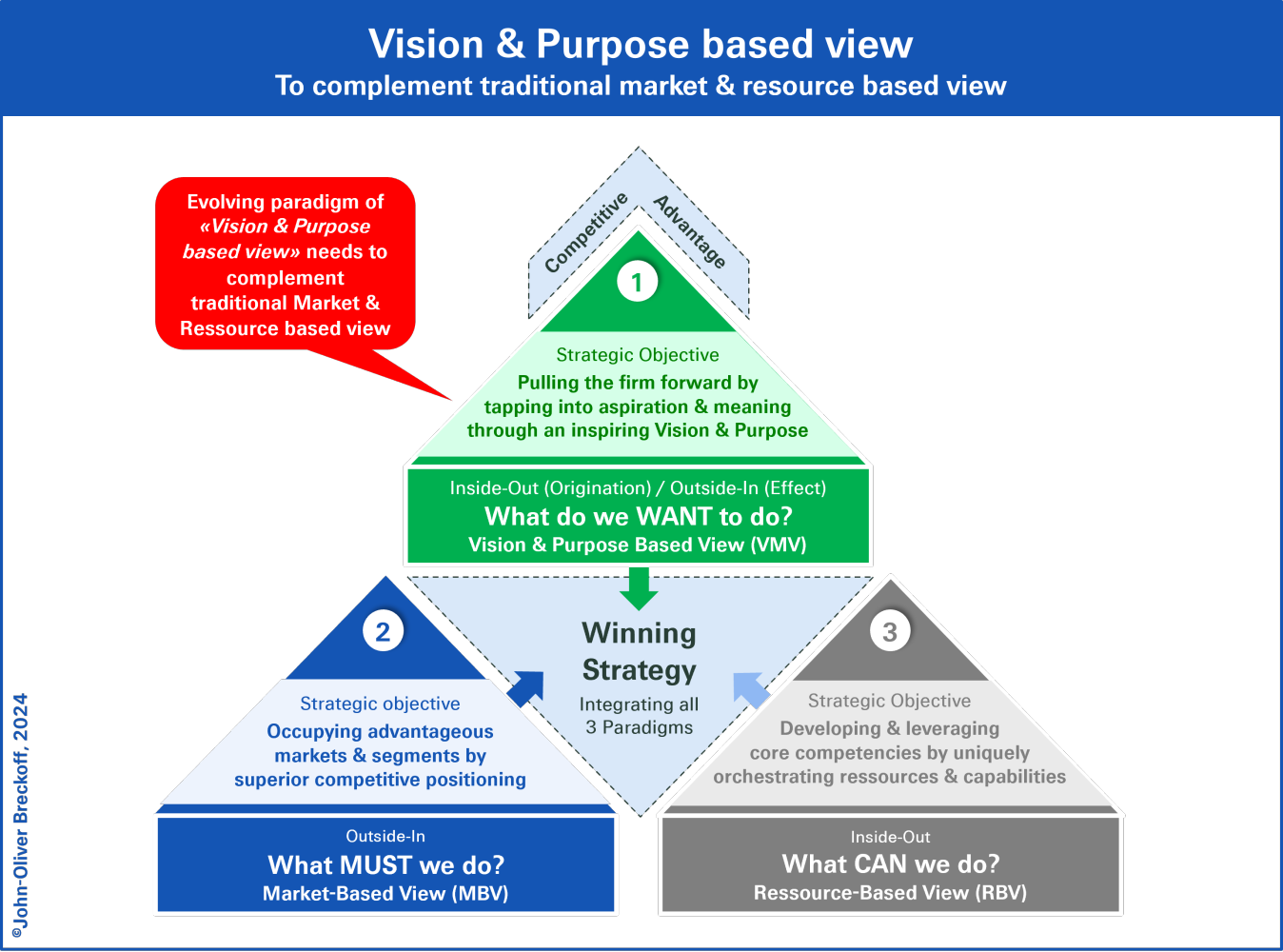
Traditionally, the success of a winning strategy has been (retrospectively) explained by the so-called “Market-based” or “Resource-based” view. Based on Apple's, Amazon's and Tesla's fundamental strategic orientation, I will show why and how these 2 paradigms need to be complemented by a "Vision & Purpose-based view" to create a winning strategy.
1. The “Market-based view” (MBV)
The “Market-based view” (MBV) is an Outside-In approach that looks at the external environment of the firm, particularly the industry's structure, markets and the competitive forces within it.
It’s about a strategic choice of attractive
- Markets
- client segments
- positioning opponents and
- service & product offerings
based on analyzing and understanding market trends, customer needs, and competitive dynamics.
The strategic objective of the MBV could be distilled as:
Gaining competitive advantage through occupying advantageous (=less competitive and therefore more profitable) markets and segments by superior competitive positioning
Example: A company analyzing industry trends to decide whether to enter a new or exit an old market, focusing on external factors like competitor actions, market size, and customer preferences.
Foundational proponents, among many others, are e.g.
- Michael Porter with frameworks to analyze industries like “5-Forces” (1979), “Value chain” (1985) or strategic concepts like “Focusing”, “Differentiation” or “Cost Leadership” (Generic strategies, 1980)
- Al Ries and Jack Trout with their seminal concept of “Positioning” (1981) emphasizing the importance of creating a distinct image in the minds of consumers relative to competitors.
- W. Chan Kim and Renée Mauborgne with their “Blue Ocean Strategy” (Harvard Business Review 1999, book 2005) and the underlying idea of creating uncontested market space ("blue oceans") rather than competing in saturated markets ("red oceans"), by redefining positioning dimensions.
Unless you’re a market shaper, the market forces you to adapt your strategic choices by exploiting market opportunities and mitigating threats. The Market-based view therefore answers the question “What MUST we do”.
2. The “Resource-based view” (RBV)
Conversely, the “Resource-based view” (RBV) is an Inside-Out approach that looks at the internal resources and capabilities of the firm, viewing them as the primary source of competitive advantage. For resources to provide a sustainable competitive advantage, they must be valuable, rare, inimitable, and organized to capture value.
The strategic objective of the RBV could be distilled as:
Gaining competitive advantage through developing & leveraging "Core competencies" by uniquely orchestrating resources & capabilities that competitors cannot easily replicate or substitute
Example: A technology company investing in research and development to create proprietary technology that competitors cannot easily replicate, thus ensuring a competitive edge in innovation.
Foundational proponents, among many others, are e.g.
- Edith Penrose’s "The Theory of the Growth of the Firm" (1959). Laying the groundwork for RBV with the conceptualization of firms as collections of productive resources, emphasizing internal growth and resource utilization
- Gary Hamel and C.K. Prahalad with their groundbreaking "The Core Competence of the Corporation" (1990), introducing the idea that firms should focus on their “core competencies”, which are a combination of unique and therefore inimitable capabilities, that provide competitive advantage but are often scattered across SBU boundaries and are therefore not systematically leveraged.
- Jay Barney's "Firm Resources and Sustained Competitive Advantage" (1991) introducing the VRIO Framework (valuable, rare, inimitable, organized) to evaluate companies’ resources as appropriate to build a competitive advantage.
- David J. Teece, Gary Pisano, and Amy Shuen with "Dynamic Capabilities and Strategic Management" (1997) as the firm's ability to continuously integrate, build, adapt and reconfigure internal and external resources to sustain a fragile competitive advantage.
The “Resource-based view” answers the question “What are we able to do, or what CAN we do” with our internal resources.
3. The “Vision & Purpose-based view” (VBV)
However, it seems like the remarkable success of companies like Apple, Amazon, and Tesla cannot be fully explained by the “Resource and Market-based view” alone, since their successes are too outstanding:
- Apple is not only the second biggest company in the world (Market Cap), it has become THE iconic role model company for design leadership and innovation both in strategy, business model and product
- Amazon’s outstanding profitability and size of market share in the very competitive and low margin retail industry and the successful creation of ever new business models has made it the 6th most valuable company (Market cap of 1880 billion dollars) and made its founder, Jeff Bezos, the richest man in the world (now second)
- Tesla’s meteoric rise within only 20 years has made it by far the most valuable (No. 14 among the most valuable companies with a market cap of 571 billion dollars, far ahead of Toyota with 291 billion ranked 31) and most talked about automobile company and its founder Elon Musk the second richest man in the world (now third)
While these traditional frameworks played a role, the achievements of these iconic companies transcend the confines of mere resources and market positioning. Instead, it is the role and effect of “Vision & Purpose” that provides a crucial missing piece to understanding their transformative impact on industries and society.
Apple's dominance, for instance, extends far beyond its innovative products and design capabilities (RBV). At its core, Apple embodies a vision of revolutionizing the way we interact with technology, making it intuitive, elegant, and deeply personal. This vision, coupled with a purpose of empowering creativity and self-expression, has cultivated a fervent global following that extends beyond mere customers – they are advocates and evangelists.
Amazon's triumph over traditional retailers cannot be solely attributed to its operational efficiencies and distribution networks (RBV) or its online market strategy (MBV). Amazon's visionary pursuit of being "Earth's most customer-centric company" has driven relentless innovation, from Prime membership to cloud computing services, to marketplace, constantly redefining customer expectations and experiences.
Tesla's meteoric rise challenges the notion that success hinges solely on traditional automotive industry resources and capabilities like lean manufacturing (RBV), as Toyota is the undisputed leader in lean management, or competitive positioning in the electric vehicle market (MBV), as all of the automobile companies target and invest heavily in this market. Elon Musk's audacious vision of accelerating the world's transition to sustainable energy, and the company's higher purpose of combating climate change, have galvanized a passionate customer base and inspired a broader cultural shift towards eco-consciousness.
These companies' success stories underscore the profound impact of a compelling vision and meaningful purpose – elements that transcend the confines of traditional strategic frameworks. While RBV and MBV provide valuable lenses, they alone cannot fully capture the transformative power of a company that taps into deeper human aspirations and emotions by applying the VBV.
The “Vision & Purpose-based view” (VBV) is not a formally defined framework, but I see it as an emerging concept that recognizes the profound motivational impact of a well-articulated Vision and Purpose.
It is an Inside-Out/Outside-In approach where a Vision & Purpose is internally set (by the founder or CEO) but then creates its pulling effect on the organization from the outside.
The strategic objective of the VBV could be distilled as:
Gaining competitive advantage through pulling the company forward by tapping into aspiration & meaning with an inspiring Vision & Purpose
Foundational proponents could be seen in:
- Gary Hamel and C.K. Prahalad: "Strategic Intent" (1989). Hamel and Prahalad introduced the idea of "Strategic intent", which involves setting a clear and compelling vision that stretches the organization’s resources and capabilities towards achieving long-term competitive advantage.
- James Collins and Jerry Porras: "Built to Last: Successful Habits of Visionary Companies" (1994). Collins and Porras emphasize the role of a clear and compelling vision in building enduring companies. They introduced the concept of BHAGs (Big Hairy Audacious Goals), which are ambitious long-term goals that inspire and motivate employees and stakeholders.
- Ranjay Gulati "Deep Purpose: The Heart and Soul of High-Performance Companies” (2022) describing the transformative power that a deeply ingrained sense of purpose can wield within organizations, leading to sustained high performance over time.
- Paul Polman and Andrew Winston “Net Positive: How courageous companies thrive by giving more than they take" (2021), which includes various case studies and examples of different companies such as Unilever, Ikea, Microsoft and Patagonia that have implemented net positive principles and achieved outstanding success with long-term orientation, purpose-driven leadership and innovative business models that prioritize sustainability and social responsibility.
The "Vision & purpose" paradigm is deeply based on and reflects the convictions and desires of the founders (or CEOs) of the companies. It is not based on what a market dictates (“What must we do”) or what their company is able to do now (“What can we do”), it is based on what they see and want for the company and the world (“What do we want to do”).
Integrating MBV, RBV and VBV into a holistic strategy
Obviously, a “Vision & Purpose-based view” alone cannot replace a "Market or Resource" based view. Rather, all 3 paradigms must be integrated into a holistic strategy.
A one-dimensional approach, whether market-centric, resource-focused, or even vision-driven, would harm a company's existence or at least limit its potential. True competitive advantage lies in orchestrating a harmonious blend of these perspectives.
Let’s look again at Tesla, Amazon and Apple:
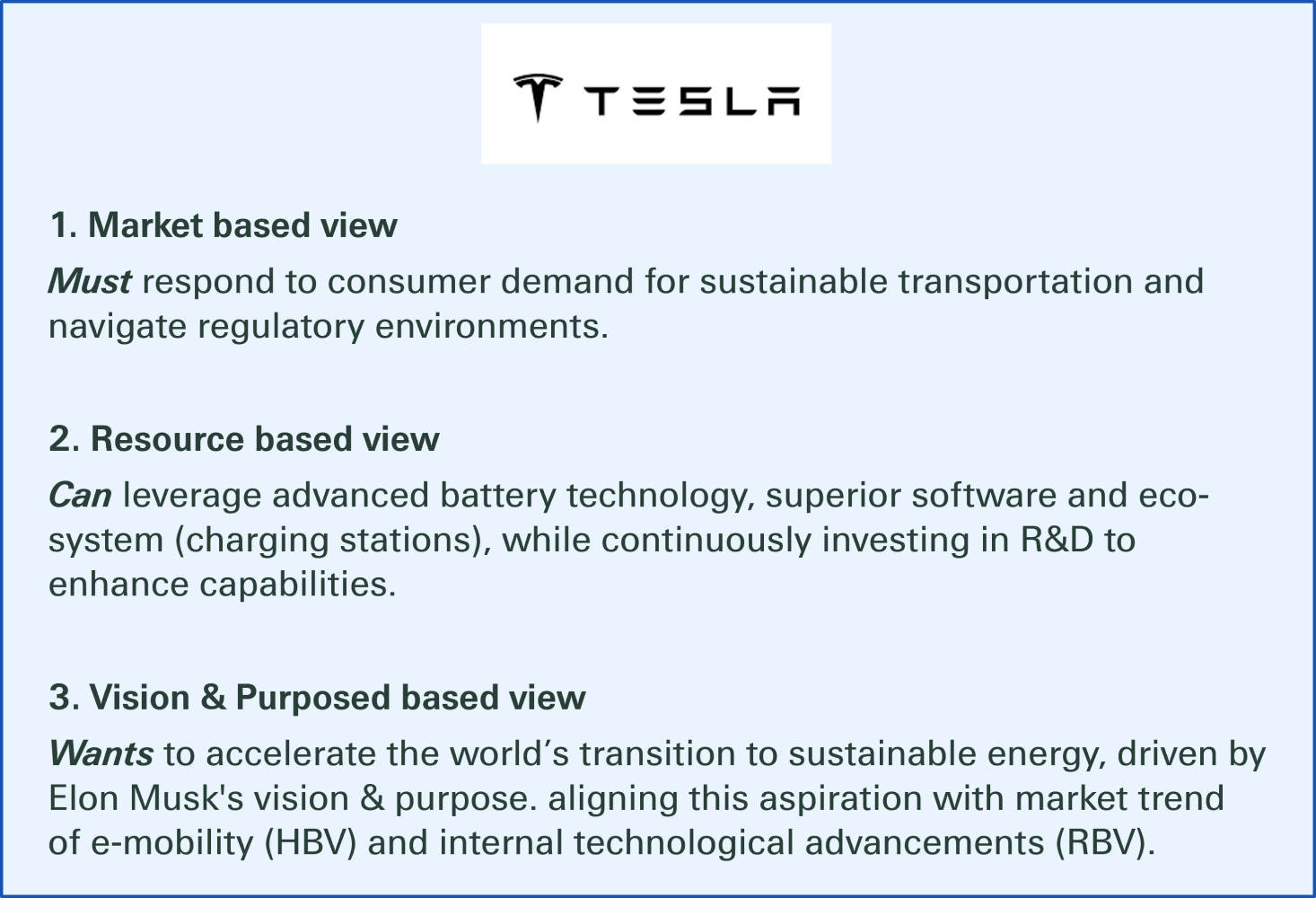
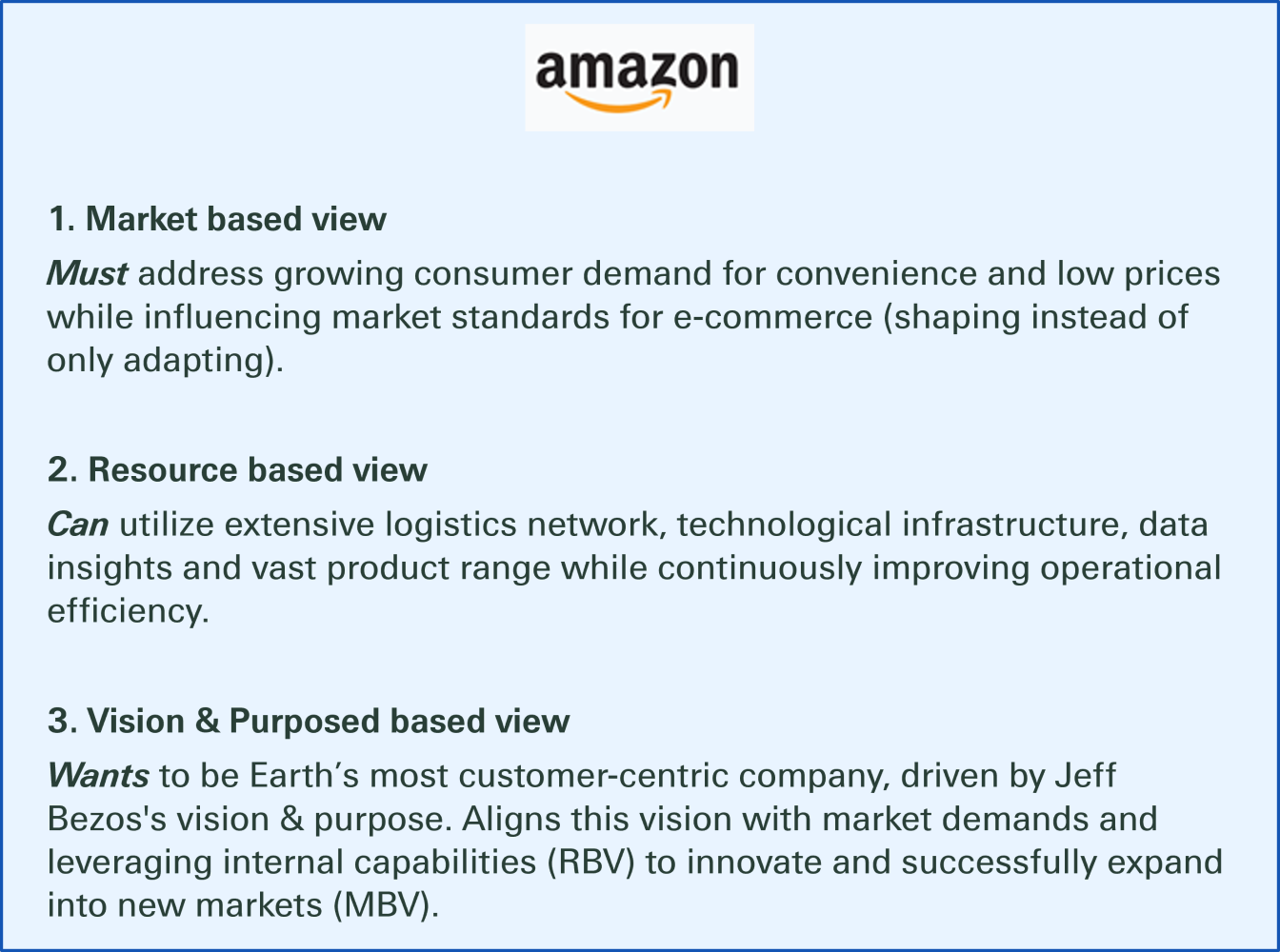
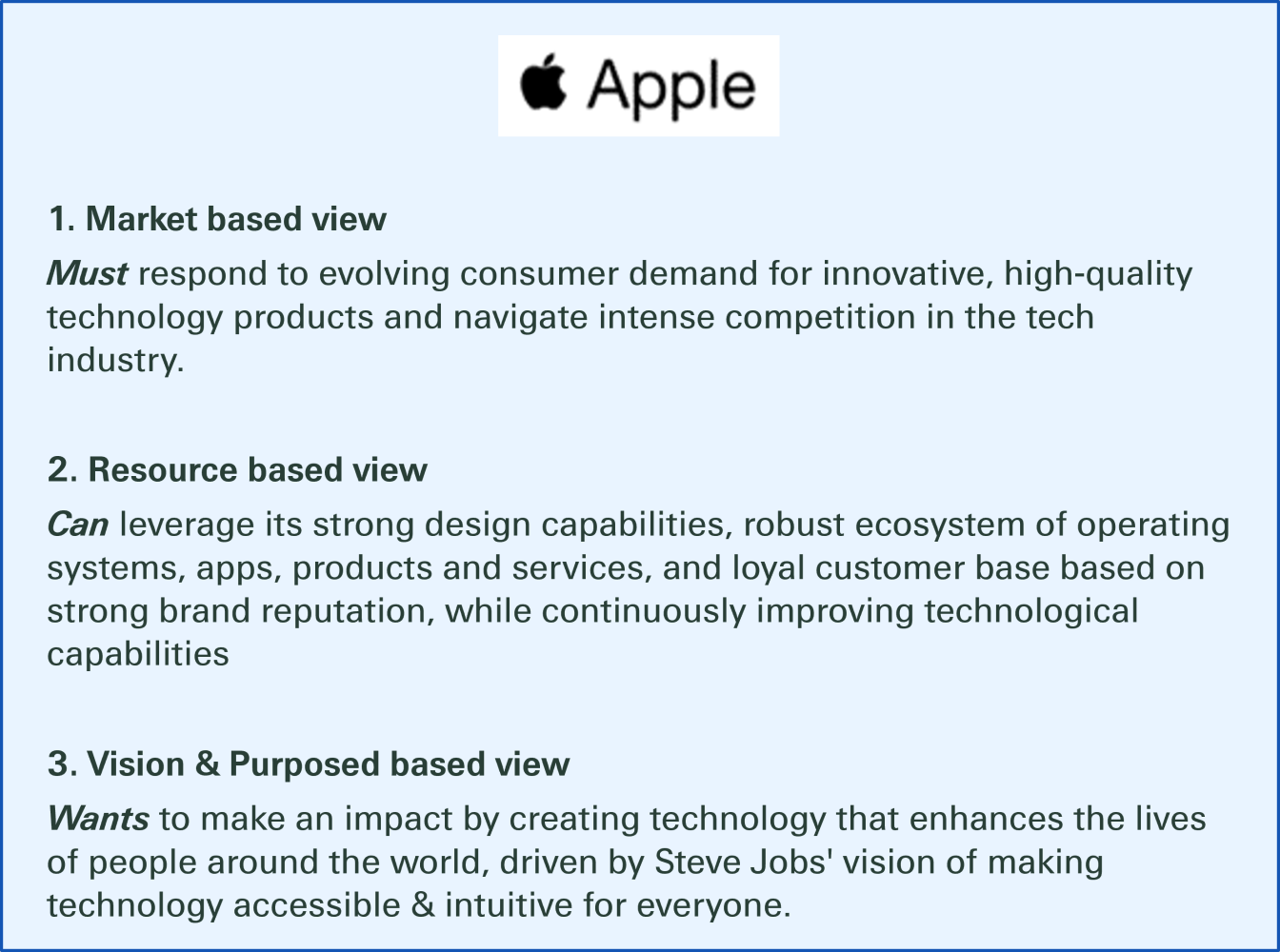
The companies clearly tap into and excel in all 3 strategic paradigms and integrate them to sustain and develop their unique competitive position.
The vision sets the long-term direction and purpose, which guides both market positioning (MBV) and the development or acquisition of internal capabilities (RBV).
Likewise, insights from market analysis (MBV) influence how resources are allocated and capabilities are developed (RBV), ensuring the organization can respond to external opportunities and threats.
Vice versa, an assessment and redeployment of existing resources and capabilities (RBV) can lead to entering new, untapped markets (MBV) to leverage economies of scope.
For those paradigms to be seamlessly integrated, the company needs to ensure feedback loops. It must implement mechanisms (e.g. in the form of short rhythmic strategic reviews, adaptive processes, cross-functional teams) to continuously integrate market feedback, resource assessments, and visionary goals.
Although I’ve illustrated the “Vision and Purpose-based view” with these outstanding and unique companies, the underlying motivational drivers of aspiration and meaning provided by Vision and Purpose are generic and can be applied to any company (or even department or team), regardless of its size, life cycle stage or industry.
Indeed, these principles are not limited to organizations alone but also resonate at the individual level, as it is the Visions and Purposes of influential individuals that often shape and imbue organizations with their aspirational essence.
To which percentage (%) is your company incorporating the MBV, RBV and VBV in its strategy? Why is that the case and what is the outcome?
To understand how to integrate Vision and Purpose and their underlying drivers, check my short post: https://bit.ly/44WKRWr
To dive deeper into why purpose has become such an important C-Level topic and how to use it to lead your organization, check my article: “The Rise of Purpose in Corporations”