Vision & Purpose are the ultimate strategic Growth tools!
An inspiring Vision and the authentic Purpose it is rooted in are the ultimate strategic tools for Growth and Success...... - provided they are consistently embedded in the company’s strategy, product and service offering, culture, and operating model.
Why? Because Purpose and Vision tap into two distinct yet synergistically connected motivational mechanisms.
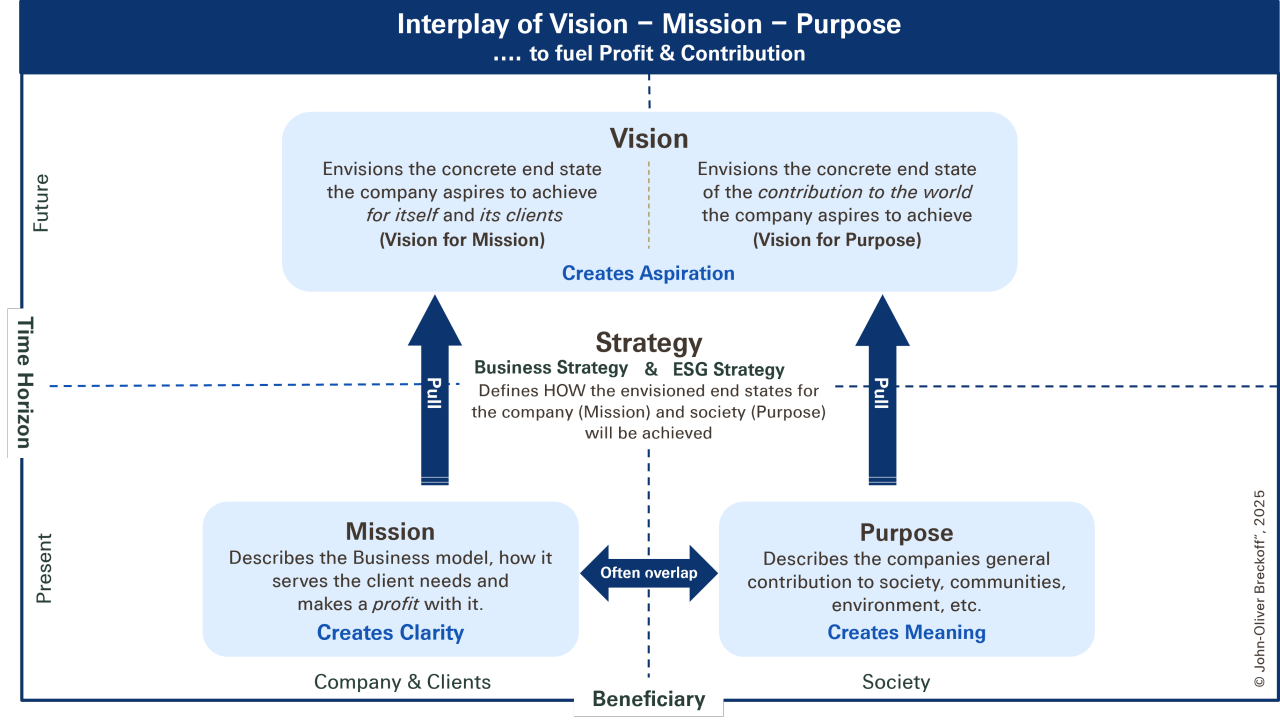
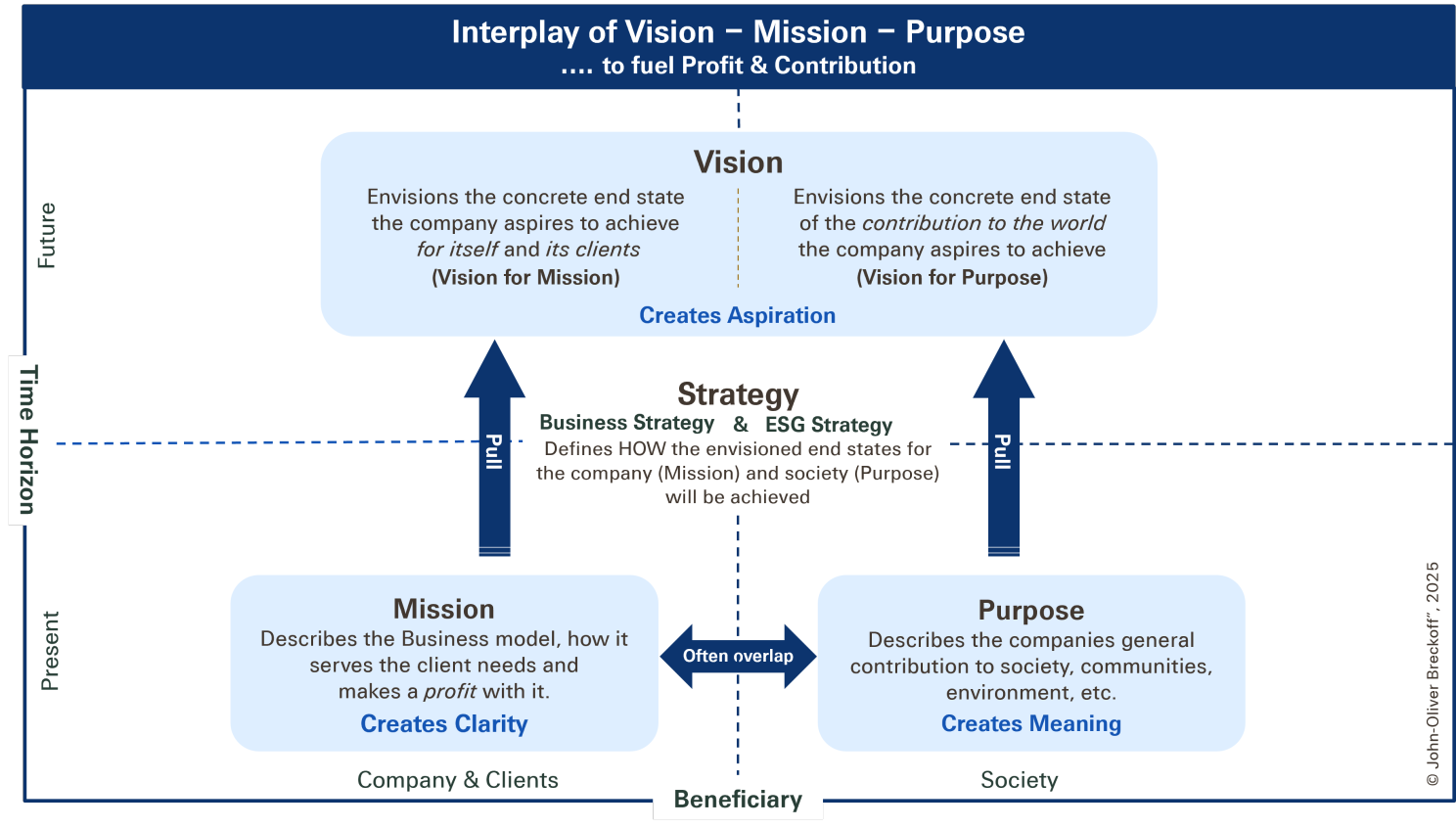
The interplay of Vision-Mission-Purpose
A well-defined Purpose ("Why do we exist?") connects to our innate need for meaning through significance, contribution, autonomy, and the desire to make a positive impact in the world. It follows a societal contribution logic that transcends "just" making a profit, addressing the pressing challenges humanity faces today.
While the profit-making function of a company is essential, it is typically articulated through its Mission ("What business are we in?"). The Mission describes the core activity and value the company delivers - not limited to specific products or technologies - to its clients, highlighting the underlying benefits they are willing to pay for. This, in turn, reflects how the company strives to generate profit.
E.g. LinkedIn’s Mission is: “To connect the world’s professionals to make them more productive and successful” (--> clear, benefit-oriented, but not confined to any particular products).
A strong Mission therefore provides clarity, strategic direction, and discipline, ensuring that all activities align with creating value for core customers without being too narrowly confined to particular product markets.
However, it is the Purpose that infuses an additional layer of meaning, attracting both employees and consumers—especially younger generations—who seek alignment with values beyond financial success. That is, among other strong arguments, very important to attract top talent nowadays (see my post: “4 Reasons high-impact Entrepreneurs and CEOs have a purpose...”).
It is less critical whether companies articulate two distinct statements for Mission and Purpose (often they do not), as long as they clearly pinpoint the societal contribution they aim to make beyond their mere profit ambition (often they don’t do that either).
Conversely, a bold Vision ("Where are we going?") inspires ambition, aspiration, and the drive for growth and mastery. It paints a vivid picture of a future desired end state. Metaphorically speaking, it serves as an "inspiration engine" or a "powerful magnet," ideally pulling both the company's Purpose (=societal contribution) AND Mission (=profit-driven operations) toward a higher level of impact and achievement.
While Mission and Purpose are enduring endeavors rooted in the present, Vision represents a future goal yet to be achieved. Once realized, it ceases to exist in its current form, making room for new aspirations.
Then it is Strategy that conceives and articulates how to transform the present Purpose and Mission into the aspired future state imagined in the Vision. It serves as the cohesive and logical thread that weaves these foundational elements together.
At the same time, Vision and Purpose form the motivational layers that elevate Strategy from a mere collection of technical (and often uninspiring) directives into a compelling narrative that truly moves people.
The following graphic pinpoints this important interplay of Vision, Mission and Purpose when understood the right way.
The case of Tesla and its CEO
Consider Tesla.
Despite the unpredictable and often questionable behavior of its CEO, the company (still) stands as a showcase for both a masterfully crafted and differentiated Purpose (“Accelerating the World's Transition to Sustainable Energy”) and Vision (“We’re building a world powered by solar energy, running on batteries, and transported by electric vehicles”).
Together with a bold competitive strategy that seamlessly integrates both Purpose and ESG, they have fueled the company's meteoric rise, remarkable growth, and impressive financial success.
Potential negative financial consequences caused by a notable drop of authenticity concerning its Purpose due to its CEO’s contradictory support of the Trump Government, which does not endorse EVs, remain to be seen (see my post: https://bit.ly/4gxEsFm).

Vision- and Purpose-driven companies create both impact and financial success
The most successful organizations in the long term always strive to combine positive societal impact with financial success. Companies like Amazon, Apple, Lego, Novo Nordisk, Unilever (under P. Polman), Patagonia, Disney are all impressive examples where Purpose driven founders or CEOs have leveraged both their conviction and energy as well as Purpose and Vision as tools to drive extraordinary and long-term financial success.
At the same time, they have contributed to society through constant innovation - enhancing health (Novo Nordisk), elevating customer experience (Apple), advancing customer service and convenience (Amazon), promoting environmental conservation through radical footprint reduction (Unilever) and championing environmental stewardship (Patagonia), or fostering universal human values such as creativity, learning, and fun (Lego) or happiness, joy, and magic (Disney).
The more Vision and Purpose work together, the stronger they become. A Vision without Purpose risks becoming a hollow pursuit of outcomes, devoid of deeper meaning. Conversely, an organization with Purpose but lacking a bold Vision may struggle with strategic focus and momentum.
The true power emerges when Purpose and Vision intertwine symbiotically. A compelling Vision gives Purpose tangible expression, framing it as an inspiring future state that people can collectively strive toward. In return, an authentic Purpose imbues that aspiration with intrinsic meaning and enduring relevance, instilling significance beyond just achievement alone.