ArticlePurpose · Leadership & Culture · Purpose & Vision
3 min read
4 Reasons high-impact Entrepreneurs and CEOs have a purpose...
...both for their Life and their Organization.
Why Life Purpose?
Humans are built for purposefulness.
Ancient philosophers like Plato and Aristotle postulated, and modern scientists have proved, that people striving for meaningful lives are:
✅ more motivated
✅ physically stronger and live longer
✅ mentally healthier and more resilient
✅ contribute more to their families, friends, and society at large
Plato wrote in 'The Republic': "Each man must fulfill his own purpose and do the work for which he is naturally suited."
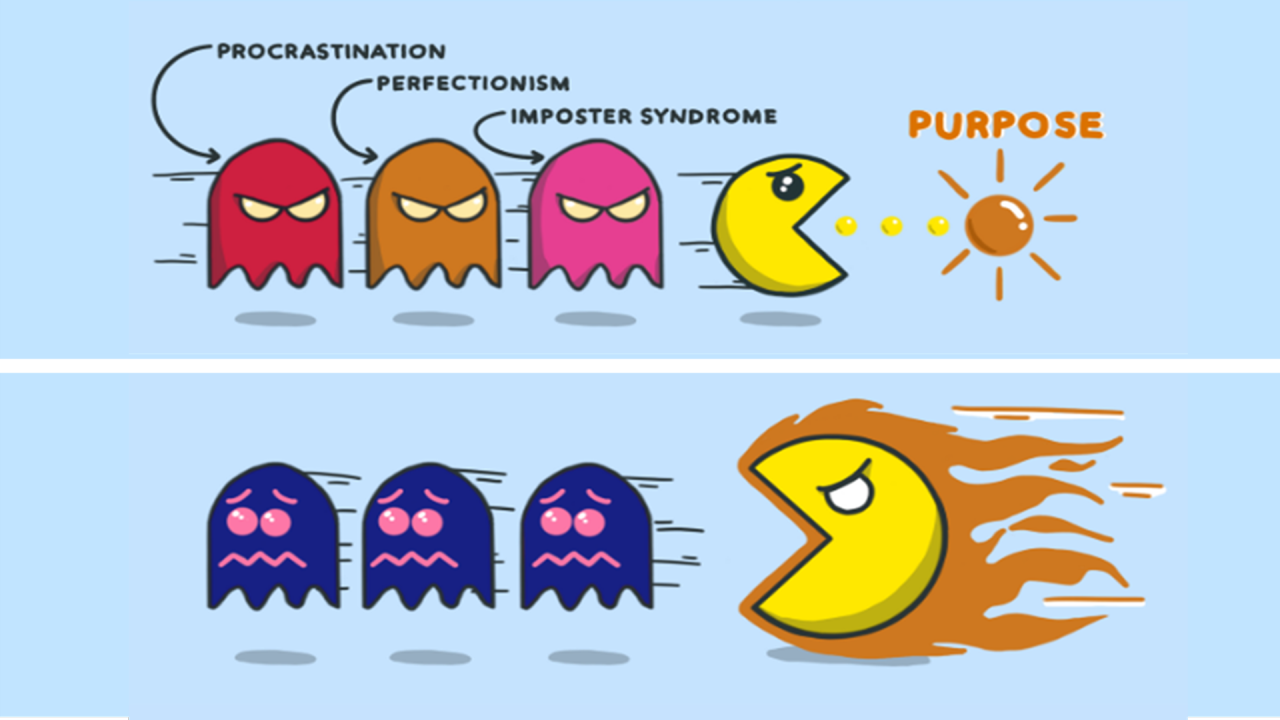
Fueled by the magnetic power of meaning, people knowing and living their purpose easily cut through procrastination, perfectionism and impostor syndrome, as this creative illustration is suggesting. And I would add emptiness, lack of orientation and even depression.
Purpose pushes people forward to reach their (often highly ambitious) goals, because these goals are linked to something larger than themselves.
But there's more to it: Positive Psychology has consistently identified purpose as one of the main drivers of happiness (e.g. M. Seligman’s PERMA Model, 2012).
I'm sure you have already noticed by now that very successful and financially rich people rarely appear to be particularly happy, as one would assume considering their possibilities. On the contrary, often they're even utterly miserable.
Success and financial freedom alone apparently don’t cut it.
💡It's not a lack of funds, it's a lack of purpose.
Striving for purpose is an innate aspect of humanity, deeply embedded in our nature and essential for our overall well-being, effectiveness and happiness.
Why organizational Purpose?
Purpose has become a main concern for individuals over the last 10 years. The sudden popularity of century-old concepts like Ikigai and the proliferation of coaching services aimed at helping individuals discover their life purpose are clear indicators of this trend.
And if it’s a main concern for individuals, it is automatically a main concern for organizations too, since organizations as social systems mainly consist of individuals.
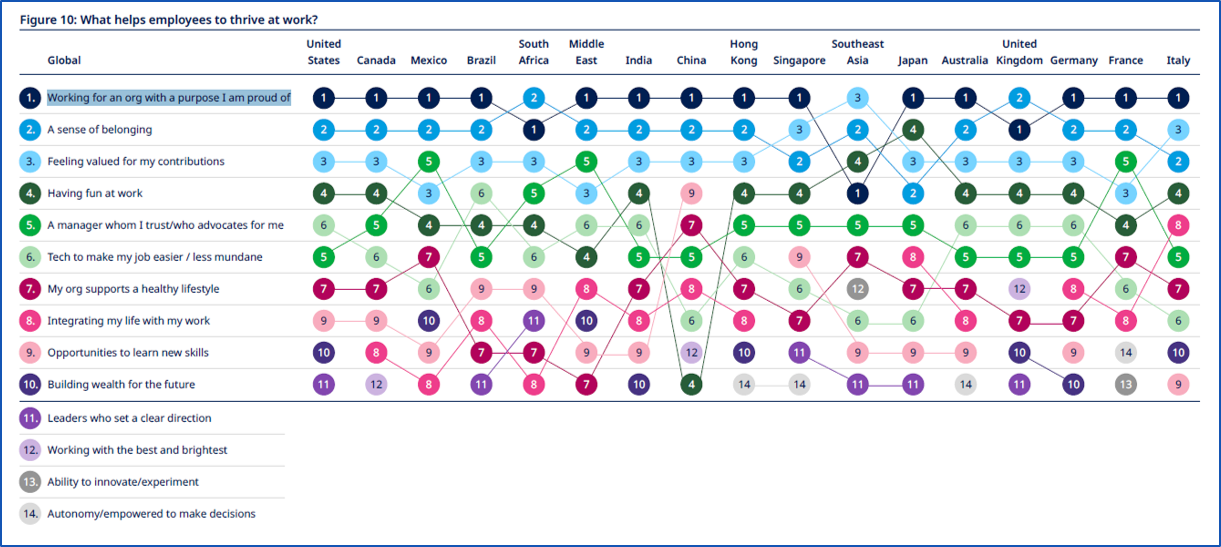
In the Mercer 2024 global talent trends study “Workforce 2.0” the No. 1 ranked answer to the question “What helps employees to thrive at work?” was:
“Working for an organization with a purpose I am proud of”.
And this is even more true for Generations Y and Z, which are both described to be driven by purpose, and that are now in or starting to take over leadership and decision-making positions.
The Deloitte Millennial Survey 2014: “Big demands and high expectations” revealed that more than 70% of Millennials expect their employers to focus on societal or mission-driven problems.
Here are the 4 benefits (and facts) that purpose-driven organizations enjoy:
✅ Greater Financial Return: 83% of companies that overperform on revenue growth link everything they do to purpose ("Grow, Change, Grow", Interbrand, 2017)
✅ Increased Innovation: Purpose-oriented companies have been shown to achieve 30% higher levels of innovation (“Becoming irresistible: A new model for employee engagement”, Deloitte, 2015)
✅ Higher Employee Engagement: 77% more likely to be engaged at work ("Purpose, not platitudes: A personal challenge for top executives", McKinsey & Company, 2020)
✅ Deeper Customer Loyalty: Consumers are 4-6 times more likely to purchase from purpose-driven companies ("Strength of purpose study" Zeno, 2020)
Companies have every reason to invest the time and effort in reflecting on, finding and then fulfilling their purpose too.
Doing good & Doing well
Purpose-driven entrepreneurs and CEOs understand this well. They align their personal purpose with their organizational purpose to enhance positive societal impact while at the same time strengthening and growing their organization.
Credits to Pejman Milani for this ingenious illustration that captures the power of purpose so perfectly!
💫 If a picture is worth 1000 words, a metaphor is worth 1000 pictures.
What is your opinion about the power of purpose and how organizations are leveraging it?