
The Superior Power of Vision-oriented Strategies
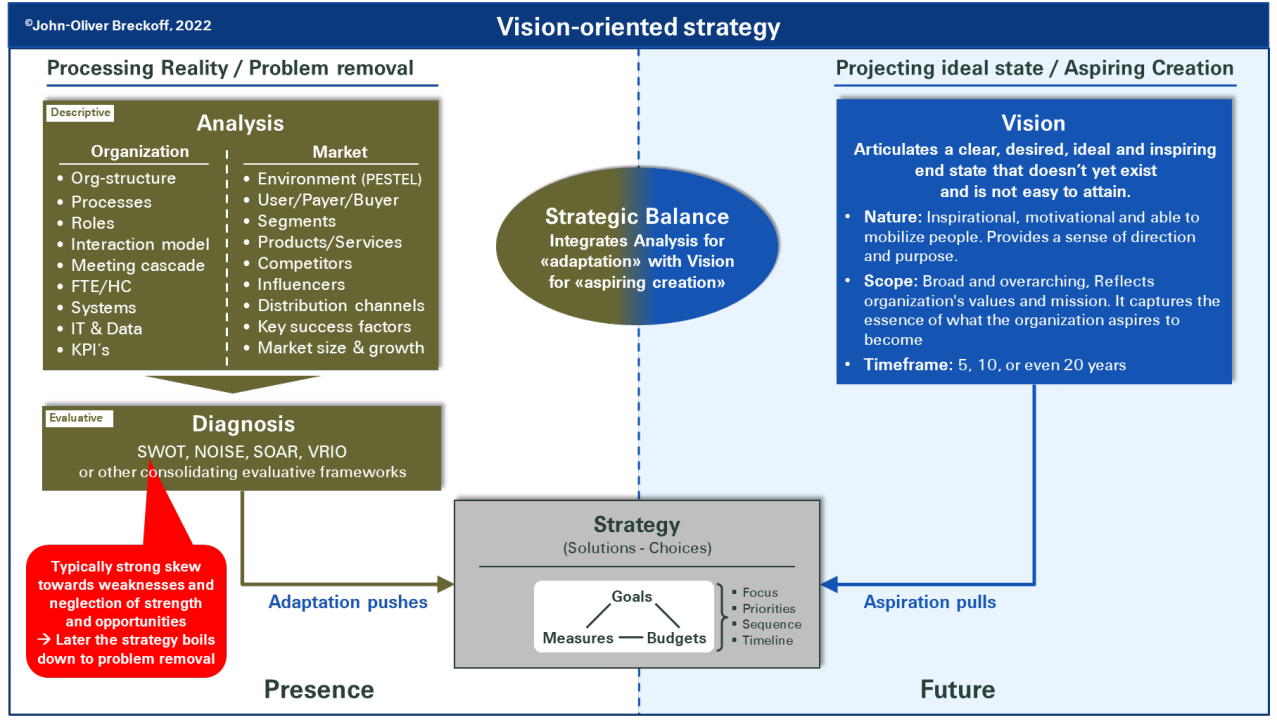
Having an inspiring and compelling vision improves strategy drastically.
Yet many companies have a vision that is uninspiring or is unaligned with their strategy and serves more as décor, or don’t have one at all.
Instead, most strategies are way too analysis-focused.
What do I mean by this?
The pitfalls of (SWOT) analysis
Of course, a certain level of analysis is almost always needed. A greenfield approach, in my view, is rarely the ideal choice. And for sure not in bigger corporations, further down their life cycle journey with dozens or hundreds of existing product lines, hundreds of thousands or millions of client relationships, the organizational capacities to serve these clients and the correspondingly tied-up capital. Not analyzing anything at all actually would be pretty foolish.
The problem arises when all mental resources are absorbed by such a hyperfocus on analysis that the creative part falls short and the strategy gets unbalanced. Especially since the analytical process typically comes with a couple of fundamental errors:
- Already during the survey phase, there is a large amount of data collection and preparation with totally unclear or doubtful relevance for the strategy formulation. Of course it looks nice, especially when beautifully visualized and presented in elaborate slides. But what actually is the value of those slides?
- At the evaluation level – typically structured in a SWOT - often no strategic implications or conclusions are derived even for relevant insights, leading to the common disconnection of analytical results from strategic decisions. Trace back which of all these arduously generated insights are actually reflected in the strategic thrusts and measures and you will very likely find that the percentage is surprisingly low.
- SWOTs often exhibit a strong skew towards weaknesses and a neglect of strengths and opportunities, which means that later the whole strategy boils down to “problem removal”. The problem with “problem removal” though is that even if you manage to eliminate all the problems of your organization, it still doesn’t mean it’s excellent. On an individual level, it is very evident that even if you manage to eliminate all your weaknesses, you would only achieve mediocrity. High performers focus on developing and leveraging their strengths. Certainly, they also work on their weaknesses at some point, but the choice and evolution of their craft, sport, or discipline is based on their strengths.
- If you only focus on finding solutions to your problems, then it’s your problems that define the scope and horizon for your strategy. This limits your search fields, since areas where you don’t have problems are out of your scope for finding potentially beneficial strategic choices.
But even if you do identify some opportunities during your analytical process:
Do you really think that e.g. Steve Jobs’ “Apple”, Elon Musk’s “Tesla” or Jeff Bezos’ “Amazon” strategies flew out of a SWOT analysis? Hardly.
Why and how visions work
Amazon, famous for its deep commitment to long-term orientation, has a vision “to be Earth’s most customer-centric company, Earth’s best employer, and Earth’s safest place to work”.
And from this bold vision, according to Bezos, the company is “working backwards”. In his 2008 letter to shareowners, he explains “Working backwards often demands that we acquire new competencies and exercise new muscles, never mind how uncomfortable and awkward-feeling those first steps might be”.
In terms of its Kindle business, he continues “More than four years ago, we began with a long-term vision: every book, ever printed, in any language, all available in less than 60 seconds. Amazon had never designed or built a hardware device, but rather than change the vision to accommodate our then-existing skills, we hired a number of talented (and missionary!) hardware engineers and got started learning a new institutional skill, one that we needed to better serve readers in the future.”
When Kindle was released in 2007 it sold out after 5.5 hours. By October 2022, over 30 million people were actively using Kindle devices in the USA alone. Amazon is known to have sold at least 487 million Kindle books and its e-book market share is estimated at 67% (in US 83%).
This is how vision drives strategy and vision-oriented strategy drives success.
A vision articulates a clear, desired, ideal end state that doesn’t yet exist and is not easy to attain. It provides a sense of direction and ideally also a purpose. Therefore, a vision is inspirational and motivational and able to mobilize people.
A “problem removal” strategy based on a SWOT analysis does not move people. A vision does.
Processing present business realities by analyzing market and organizational conditions is indispensable, as it forms the basis for necessary constant adaptation. However, this should be counterbalanced by the aspirational creation of an "aiming" at a future ideal state through a well-articulated vision.
5 practical steps to implement a vision-oriented strategy
To unfold its pulling power, a vision must be inspiring, challenging and fully aligned with strategy and then integrated into the company’s culture and operative management. Here is some practical implementation advice:
1. Crafting a clear and compelling vision
Define your ideal end state: Articulate a vision that describes a desirable and ambitious future state for your company. Make sure it is specific, inspirational, and challenging.
Align with core values: Ensure your vision aligns with the company’s core values, mission and purpose. This alignment will help to inspire and motivate your people.
2. Effective communication of vision
Inspire and engage: Regularly communicate the vision to all levels of the organization. Use storytelling to make it relatable and compelling.
Ensure leadership commitment: Leaders should embody and advocate for the vision consistently. Their commitment will drive alignment and buy-in across the organization.
3. Balancing analysis with creativity
Integrate vision into strategic planning: While conducting SWOT analyses and other assessments, always link findings back to your vision. Ensure that the vision informs decision-making and strategic priorities.
Encourage innovation: Create space for creative thinking and innovation. Encourage teams to develop ideas and solutions that move the organization closer to its vision.
4. Fostering a culture of adaptability
Empower employees: Enable employees to take initiative and make decisions that align with the vision. Provide them with the resources and support needed to experiment and innovate.
Provide continuous learning: Promote a culture of continuous learning and improvement. Encourage feedback, reflection, and adaptation to stay responsive to changing conditions.
5. Tracking progress and adaptation
Set milestones: Establish clear milestones and metrics to track progress towards the vision. Regularly review and adjust strategies to ensure they remain aligned with the vision.
Celebrate successes: Recognize and celebrate achievements that contribute to the vision. This reinforces commitment and motivation.
By implementing these practical steps, companies can effectively integrate a vision-oriented approach into their strategic management, ensuring that they not only adapt to current realities but also strive towards a compelling and inspiring future.
On a scale of 0-10, how inspiring actually is your company’s vision and how well is it reflected in the strategy and embedded in the culture (=how well are you moving towards it)?