
ArticleVision · Strategy · Leadership & Culture
5 min read
From IBM’s caution to Swissair's collapse: Ambitious Visions need robust Strategies and strong Leaders to unfold their power
Back in 2007 when hyper-bold and purpose-driven visions like Tesla’s and Amazon’s weren’t yet so prolific (and even less so successful), I wrote a short article in "Alpha Kadermarkt", a supplement of the Swiss newspaper "Tages-Anzeiger" about the power and perils of pursuing visions.
17 years later I think the described concepts and characteristics still apply, so I translated it into English.
Already "Envisioned" Today?
Blessing or curse? Burdened and supported by both negative and positive examples, the vision struggles for recognition. When understood correctly and lived consistently, it is the element that sets your strategy apart.
"Those who have Visions should go to the doctor", once said Helmut Schmidt, the former Chancellor of Germany. But there are also critical voices from within management itself, such as from Lou Gerstner, the former CEO of IBM, who said:
"The last thing IBM needs now is a new Vision"
Concrete case examples do not paint a much better picture. Failed repositionings seem to be primarily the fault of "visions" and the managers who succumbed to them.
One need not look abroad to DaimlerChrysler first as an "Integrated Technology Group," then as "Welt AG" ("Global Corp"), but can refer to the Swissair debacle as a shaping experience. The so-called "Hunter-Strategy" at that time, consisting of acquiring minority stakes in several smaller, often struggling airlines around the world, was driven by the vision of positioning Swissair as an independent, alliance-free but nonetheless internationally operating network carrier. A concept that seems as absurd today as it did then, in light of the small Swiss domestic market and the already well-established, powerful alliances.
Were the wrong visions chosen, or were the right visions poorly implemented? Or are visions in management at best esoteric "hocus-pocus," scoffed at by successful (change) managers as frippery, or at worst leading to massive value destruction and bankruptcy in companies?
Visions are nothing new
First hinted at in the 1950s by the economics professor J. Schumpeter, who saw the driving force of capitalism not in capital allocation but in the continually new business visions of the entrepreneur ("Creative Destruction"), the topic moved into the spotlight of research and management in the mid-1980s.
It was understood either as an individual-focused leadership concept (W. Bennis, B. Nanus) or as a company-focused strategic concept.
The former involved specific skills and behaviors of leaders, such as optimism, foresight, enthusiasm, and empathy.
In the latter, the vision was the most general and long-term statement of goals, often presented together with a mission statement and guiding principles ahead of the strategy.
Vision: Neither Strategy nor Planning
Visions predominantly involve the use of the right hemisphere of the brain. They consist of concise future statements that often focus on competitors (Nike in the 60s: "Crush Adidas"), market conditions (Boeing: "Become a dominant player in commercial aircraft"), or the customer (Walt Disney: "Make people happy").
In contrast to the goals formulated in strategies, which primarily follow a planning, present-based, linear causality logic, visions aim to create a desired overall state largely independent of the present. Creation instead of planning, construction instead of causality. While goal planning requires analytical skills and is guided by the questions "What can I do?" (resources) and "What must I do?" (market environment), vision development foregrounds the question "What do I want?"
Visions are further characterized by simplicity, emotionality, and imagery. While strategies are technical, long, and therefore often boring, visions are short and seek to stimulate a certain positivity, desire, or even longing. Visions employ a simple and visual language that every employee understands. If a picture replaces a thousand words, a metaphor replaces a thousand pictures.
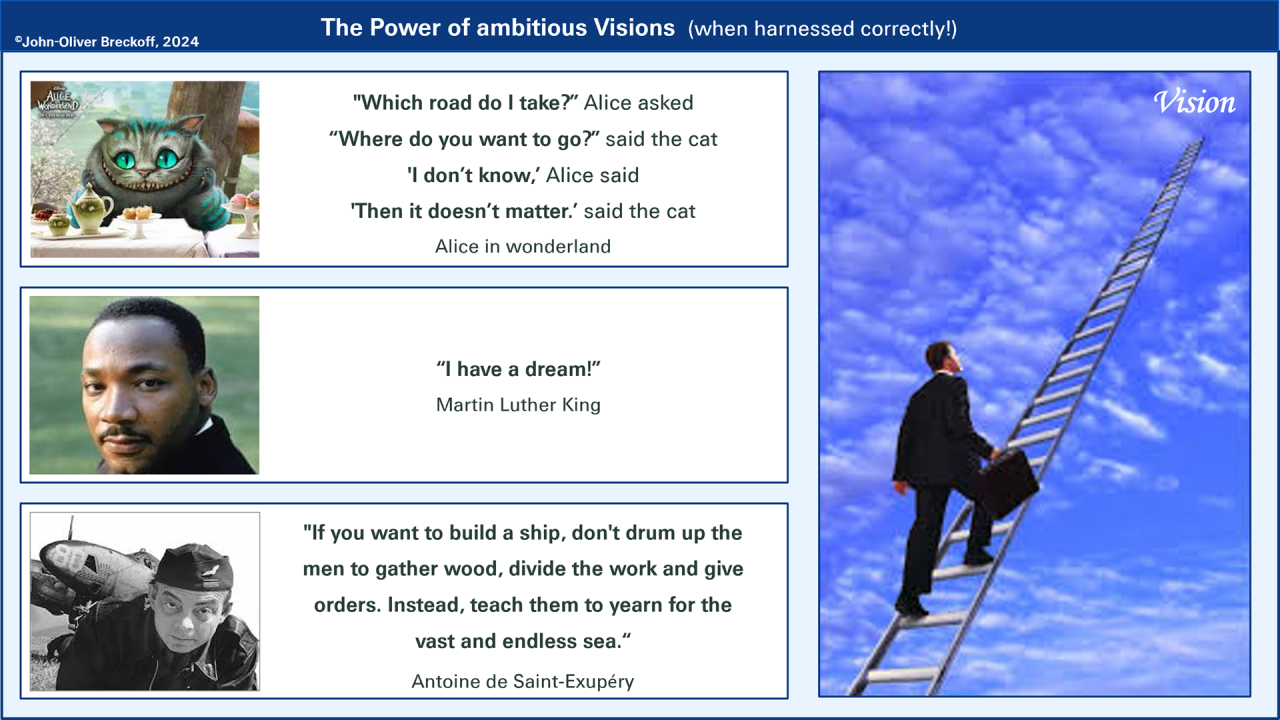
"If you want to build a ship, don't drum up the men to gather wood, divide the work and give orders. Instead, teach them to yearn for the vast and endless sea." (Antoine de Saint-Exupéry)
Prof. J.P. Kotter, a change management guru at Harvard Business School, scientifically supports these connections and posits that human behavior is much more controlled by the sequence See-Feel-Change than by Analyze-Think-Change.
Therefore, visions are also used by systemic change consultants in the change process as one of the main management interventions, because visions reach and move people.
Visions must be lived
Detail work instead of Big Picture optics. Developing a vision represents only the beginning and the simplest part of an overall philosophy.
Visions must be lived and permeate the company. This includes operationalizing them, incorporating them into strategy formulation and goal setting.
While this usually still happens in companies, further integration with, for example, subsequent MBO and remuneration systems is often ignored, as this part involves effort and the completion of checklists, which many managers find unattractive.
Living visions also involves aligning the leadership behavior of all leaders with the vision. Moreover, the vision must manifest itself in the entire company culture.
In an environment of change, visionary management must complement operational management, constantly rebuilding it to remain profitable under changed conditions. A "both/and" instead of an "either/or" paradigm.
Success is not accidental
J. Collins and J. Porras also identified this principle as an important success criterion for visionary companies in their classic "Built to Last – The Successful Habits of Visionary Companies." The extensive empirical research underlying this book highlighted the superior market and financial performance of visionary companies compared to their respective No. 2 companies.
Although some of the companies described in this book have faltered over the years, the correlation between market success and a lived vision is evident. Former IBM CEO L. Gerstner himself points out in his book 'Who Says Elephants Can’t Dance' that he was quoted out of context.
A new vision was not necessary at that time, as IBM already had a viable vision; what was lacking, however, were concrete strategies for its implementation.
How important are bold visions nowadays for market success?
💡For the interplay of vision & purpose check my short article: https://bit.ly/44WKRWr