
PostStrategy
2 min read
The most advanced strategic framework ever: None!
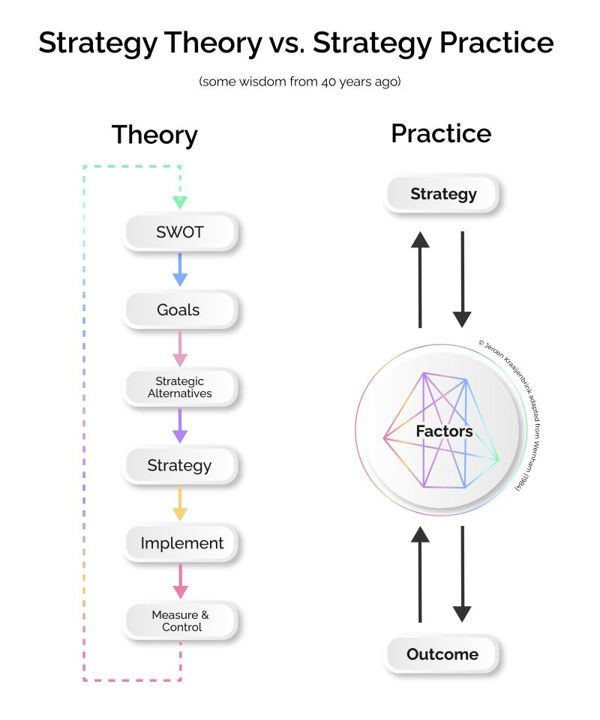
In this graphic, Jeroen Kraaijenbrink contrasts the classic linear model of strategy on the left with a systems-thinking-oriented, adaptive, iterative reality on the right. This dates back to Roy Wernham’s article “Bridging the awful Gap Between Strategy and Action” he published already in 1984 calling this traditional approach “oversimplified....to the extent that it seriously distorts the reality”.
I agree with that on 2 dimensions:
1. Non-Linear Reality
Strategy work doesn’t follow unilateral cause-and-effect relationships that can be analyzed or designed in a neat, isolated sequence. Instead, reality presents itself as a complex, dynamic system where feedback loops and multilateral interdependencies continuously reshape the outcomes.
2. Transcending Framework Fixation
The value of knowing standard frameworks alone (like SWOT) is very limited. Only years of APPLYING frameworks (and seeing what, how and why things work or not), then tweaking and adapting them and then creating your own ones, tailored to the context at hand leads to practical, experience-based knowledge and CAPABILITIES, finally making frameworks obsolete altogether.
The Japanese ShuHaRi concept borrowed from martial arts describes this perfectly.
💡 The ShuHaRi Concept (守 破 離)
ShuHaRi is a three-stage learning journey.
1. In Shu (follow), you follow an established system and absorb it faithfully
2. In Ha (break), you begin to adapt those systems to your own context
3. Finally, in Ri (separate), you transcend all formal structures, applying your expertise flowing out of your accumulated experience and emerging intuition
Strategic frameworks can't substitute strategic thinking. At best, a framework might prompt the right questions, but it doesn’t guarantee the right answers.
I'd estimate that developing a framework represents max. 2-5% of my effort and value created working with clients on strategic projects.
Yet LinkedIn is full of people endlessly regurgitating these frameworks and it says everything about what state of development they are in😉. Don’t get stuck there.
💡 Going beyond strategic frameworks
Instead:
✅ Cultivate true strategic thinking: Go beyond rigid models and develop flexible skills and judgment
✅ Do regular reflection loops: Note which frameworks work when to what extent and when not and why. Learn from successes and failures
✅ Expand your contextual awareness: Observe how changing conditions affect strategic decisions
✅ Engage in interdisciplinary discussions: Bring together varied perspectives to spark creativity, challenge assumptions, and co-create more robust solutions
✅ Start from scratch: Ignore any sort of framework, instead really deep dive into the domain and find the questions that need to be answered. That’s your framework
✅ Practice quick iteration: Test ideas or concepts and learn in short cycles to adapt rapidly