ArticleStrategy
7 min read
Strategic Management beyond SWOT, PESTEL and 5-Forces: The Cynefin Framework
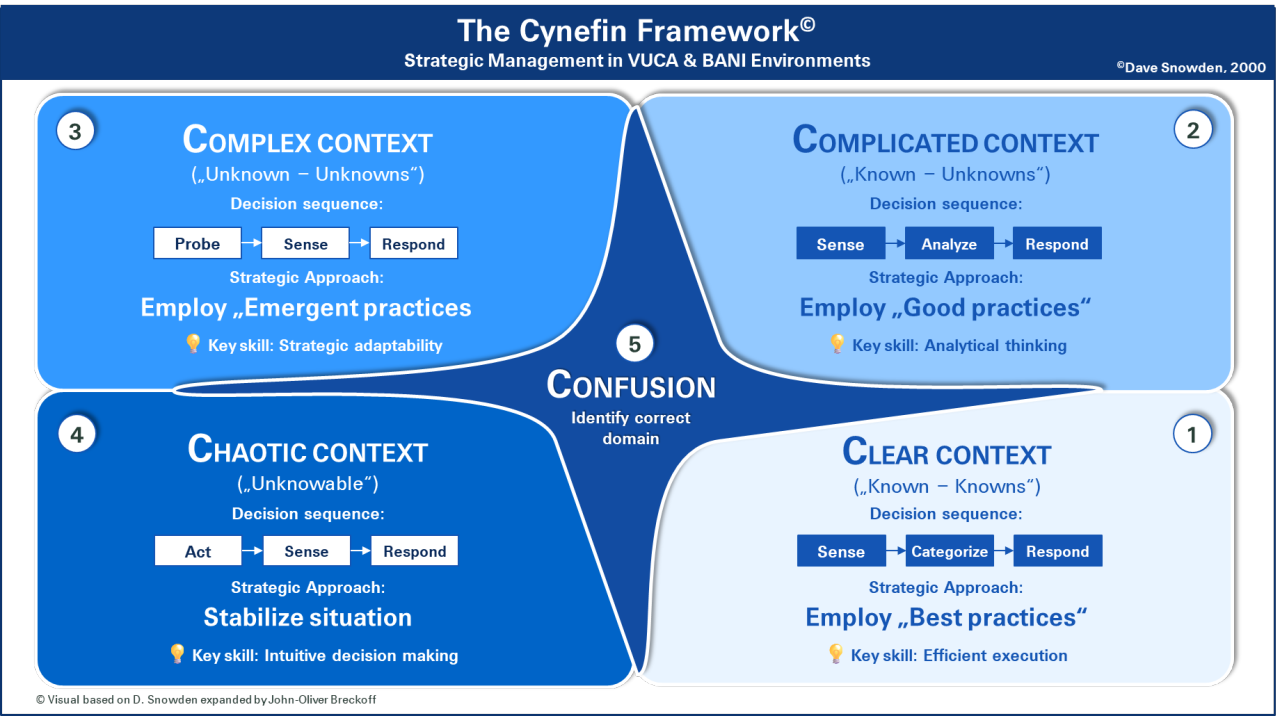
The Cynefin framework was developed between 1999 and 2000 by Dave Snowden, at that time IBM's Director of the Institute of Knowledge Management.
Older and classic frameworks like SWOT, PESTEL, and Porter's Five Forces have provided robust tools for stable business environments.
However, they often fall short in today’s fast-paced, unpredictable markets because they primarily focus on static factors and typically assume that future events will unfold in a linear, predictable fashion.
Additionally, they provide no instructions on how to actually use the analysis results they produce, leading to the typical disconnect between generated insights and strategic choices commonly observed in strategic planning.
In contrast, the Cynefin framework is a comprehensive analytical tool that transcends the limitations of these traditional models by:
1. Creating awareness and nuanced insights into the nature of different situational contexts.
2. Providing leaders with specific guidance to tailor their strategic approaches to the actual contexts they’re operating in.
This encompasses both the external market responses of the company and also the essential organizational adjustments necessary to support the diverse strategic approaches recommended for each specific context.
Benefits and application of the Cynefin Framework
The benefits of the framework are therefore manifold and comprise:
- Enhanced Decision-Making: Provides a clearer understanding of the context for decisions, reducing missteps.
- Increased Organizational Agility: Helps organizations become more responsive and able to adjust quickly to change.
- Context-Sensitive Resource Allocation: Ensures resources are used more effectively by aligning strategies with the specific nature of the environment.
- Support for Innovation: Encourages adaptive tactics in complex or dynamic scenarios.
- Effective Crisis Management: Offers strategies for acting under pressure when swift, decisive action is necessary
The Cynefin Framework has been widely applied across various sectors, including healthcare, government, and corporate management in areas such as policy-making, product development, market creation, supply chain management, branding, and customer relations.
Exploring the 5 domains of the Cynefin Framework
The Cynefin Framework consists of the 5 “C” domains: Clear, Complicated, Complex, Chaotic, and Confusion, each describing a different situational context and therefore suggesting a different approach to decision-making and problem-solving:
1. "Clear"-Domain
o Situational Context: Problems in this domain are straightforward, well-understood, and predictable, allowing for a stable environment where cause and effect are apparent to everyone involved. ("Known-Knowns") Unlike more complex domains, there is no need for deep interpretation or analysis.
o Strategic Approach: Employment of best practices that are well-documented and known to produce consistent results. As solutions are known and obvious, the decision sequence is "Sense-Categorize-Respond". The benefits of planning (as a forward projecting linear process based on predictable data) can be fully reaped.
o Example: Standardizing established and working processes in manufacturing to ensure quality assurance, compliance and efficiency gains.
o Difficulty/Danger: The main risk here is complacency and the potential for over-simplification, which might overlook subtler issues.
2. "Complicated"-Domain
o Situational Context: This domain involves intricate challenges that need to be deciphered through expert analysis, requiring more specialized knowledge than the “Clear domain”. The environment still maintains predictability but unlike the “Clear domain”, it needs detailed exploration to uncover solutions. ("Known-Unknowns").
o Strategic Approach: Utilization of expert insights and sophisticated analytical methods to develop solutions that are not obvious to the untrained eye. Not merely one undisputed and obvious "Best practice" but several "Good Practices" exist that need to be evaluated and weighed against each other. As solutions are not obvious, the response sequence is "Sense-Analyze-Respond". Here a strategy must precede planning for optimal results (deliberate strategy).
o Example: A consulting firm conducts a detailed market analysis to devise a strategic investment plan.
o Difficulty/Danger: The danger lies in becoming bogged down in analysis paralysis or relying on incorrect or inadequate expert advice.
3. Complex Domain
o Situational Context: Characterized by a high degree of uncertainty and the absence of clear cause-and-effect relationships, where patterns only emerge over time. ("Unknown-Unknowns"). This domain requires a shift from the more predictive and stable approach of the “Complicated” domain to one that embraces uncertainty and adaptability.
o Strategic Approach: Fostering of an environment of experimentation and learning, allowing strategies and responses to evolve based on what is found to work in practice. As predictability is low, the decision order is "Probe-Sense-Respond". That can be reflected in pilot projects, prototyping or MVPs. Planning becomes difficult or impossible due to the high degree of unpredictability. The strategic focus shifts from “deliberate strategy” to “emergent strategy” (or is enhanced with extensive scenario planning).
o Example: A tech startup employs agile development methods to continuously adapt its product based on real-time user feedback and rapidly changing technological advancements.
o Difficulty/Danger: The primary challenge is the unpredictability of outcomes, which can lead to initiatives that fail to achieve their intended results.
4. "Chaotic"-Domain
o Situational Context: Defined by turmoil without clear patterns ("Unknowable"), requiring urgent and immediate actions to prevent further disorder. This is a significant shift from the “Complex domain”, where there is time for probing and sensing; here, the need for rapid and decisive response is paramount.
o Strategic Approach: Focus on stabilizing the situation with quick, decisive actions that aim to reestablish order before moving on to more sustainable solutions. As urgency is high, planning is no longer feasible and the decision sequence is "Act-Sense-Respond".
o Example: Responding swiftly to a major cybersecurity breach to mitigate damage and restore security, such as by isolating infected systems, deploying emergency patches, and establishing ad-hoc communication with stakeholders to manage the situation effectively.
o Difficulty/Danger: Inaction (e.g. through planning) or inappropriate actions can lead to severe and immediate negative consequences.
5. "Confusion"-Domain
o Situational Context: A state of confusion where it’s unclear which or how many of the other four domains apply ("Confusion"). It’s distinct from other domains where at least some direction or methodology is apparent. This domain is marked by a lack of clarity that can lead to misapplied strategies.
o Strategic Approach: Unless in the “Chaotic” domain (which, due to its urgency, would be obvious): taking a step back to diagnose and analyze the situation more comprehensively to determine the correct domain before proceeding with domain-specific strategies. If (also) in a “Chaotic” domain: acting quickly and then taking a step back.
o Example: A multinational corporation facing a reputational crisis in one of its regions with a high risk of spillover effects in multiple departments and regions, each with its own unique set of challenges.
o Difficulty/Danger: Paralysis by analysis and the risk of applying incorrect strategies due to misdiagnosis of the situation.
Navigating domain transitions in the Cynefin Framework
Transitions between domains often occur as situations develop or as more information becomes available, revealing new complexities or uncertainties (“Counterclockwise movement”).
Leaders must be vigilant and adaptable, ready to reassess their strategic approach as they shift from one domain to another. For instance, what begins as a complicated issue may reveal deeper complexities that push it into the “Complex domain”, requiring a shift from a more analytical strategy to one that emphasizes experimentation and adaptation.
Vice versa, the movement between domains isn’t only reactionary to increasing complexity or chaos; it can also be a deliberate strategic shift towards greater order and simplicity as learning and understanding deepen (“Clockwise movement”).
It typically occurs as organizations develop a clearer understanding of the environment through experience and deliberate exploration. For example, a situation initially perceived as “Complex” might be demystified through extensive experimentation and learning, gradually transitioning it into the “Complicated domain” as patterns become clearer and solutions more discernible.
Such transitions underscore the importance of continuous learning and adaptation, not just to manage crises but to proactively refine and streamline organizational processes and strategies.
Enhancing Strategic Responses: Integrating Cynefin Framework with SWOT, PESTEL, 5-Forces
The Cynefin Framework was developed to help leaders understand and react appropriately to their operational contexts. It focuses more on how leaders should choose their strategic approaches rather than how to actually develop them. In a way, it’s a meta-framework that guides thinking and responses based on the nature of the situation, whether ordered or unordered.
In contrast, SWOT Analysis provides a structured method to directly inform strategy formulation, by generating actionable content that can be applied to achieve competitive advantage and strategic goals.
The Cynefin Framework and SWOT Analysis therefore serve distinct yet complementary roles. By integrating Cynefin’s context awareness with SWOT’s strategic or tactical analysis, organizations can apply a more effective and nuanced approach to strategic management.
For example, in Cynefin’s "Complicated domain", where specific expertise is needed to understand challenges, SWOT can identify critical leverage points for action. In more Complex scenarios, Cynefin’s emphasis on experimentation pairs well with SWOT’s ability to pinpoint where to experiment and which weaknesses to watch.
Likewise, PESTEL and 5-Forces enhance the framework's effectiveness by providing a deeper understanding of the external environment, which is crucial for accurately categorizing situations into the appropriate Cynefin domains. They help to illuminate external pressures that might shift a situation from one domain to another, such as from “Complicated to Complex”.
The comprehensive and adaptable nature of the Cynefin framework effectively guides companies both in their market responses and required organizational adaptations, and sharpens leadership awareness across various strategic contexts. By integrating this framework with established tools like SWOT, PESTEL, and Porter's Five Forces, organizations can further refine their strategies, ensuring they are well-suited to navigate complex and unpredictable market environments.