ArticleStrategy
5 min read
Navigating Strategic Uncertainty in Reinsurance: Cynefin Framework in action (Case)
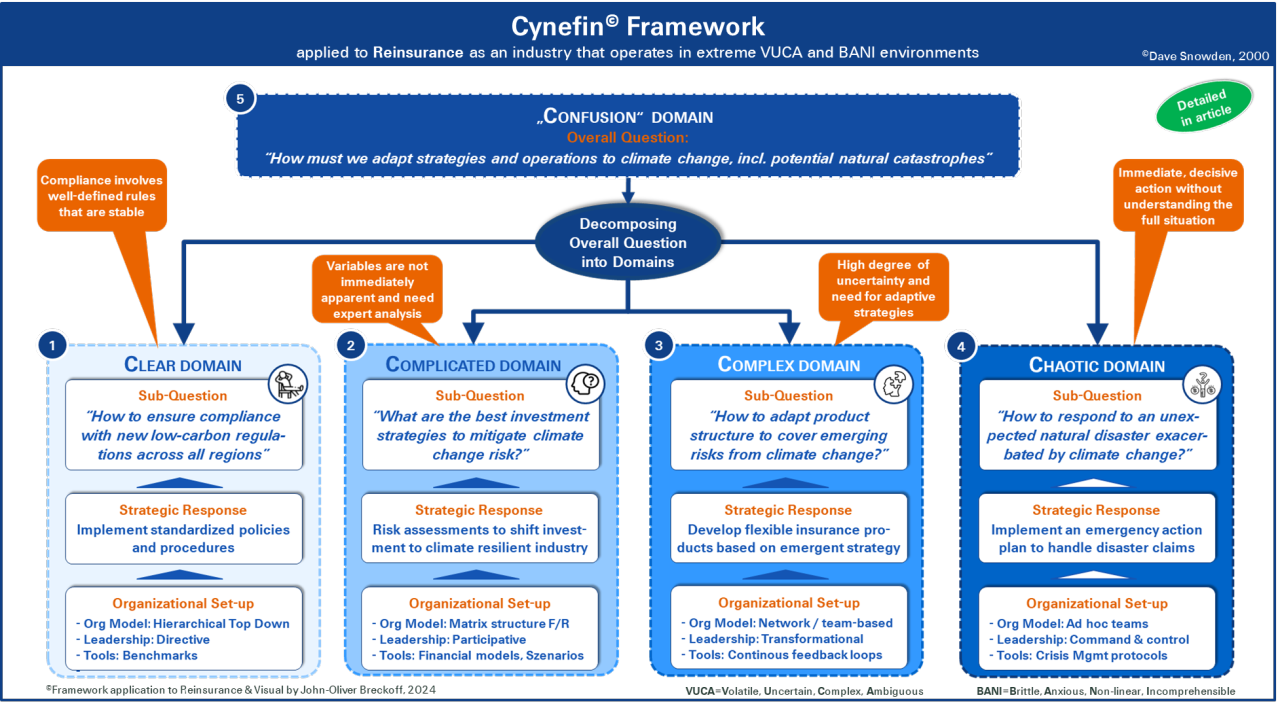
Last week, I introduced the Cynefin framework developed by Dave Snowden, emphasizing its advanced role in strategic management and outlining its general mechanics and numerous benefits. Building on that foundation, this article delves into a practical application of the framework within the Reinsurance industry. Given the high complexity and uncertainty posed by the ever-evolving nature of interconnected risks in this sector, such as the
- Vast array of natural catastrophes caused by climate change
- Cyber threats
- New technologies like AI and IoT
- Economic volatility
- Not yet known but constantly new emergent risks
it provides an exemplary setting to illustrate how Cynefin can guide strategic thinking and decision-making under these demanding conditions.
Reinsurers must constantly adapt their strategies, operations and products to a variety of pressures, from regulatory changes to technological advancements to the physical impacts of looming natural catastrophes.
This article explores how a reinsurance company can strategically manage these increasing challenges presented by climate change, using the Cynefin framework to navigate this complex and volatile landscape.
Understanding the 5 domains: A Strategic Breakdown for Reinsurance
The analysis in this article is organized according to the 5 domains of the framework—Clear, Complicated, Complex, Chaotic and Confused, starting with the "Confused" domain encapsulated by the following overall question:
"How should a reinsurance company adapt its strategies and operations to effectively manage the increasing risks and opportunities presented by climate change, including potential natural catastrophes?"
This overall question will then be decomposed into sub-questions relevant to the Reinsurance industry and distributed to the corresponding other 4 domains.
Each section will then address these specific sub-questions, outlining the
- Rationale why this particular domain applies
- Strategic response
- Organizational Set-up described by a variety of factors
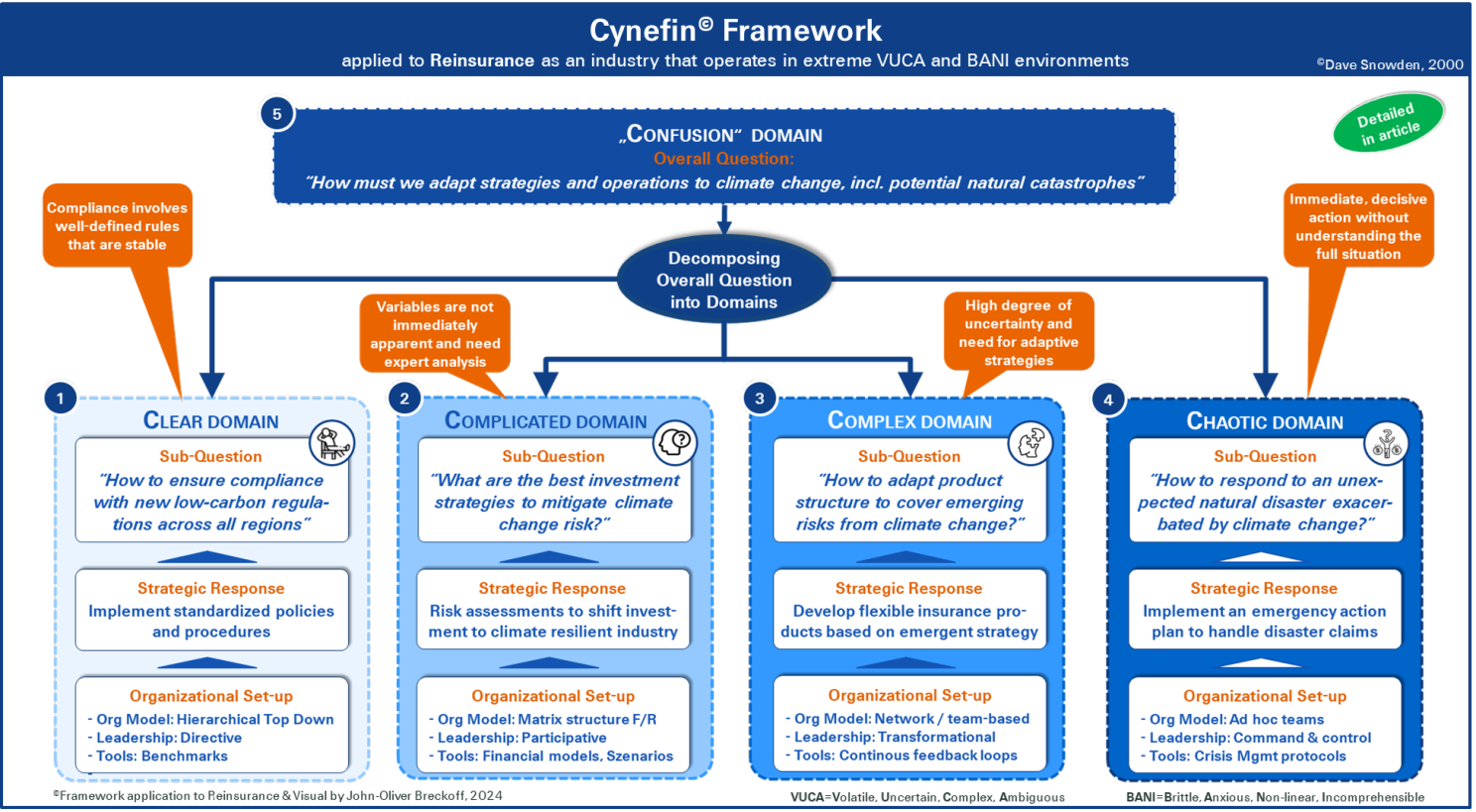
1. Clear - Domain Analysis
Sub-Question: "How can we ensure compliance with new low-carbon regulations across all operational regions?"
A. Rationale for Domain Fit
This question falls into the Clear domain because regulatory compliance typically involves well-defined rules and procedures that are stable across contexts and require straightforward application without the need for interpretation.
B. Strategic Response
Implementation of standardized policies and procedures that comply with international low-carbon regulations.
C. Organizational Set-up
- Responsible Functions: Central compliance unit that monitors regulations and ensures company-wide adherence.
- Ideal Organizational Model: Hierarchical, with clear top-down directives to ensure uniformity.
- Ideal Leadership Model: Directive leadership that enforces standards and ensures compliance.
- Ideal Mindset: Focus on adherence to standards and minimizing risk.
- Enabling Technologies: Compliance management software such as NAVEX Global and MetricStream
- Required Skills and Competencies: Regulatory knowledge, attention to detail.
- Tools: Compliance checklists, regulatory updates.
2. Complicated - Domain Analysis
Sub-Question: "What are the best investment strategies to mitigate risks associated with climate change?"
A. Rationale for Domain Fit
This fits the Complicated domain as it requires expert analysis and involves multiple variables that are not immediately apparent but can be understood through deep analysis and expertise.
B. Strategic Response
Conduct detailed risk assessments to shift investments towards more sustainable and climate-resilient industries.
C. Organizational Set-up
- Responsible Functions: Dedicated investment analysis team.
- Ideal Organizational Model: Matrix structure to facilitate collaboration between finance, sustainability, and risk management teams.
- Ideal Leadership Model: Participative leadership that values expert input and collaborative decision-making.
- Ideal Mindset: Analytical, data-driven, focused on long-term sustainability.
- Enabling Technologies: Advanced analytics platforms for assessing investment risks and returns.
- Required Skills and Competencies: Financial expertise, analytical skills, knowledge of sustainability.
- Tools: Scenario planning, Financial modeling, risk assessment frameworks.
3. Complex - Domain Analysis
Sub-Question: "How can we innovate insurance products to cover emerging risks from climate change, such as increased frequency of extreme weather events?"
A. Rationale for Domain Fit
This question is categorized under the Complex domain due to the high degree of uncertainty and the need for adaptive strategies that respond to changing and unpredictable patterns.
B. Strategic Response
Devise emergent product strategy to develop flexible new insurance products that can adapt to emerging data and risks associated with climate change.
C. Organizational Set-up
- Responsible Functions: Cross-functional innovation teams that include risk analysts, product developers, and actuaries.
- Ideal Organizational Model: Networked or team-based structure that supports rapid prototyping and iterative development.
- Ideal Leadership Model: Transformational leadership that inspires innovation and fosters a culture of continuous learning and adaptability.
- Ideal Mindset: Open to experimentation and failure, comfortable with ambiguity, forward-thinking and trusting
- Enabling Technologies: Big data analytics, AI for predictive modeling.
- Required Skills and Competencies: Creativity, adaptability, strong understanding of complex systems (systems thinking).
- Tools: Scenario planning, Agent-based modeling (ABM), Real options analysis, Dynamic systems modeling, Design thinking, continuous feedback loops
4. Chaotic - Domain Analysis
Sub-Question: "How can we respond to an unexpected massive natural disaster exacerbated by climate change?"
A. Rationale for Domain Fit
This scenario falls into the Chaotic domain as it requires immediate, decisive action without the benefit of understanding the full situation—actions are needed to prevent further destabilization.
B. Strategic Response
Implement an emergency action plan to handle large-scale disaster claims efficiently and effectively
C. Organizational Set-up
- Responsible Functions: Emergency response team with clear roles and rapid decision-making authority
- Ideal Organizational Model: Ad hoc teams formed quickly with clear, empowered roles and minimal bureaucracy.
- Ideal Leadership Model: Command and control leadership that provides clear, direct instructions as guardrails during crises but leaves the local ad-hoc teams authority to make the necessary operational decisions
- Ideal Mindset: Decisive, resilient, capable of rapid stabilization.
- Enabling Technologies: Real-time communication and data gathering tools such as ArcGIS or CrisisComander
- Required Skills and Competencies: Intuition, quick decision-making, crisis management, leadership under pressure.
- Tools: Crisis management protocols.
This differentiated and flexible approach helps the Reinsurance company to strategically manage each aspect of climate change adaptation by aligning decision-making processes, tools, and organizational dynamics with the nature of each specific challenge within the broader strategic context.
Which domain has the biggest potential for professionalization and improvement?