Is The German Car Industry Doomed?
A comment on a post by Prof. Dr. Karolin Frankenberger
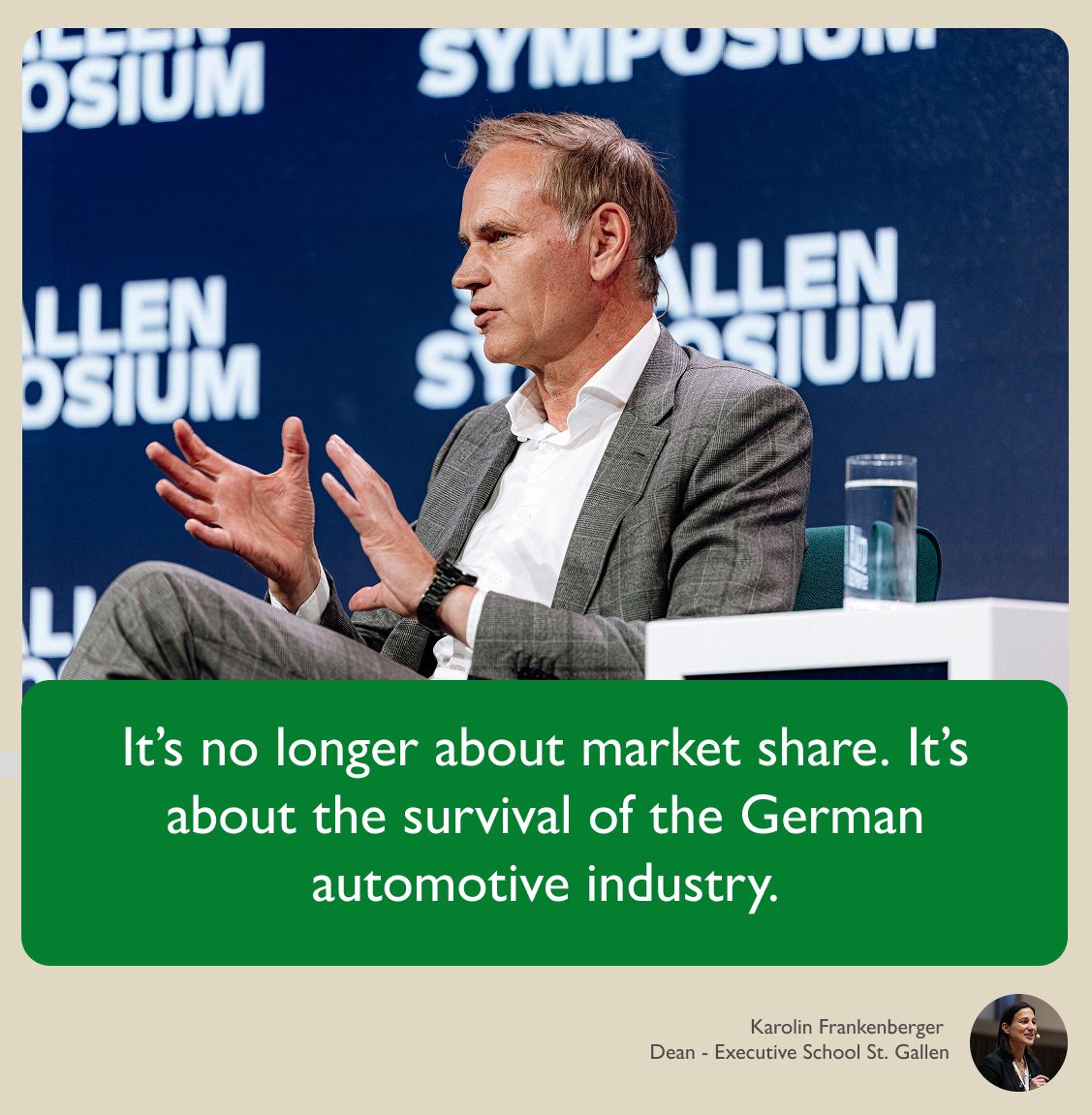
A Volkswagen internal management memo leaked recently.
The headline: the business model that carried VW for decades no longer works. Two weeks ago, VW CEO Oliver Blume spoke at our Symposium in St. Ga In the leaked memo, Audi CEO Gernot Döllner wrote: "Es geht längst nicht mehr um Marktanteile. Es geht um den Fortbestand der deutschen Automobilindustrie." An entire…
Read the original on LinkedInA superb illustration of the difference between operational optimization and strategic decision-making, ideally connected to a trend reflecting vision that is grounded in an authentic purpose boosting that vision.
This distinction becomes even more vital as competitive strategy increasingly expands into ecosystem strategy, driven by blurring industry boundaries, platform dynamics, technological convergence and shifting control points in how value is created and captured.
Tesla is not only an “electric car” company but has been called “software on tires”. It combines a vision of the future, a clear purpose narrative, new technology, a different business model, software logic, infrastructure thinking, direct customer access and a very different speed of decision-making (of course, this is not all about Tesla, and the company faces its own strategic and operational challenges).
Improving efficiency, reducing costs, streamlining structures, accelerating product development or fixing execution gaps are all important management tasks. But they do not yet constitute strategy.
Which future do we want to shape? Where will we compete and against whom? How will we win? Whom will we charge? What capabilities must we build? What will we stop doing? Which trade-offs are we willing to accept? And how do vision and purpose translate into a distinct logic of value creation?
True strategy is neither an efficiency program nor just an AI adoption initiative. It is an integrated set of choices about future positioning, value creation, capabilities, trade-offs and long-term direction.
The VW case illustrates how even highly successful and operationally well-managed companies, and sometimes entire industries, can become existentially threatened when strategic direction is not renewed decisively enough over time.
And yes, it did not only happen before to the textbook examples of Nokia and Kodak. Similar patterns can be seen in Intel, Boeing, parts of traditional banking, parts of retail and large parts of the media industry. Different industries, different causes, but the same underlying pattern: operational excellence, even innovation at product level was in place but maintained for too long while the strategic logic of the whole business was changing.
Strategy work is expensive. It absorbs leadership attention and it often involves external advisory costs. It does not usually create immediate profit, no, the profit typically results from optimized OPERATIONAL management.
But strategy buys the time to recognize where the game is changing and to make deliberate choices before they become forced choices. Time to rebuild capabilities before they are urgently needed and to redirect operational management towards areas where future profits will still be possible.