
How to achieve Purpose AND Profit!
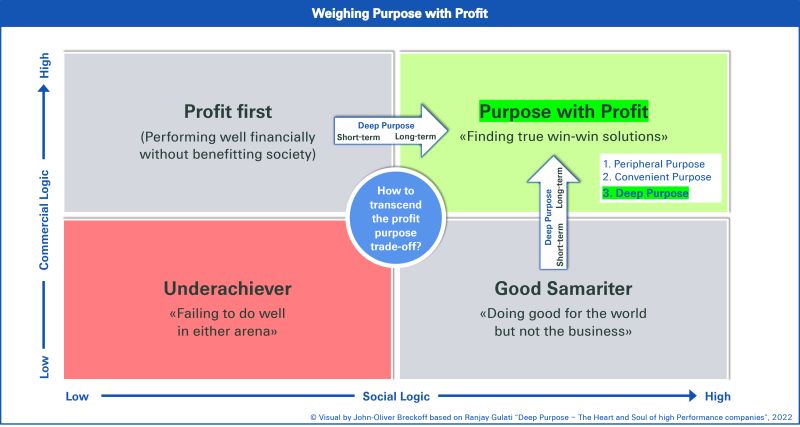
In his thought-provoking book "Deep Purpose," Ranjay Gulati describes the difficult balance that companies must maintain between their social missions and profitability.
Many firms struggle with aligning their purpose-driven goals with their financial objectives, often finding themselves sacrificing one for the other.
Gulati offers a simple 2x2 matrix crossing the social and the commercial logic to pinpoint this tricky trade-off.
The resulting lower left quadrant ("Underachiever") depicts companies that fail on both fronts.
Companies in the lower right quadrant ("Good Samaritan") focus on social impact but neglect profitability.
The upper left quadrant ("Profit First") shows firms prioritizing financial gains, often at the expense of societal benefits.
Finally, in the upper right ("Purpose with Profit") is where companies aspire to be, achieving a win-win situation.
However, Gulati identifies 3 less ideal types of purposes companies might pursue:
1. Purpose in Disguise
This involves companies using a facade of purpose to mask underlying practices that may be harmful or unethical, misleading stakeholders about their true intentions, like e.g. Theranos or Purdue Pharma.
2. Peripheral Purpose
These companies engage in social or environmental initiatives that are not central to their core business activities, often resembling add-on CSR efforts.
3. Convenient Purpose
Firms in this category adopt socially responsible practices when they align with financial goals or provide a marketing benefit, but abandon them when they do not.
Only "Deep Purpose" companies view their purpose as intrinsic to their business model. It is not merely about public relations or superficial benefits; it's about fundamentally shaping the company's impact on the world even when it’s hard and an easy “win-win case” isn’t available at first sight.
Let’s make no mistake, it’s difficult to strike this balance all the time even for "Deep Purpose" companies.
They may find themselves temporarily in the "Profit First" or "Good Samaritan" quadrants as part of their strategic journey. For instance, they might prioritize profit in the short term to fund long-term purpose-driven projects or focus on social impact activities that may not initially be profitable. However, the goal is always to move toward the "Purpose with Profit" quadrant over time.
Although not always successful in the short term, Deep Purpose companies manage to conquer this difficult trade-off in the long run by
- Embedding the company's purpose into all aspects of the business
- Prioritizing long-term impact over immediate returns
- Leveraging purpose to drive ongoing product and service innovation
- Regularly involving stakeholders to align expectations with the company’s purpose
- Collaborating with diverse organizations to amplify impact
For a deep dive into "Purpose driven Management" check out my article “The Rise of Purpose in Corporations”.