ArticleAI & Future · Strategy
5 min read
From Slide Decks to Real Impact: How AI Is Reshaping Consulting Value
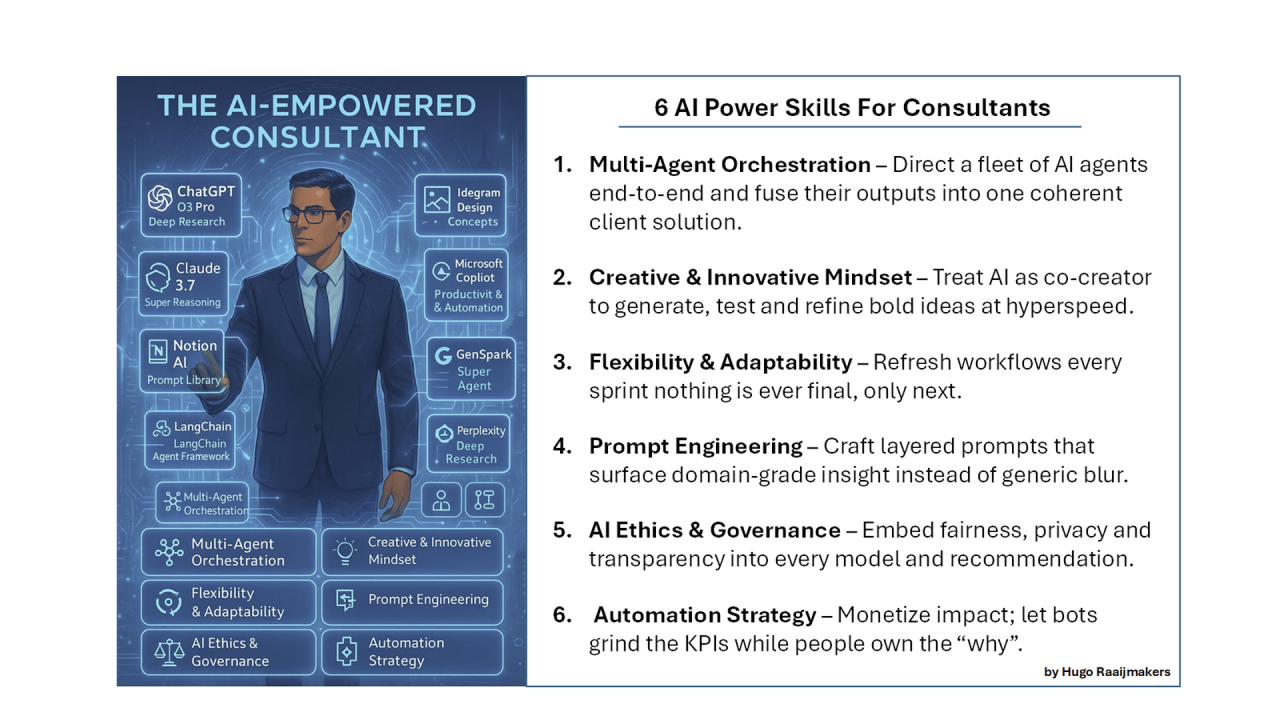
There are 6 highly relevant AI-related power skills that will shape future consulting work that Hugo Raaijmakers outlines in his forward-looking post “Consulting’s “AI Earthquake” Is Here - Move Fast or Fade Out”:
- Multi-Agent Orchestration – Direct a fleet of AI agents end-to-end and fuse their outputs into one coherent client solution.
- Creative & Innovative Mindset – Treat AI as co-creator to generate, test and refine bold ideas at hyperspeed.
- Flexibility & Adaptability – Refresh workflows every sprint—nothing is ever final, only next.
- Prompt Engineering – Craft layered prompts that surface domain-grade insight instead of generic blur.
- AI Ethics & Governance – Embed fairness, privacy and transparency into every model and recommendation.
- Automation Strategy – Monetize impact; let bots grind the KPIs while people own the “why”.
Shifting from "+AI" to "AI+"
This would be just a typical case of what IBM senior executives Rob Thomas , Paul Zikopoulos , Kate Soule describe in their brand new April 2025 book “AI Value Creators: Beyond the Generative AI User Mindset” as
- “+ AI” = Adding AI to existing processes to improve efficiency.
However, the real transformation goes far beyond that. What we’ll be seeing is a shift to
- “AI +” = Rethinking the consulting model entirely, with AI as the starting point and structural driver.
The 7 dimensions where traditional consulting must evolve
AI will both enable and force a redefinition of how consulting value is perceived by the client, and with it, how value needs to be delivered and priced by the consultancies.
As a consequence, the real value of consulting work is finally shifting to where it always belonged, but was never fully realized, because consultants were absorbed with and defined their value by tasks, that can now be delivered or at least strongly facilitated by AI.
Complementary to the above-described AI related tasks shifts for consultants, here are the 7 focus, process, and human oriented dimensions where consulting as a whole must evolve:
- Value & outcome shift: From producing stylized slide decks for the C-suite ➡️ to catalyzing real mindset shifts and behavioral change across the entire organization (slides will still play a role but lose their status as the primary deliverable and yardstick for consulting impact and value generation).
- Consulting process: From an expert-attitude and linear “Interview – Inhouse Analysis – Top-down recommendation - Final presentation” model ➡️ to a truly workshop and other formats-based, iterative process grounded in eye-level attitude, co-creation, design thinking, and deep cross-functional engagement (including the C-suite).
- Consulting approach: From pure advising, addressing mostly strategy, structure, system, technology related problems ➡️ to a hybrid of advising, coaching, and strategic mentorship that builds capability and ownership and also addresses the individual and their personal growth and leadership potential.
- Client-specificity: From generic frameworks and benchmark-derived recommendations ➡️ to context-sensitive, deeply tailored, client specific, and innovative solutions.
- Strategic focus: From designing strategy on paper ➡️ to actively supporting and enabling strategy implementation and execution in the field.
- Human development & Organizational learning: From purely IQ-based analysis ➡️ to competency building that integrates IQ, EQ, AQ (Adaptability Quotient), SQ (Spiritual Quotient) and people-centered transformation.
- Intelligence model: From pure left brain rational intelligence ➡️ to the seamless integration of rational human intelligence with AI capability, guided by human intuition.
The need for domain specific analytical thinking won’t disappear, but much of it can now be outsourced to AI. That shifts our human focus to what can’t be automated and is exactly what organizations are often lacking the most anyway:
- Visionary thinking
- Purposeful sense making
- Genuine creativity
- Emotional resonance
- Ethical leadership
- Deep transformation
This kind of support can only be delivered by seasoned senior professionals with a long and multi-faceted track record and a well-integrated balance of left- and right-brain faculties (as ingeniously described in Iain McGilchrist’s foundational 2009 book "The Master and His Emissary"), combined with the ability to work empathetically with people across functions and hierarchies.
AI won’t kill consulting, but it will transform the general value delivery model of the Big 5 and dismantle both its overblown partner structure and its "pyramid scheme" (pun intended), in which armies of juniors are billed at premium rates to crunch Excel files and assemble slide decks.
This is not meant as blanket industry bashing. These firms have responded to certain client needs (or at least perceived wants) and therefore delivered value over decades at least in particular contexts such as
- large-scale cost reduction programs
- regulatory compliance efforts
- standardized technology implementations
where genuine creativity, emotional intelligence, or contextual sensitivity were not critical or even counterproductive to success.
But in light of today’s AI capabilities, even those justifications are eroding, making the traditional model more of a legacy habit than a future-fit solution.
The consulting industry is heterogeneous and offers alternatives
At the same time, there have always been alternative approaches by players (among them the author of this article), who, independently of AI, have either abandoned, transcended, or further developed this traditional model long ago (or never fully subscribed to it in the first place).
Examples include practitioners of systemic consulting, later complementary consulting, and many independent professionals focused on workshop-driven, people-oriented and participatory, or facilitation-based formats.
The steady rise of consulting pools over the past 20 years also reflects a growing segment of clients who no longer buy into rigid pyramid structures. Instead, they value the agility and cooperational skills of independent senior professionals working in flexible networks. These clients are often more experienced in working with consultants and less driven by fear-based decision-making or defaulting to brand-name safety.
Personally, I remain convinced of the inherent value external consulting can deliver across virtually every dimension of a client’s operations.
But let’s fully leverage the “AI+” potential to upgrade the traditional consulting model by shedding its outdated structures and evolving into a leaner and at the same time more human-centered, purpose-driven, and transformational force than ever before.