ArticlePurpose & Vision · Transition & Change
14 min read
The Unexpected Gift of “Being Lost” and how a personal Vision and Purpose show the way out!
“I am lost” were the words a client told me in our first session. “Congratulations!” was my spontaneous response to her.
Not because feeling lost is easy, pleasant, or a destination anyone seeks, but because recognizing it is already a major step forward. It means you have outgrown some part of yourself or a life structure that once stabilized you, AND a process of letting go has already begun.
While this often feels utterly disorienting, it is also a clear sign that something transformative is unfolding.
But what does it actually mean, “being lost”? What are the underlying judging mechanisms and how can I move forward from it?
“Being lost” needs to be verbalized to be processed and to gain Perspective
Feeling lost is a deeply personal experience, shaped by both mental and emotional perceptions. That’s why it’s crucial for both the coach and the coachee to pinpoint what exactly this perception consists of and to clearly articulate it.
In her case “being lost” meant:
- She had quit a demanding job she had been good at, but after eight years, it no longer felt aligned - without fully understanding why or which part no longer fit
- She experienced a drop of passion
- Physically she felt drained and deeply exhausted
- She had no direction for what was next
- There was an opportunity to take on a newly created leadership role in her family’s business, but instead of excitement, it triggered hesitation for reasons she could only partially verbalize
- She had no idea where her next source of income would come from, and looming financial constraints amplified a sense of urgency and disorder
- A mix of difficult overlapping and shifting emotions, such as anxiety, doubt and fear
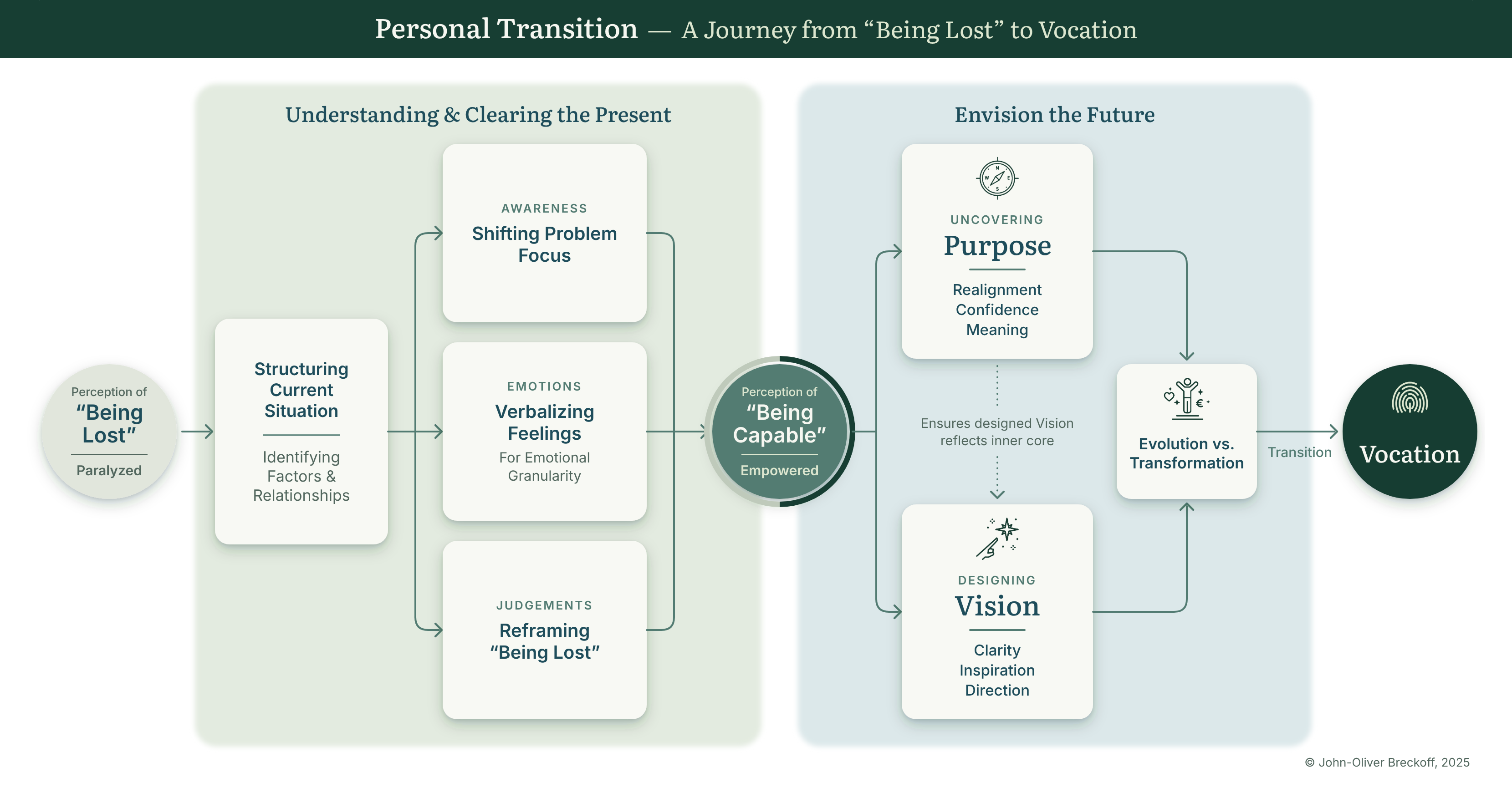
Addressing feelings & emotions is an essential first step.
Research by Neuroscientist & Psychologist Matthew Lieberman from UCLA shows that putting difficult emotions into words calms the brain’s alarm response and actively helps in processing them.
Naming emotions with precision increases so-called emotional granularity, which, as research by Lisa Feldman Barrett from Northeastern University suggests, helps people regulate their feelings more effectively.
Beyond that, what initially seemed like an overwhelming, chaotic situation became less paralyzing once we structured it into its different components. Identifying and defining the exact factors at play, including their underlying interdependencies, helped create clarity.
And clarity diminishes overwhelm and therefore brings relief. “Clarity is power!”, as Tony Robbins never tires of proclaiming.
Moreover, “being lost” is often perceived as a total collapse - a dissolution of everything. However, once an overwhelming situation is structured and put into perspective, it often reveals that many stabilizing life structures are still in place.
In her case, upon deeper reflection, she also realized that among other things:
- She had a stable and supportive relationship
- The departure from her job now gave her much needed time and mental space for self-care, family, and fitness
- Though financially unwelcome, the budget gap could easily be bridged by her partner
- Though overlaid by exhaustion, she still had strong mental resources
In overwhelming situations combined with difficult emotions – especially fear – the amygdala’s response is triggered, leading to what Daniel Goleman called an “amygdala hijack” (which from a neuroscience perspective is an oversimplification, as emotional processing involves multiple brain structures, including the prefrontal cortex, hypothalamus, and hippocampus).
This reaction typically causes a narrowing of focus, where attention is fixated on what is dissolving or uncertain while filtering out the stable aspects of one’s life. As a result, this selective perception creates the illusion of being completely lost, even when many foundational elements remain intact.
Reframing “Lost” as part of a transformative and valuable Process
Regardless of how “lost” someone actually is or not, the next step is to explore and question the underlying judgments.
In a society where we are conditioned to value control, predictability, and a clear sense of direction at all times, our default judgment is that “being lost is bad and must be avoided at all costs”.
However, I have seen significant shifts in both emotional well-being and action orientation – in my clients and myself – by challenging and reframing this judgment.
First of all, like everything else, being lost is not a permanent state. It is a temporary phase, a point in transition rather than an endpoint. Reality itself is in constant flux, nothing remains static. Just as seasons shift, economies evolve, and personal circumstances change, so too do our internal states and perceptions.
Secondly, it’s a necessary phase of change. What feels disorienting today may, with time and perspective, reveal itself as the necessary prelude to transformation.
Nature, history, mythology or spiritual systems provide countless examples and analogies:
- The caterpillar completely dissolving in its cocoon before emerging as a butterfly
- The phoenix burning to ashes before rising anew
- The Hindu cycle of destruction and renewal, represented by Brahma (the Creator), Vishnu (the Preserver), and Shiva (the Destroyer)
- In business, Schumpeter’s “creative destruction” principle, where old structures must break down to allow new innovations to emerge
Studies and models on transformation from different fields and scientists like
➡️ Kurt Lewin’s Change Theory (Unfreeze-Change-Refreeze Model)
➡️ The Virginia Satir Model (J-Curve of Change)
➡️ Otto Scharmer’s “U-Theory”
➡️ Carol Dweck’s “Growth Mindset”
all show that right before a real breakthrough, people often experience their highest level of frustration.
Why? Because old patterns don’t let go easily. The mind still might have residual change resistance because the old has died while the new hasn’t yet emerged. But that struggle isn’t the dead end of “being lost”; it’s the last barrier before something new can unfold.
Rather than seeing “I am lost” as a state of defeat, it can be seen as an invitation:
✅ To let go of outdated identities
✅ To discover new facets and untapped potential of yourself
✅ To realign with what truly matters to you
From Reframing the Present to Designing the Future
Once the present is no longer a source of energy-draining disorder and limiting beliefs, attention can shift toward the future, not from a place of desperation and narrowed focus, but now from a space of clarity, capability and empowerment.
Now, an aspirational Vision that depicts a compelling and desirable future state is one of the most powerful tools to transform the perception of being lost into a sense of direction and motivation.
A vision paints a holistic and integrated image of how you want to live and what you want to achieve in all life aspects relevant to you: Career, finance, family, health, friendships, love life, intellectual life, spiritual life, community life, etc.
It envisions where and in what environment you want to live, the people you surround yourself with daily, how you integrate and balance work with life, how intensely, when and where you travel, and which hobbies you pursue.
It declares which dreams you want to realize and what experiences you want to have.
The moment a personal vision takes hold, the sensation of being lost dissolves.
Evolution vs. Transformation
At this point, it’s important to realize that, while every change situation is highly individual and unique, there are two fundamental types of transitions:
1. Advancing within the same path (Evolution)
When your current career or direction still feels aligned, but the next step requires growth, challenge, or a new level of mastery. This could mean:
- Changing the company
- Shifting industries
- Switching your role
- Taking on a leadership position
- Expanding responsibilities
- Enhancing competence by refining your existing or picking up new skills
2. Changing the path itself (Transformation)
When what once felt right no longer does, and instead of simply evolving within the same framework, you feel the need to step into something significantly new. This could involve:
- Completely redefining your job, often to increase or change societal contribution, amplify your impact or pursue different interests
- Transitioning from employment to work as an independent professional
- Pursuing a long-suppressed passion or lifelong dream project
- Realigning your work-life balance in a way that better suits your evolving values
- Founding a business and becoming an entrepreneur
A previous perception of being lost – especially when felt as a loss of passion – is often a strong indicator that the change you are facing belongs to the second category – a more fundamental shift rather than just an incremental step forward. When the feeling of disconnection persists, it’s usually not about what’s next within the same track, but about whether the track itself is still the right one.
In such cases of profound change, going deeper before moving forward is important. It’s an exploration into yourself before designing your outer life.
Personal Purpose guides the Vision
This is where personal purpose comes into play. Your purpose reflects your true and unique essence. It is not just about what you do, but who you are and why you do it.
Personal purpose is typically found in the intersection of four elements:
- Passion – What excites and energizes you?
- Unique Gifts – What are your natural strengths and talents expressed in your special way?
- Values - For what do you stand?
- Contribution – How do you want to impact something beyond yourself?
Your purpose provides the foundation for alignment to your inner core, ensuring that whatever vision you create is a meaningful and sustainable expression of who you truly are. It prevents you from unconsciously following a script shaped by external expectations or past conditioning, or being driven just by ego - pursuing prestige, validation, or arbitrary ambitions that ultimately feel hollow.
Without this alignment, and therefore lacking the inner motivational fire to break through obstacles and setbacks, your vision is either difficult to reach or, even worse, meaningless once achieved.
It’s the classic example of “climbing the ladder of success, only to realize it was leaning against the wrong wall”.
Vision and purpose work synergistically, with purpose acting as your inner compass, providing:
✔ Realignment – Creating a deep connection between who you are and what you do.
✔ Confidence – Giving you a strong inner foundation to navigate change with certainty.
✔ Meaning – Offering a sense of contribution and personal significance beyond just achievements.
Meanwhile, vision acts as your guiding star, offering:
✔ Clarity – Sharpening your awareness of possibilities and helping you see the bigger picture.
✔ Inspiration – Fueling motivation and perseverance.
✔ Direction – A tangible future you can move toward.
Uncovering one’s unique purpose and designing an inspiring vision are two interrelated yet distinct processes. Purpose requires introspection to uncover what truly drives you, while vision is an act of creation, shaping a compelling future based on that foundation.
Both processes ideally integrate analytical thinking to engage the rational mind while simultaneously doing the opposite: quieting mental activity and shifting focus to somatic awareness, allowing intuitive insights to emerge.
Developing personal Vision and Purpose in Practice
Within the process of uncovering and designing her purpose and vision, several relevant and important insights could be gained, e.g.:
- Her job felt too constrained and predefined by existing processes and structures, leaving little room for flexibility or innovation.
- She still enjoyed psychological concepts and the intellectual engagement that came with them, but after eight years of intense work with patients, she felt drained by the constant focus on pathology that her job required.
- Working with groups was both stimulating and challenging for her, often bringing her into a state of flow.
- She had a deep appreciation for conceptual work, project management, and building structures, enjoying the process of shaping ideas into tangible outcomes.
- When identifying her role models, a clear pattern emerged: they were all independent professionals or business owners – people who had built something of their own, combining expertise with personal creative expression and enjoying a high level of autonomy in both their work and lifestyle.
- She felt a strong sense of enthusiasm, invigoration, and joy when watching people perform on stage. Not necessarily in the arts, but in any form of creative expression, in particular when innovative and improvised instead of scripted.
- Talking to several family members, it became clear that one of her natural gifts, already evident in childhood, was her ability to approach and connect with people from all walks of life, and “open them”, meaning effortlessly engaging them in conversation and even lifting their mood, regardless of age, background, or personality type.
- She had a passion for poetry and painting and deeply regretted not finding time to pursue these creative outlets.
As the main theme it became clear that creativity and autonomy had been overlooked elements in her previous career. What was missing was a strong creative component both as part of her daily work and as an ability to shape and design her own approach rather than working within too rigid frameworks predefined by others. Moreover, human connection clearly remains a central part of her work but in a different expression than before.
Her job as a psychologist working for a public organization, helping people with limited resources, had a pronounced element of contribution, from which she derived a strong sense of meaning, but it lacked the vibrant energy people typically experience when engaging with something they are truly passionate about.
In my observation, people over time tend to struggle, grow disengaged, or even burn out in their jobs – or at the very least, they don’t perform at their highest potential, neither in terms of achievement nor fulfillment – even when there is a strong talent fit and clear contribution (the result of their work), but the activity itself doesn’t spark enough passion or joy.
This is particularly common in professions with a helping or cause-driven component, and especially when these causes or job functions primarily consist of “removing problems” rather than “creating possibilities.”
While problem-solving is essential, work that is primarily focused on fixing, healing, or mitigating negatives can feel depleting over time, especially for individuals whose natural energy and fulfillment come more from creation, self-expression, or shaping something new.
From Vision to Vocation: A Business takes Shape
Her vision naturally evolved toward this path: starting her own venture, using her psychology expertise in a more autonomous and innovative way, while integrating creative conceptual work, potentially within the arts, culture, learning, or lifestyle domains. Once she had uncovered her purpose and designed her vision, things started falling into place quickly.
Just four weeks after completing her vision board, filled with evocative images to tap into deeper emotional layers and subconscious aspirations rather than just rational planning, she had a clear idea of what she wanted to create. At the same time, as one of those lucky synchronicities often observed when taking decisive steps towards one’s purpose, she found the perfect business partner who shared her enthusiasm and complementary skills.
A Business idea based on Passion and Values
Together, we developed the initial concept into a structured business model. The core offering was a 2.5-hour guided creativity group for children, held in a dedicated learning space where kids could create and build using physical materials – not through concepts or lessons but experientially by fully engaging their hands, imagination, and social skills. The sessions were intentionally free from screens and technology, focusing instead on tactile experiences, group collaboration, and creative expression.
These classes were scheduled for mornings and afternoons, positioned as an alternative or complement to kindergarten and summer school. This allowed parents the flexibility to attend appointments, run errands, or take time for self-care (such as going to the gym or a yoga class) while knowing their children were in a healthy, enriching environment.
In the evenings, the space transformed into a hub for adult creativity workshops at the intersection of art, self-expression, and mindful exploration. Like the children’s program, these workshops also avoided screens and digital tools, emphasizing hands-on engagement, beginner’s mind and spontaneous creativity. Additionally, with the possibility of future collaboration in mind, the space was rented out to third-party instructors and facilitators, offering courses ranging from design thinking and improvisational theater to traditional crafts and hands-on innovation techniques.
As a potential second step, the plan was to market workshops as a high-margin in-house offering directly to companies once suitable formats had been tested and refined.
The Pay-off
Eight weeks later, we finalized a fleshed-out business plan and Go-to-Market strategy. Since the required investment was kept to the necessary minimum, they were able to secure funding quickly within the family. As they shared their vision with friends and professional networks, another synchronicity occurred: an ideal space with the perfect layout and atmosphere surfaced almost instantly through a personal connection.
After two months of designing and equipping the space, transforming it into a beautiful and warm creativity lab, they launched their business. Within just three more months, 60% of their available capacity was booked, and they were already operating profitably.
However, the financial success wasn’t the most decisive factor for her. What truly mattered was the profound shift in energy, happiness, and fulfillment, the kind of deep satisfaction that comes from working in a field that feels like a true vocation deeply aligned with her purpose.
The Process to guide the Journey
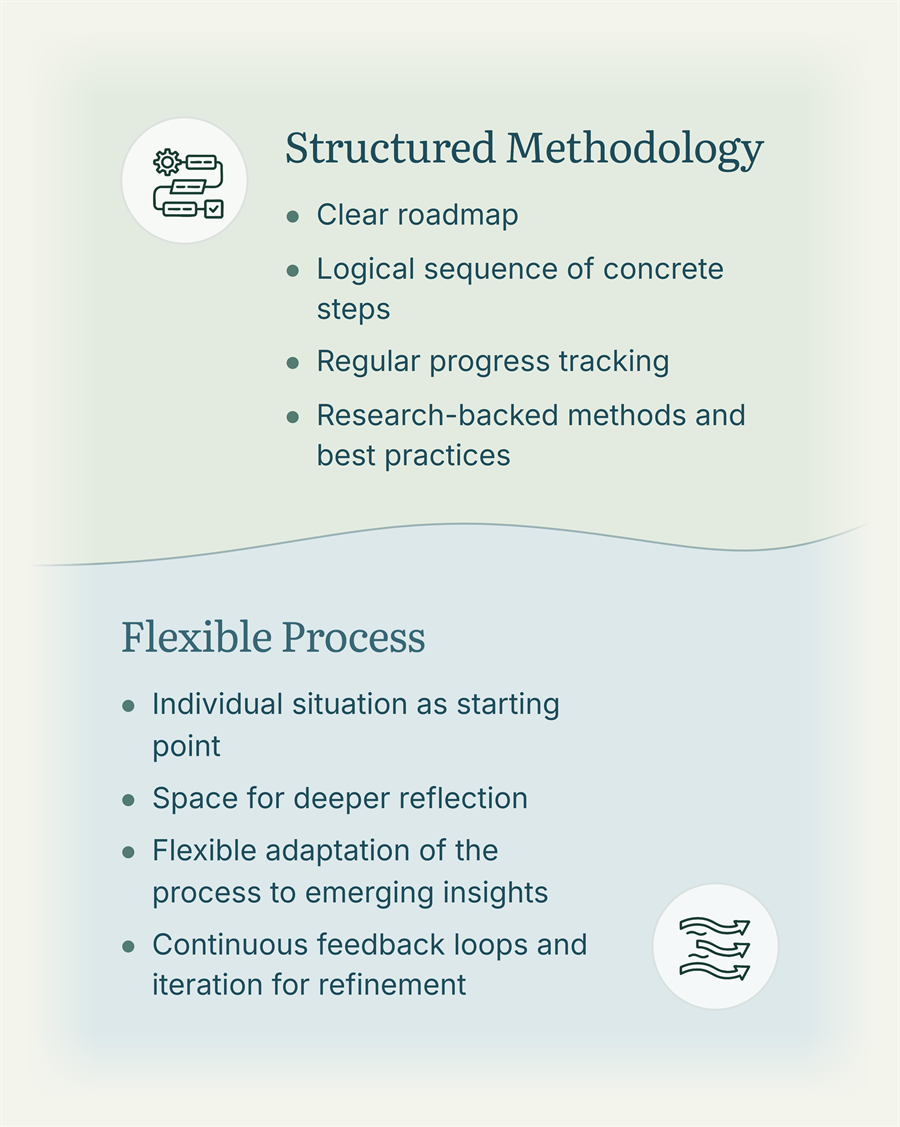
Although a structured methodology in form of a general roadmap rooted in research-based concepts or best practices is clearly beneficial in guiding such a journey, I don’t want to create the false impression that these processes can be fully planned or broken down into a fixed, logical, and replicable sequence of steps – something that can be neatly checked off in a linear fashion like a to-do or shopping list.
These processes are inherently creative and exploratory and involve a high level of emotional engagement. They require a flexible and iterative approach leaving space for deep reflections and insights to emerge that then indicate the next step to take.
I also don’t want to suggest that these processes are consistently easy or that they unfold in a continuous state of flow, where one synchronicity effortlessly follows another, creating an uninterrupted sense of bliss.
Instead, this work also involves phases of slow progress, uncertainty, and self-doubt, making resilience and adaptability essential parts of the journey.
Especially the transition from an inspiring vision to a money-generating vocation requires learning new skills, taking risks, and making leaps of faith. Depending on the scale of change, it may also require evolving your self-image to the next version of yourself, ensuring it matches and catalyzes the necessary outer growth and changes to fully unfold.
Yet despite the challenges that come with embracing your lostness, the journey toward discovering your personal vision and purpose is profoundly worthwhile. Each moment of doubt, discomfort, or fear holds the potential for deeper insight, integration and exponential growth.
The path may not always be easy, but the richness of finding your vocation, and of living or steadily progressing toward your vision, is the most powerful catalyst for fulfillment, impact, and success.